Posts Tagged ‘Michael Adams’
MMmmm…. 1,000 down and counting
 August 25th, 2018 |
  Author:
 In the final round of the recent British Championship in Hull, 3-times champion David Howell (2009; 2013 & ’14) was drawn against Luke McShane, and one of them had to win if either was going to try to catch Michael Adams and force a play-off.
White: D. Howell (2687). Black: L. McShane (2669).
Ruy Lopez – Steinitz Defence Deferred. [C72]
1.e4 e5 2.Nf3 Nc6 3.Bb5 This was not the moment to be experimenting with unusual openings in the hope of catching one’s opponent unawares, as it’s always liable to rebound on one’s head, so familiar, well-trodden ground should be safer, in this case the centuries-old Ruy Lopez. 3…a6 4.Ba4 d6 Key move in the Steinitz Defence Deferred, but McShane knows most variations in this opening well and is well-versed in this one. 5.0–0 Bd7 6.d4 exd4 7.Nxd4 Nxd4 8.Bxd7+ Qxd7 9.Qxd4 Nf6 10.Nc3 Be7 11.Bf4 0–0 12.Rad1 Qc6 13.Nd5 Nxd5 14.exd5 Qxc2 15.Rc1 Qf5 16.Rxc7 Attack and… 16…Bf6 counter-attack. 17.Qd2 Rfc8 18.Rfc1 Rxc7 19.Rxc7 Re8 Theatening …20.Qb1+ 21.Qc1 QxQ+ 22.BxQ Re1#. 20.h3 Playing a “safe” opening is all very well, but someone has to get aggressive at some point, and Black takes up the challenge. 20…h5 21.b3 g5 22.Be3 Re5 winning the d-pawn 23.Rxb7 Rxd5 24.Qc1 Be5 Black is now throwing almost everything he’s got at the White king’s position. 25.Rb4 Qd3 Mate alert! 26.f4 Qe2 threatening Rd1 winning the queen, after …Rd1+. 27.Kh2 gxf4 28.Bxf4 Rd2 29.Qc6 Kg7 30.a3 h4 31.Rc4 Qe3! Utilising the pin on White’s bishop. 32.Qe4 Qg3+! 0-1 resigned in view of 33.Bxg3 Bxg3+ 34.Kg1 Rd1+ mate.
In the subsequent play-off, McShane and Adams played 2 games at RapidPlay speed, resulting in 1-all, necessitating another two games at Blitz speed, both of which Adams won. So the £10,000 1st prize went to him, while McShane had to be content with £5,000. But it wasn’t just about the money. However, McShane could be proud of his play under that maximum pressure.
The 68th Paignton Congress starts a week on Sunday, 2nd September, at the Livermead House Hotel, and entry forms can be downloaded, and entries even paid for, at the event website dccapaigntonchess.com.
The solution to the starter problem for the next British Solving Championship has been announced. The best responses were, not unnaturally, from the big national dailies, while those from the Western Morning News were the only ones from any provincial newspaper.
The answer to last week’s problem was 1.f4! and depending on what Black tries, White will have 3 mates available viz. 2.Qb4; Nxb7 or b8=Q.
As this is my 1,000th column I have chosen a 2-mover in the shape of the letter M, the Roman numeral for a thousand, which was composed by Mrs. W. J. Baird née Edith Elina Winter-Wood (1859 – 1924) whose ancestral home was at Hareston in Brixton, near Plymouth.
 Posted in Western Morning News |
  Tags: British Championships 2018, David Howell, Luke, Michael Adams, Mrs. W. J. Baird |
  No Comments »
Adams Wins Again…. but it wasn’t easy!
The final 3 rounds of the British Championship finished with the result most people would have expected, but not without a few twists and turns along the way. In Rd. 7 Adams beat the defending champion, Gawain Jones and thereafter, maybe thinking “job done”, played steadily to get draws against Nick Pert and Danny Gormally. Meanwhile, Luke McShane drew against Hebden in Rd. 7 but finished strongly to beat Fodor and, perhaps surprisingly, former champion David Howell, leaving Adams and McShane tied on 7/9 pts, necessitating a Rapidplay play-off.
Adams won the first game (see this week’s position) and only needed another steady draw to clinch the title. But no; McShane hit back to inflict Adams’ only loss in all the games he’s played in this event since 1989. So, at 1-1 this meant 2 further play-off games had to be played at an even quicker pace - Blitz games, so fast that the computerised board and internet couldn’t keep up with transmitting the moves on screen, but not too fast for Michael who won them both.
This was Michael’s 6th title, having first been champion in 1989 in Plymouth, - the greatest number since Jonathan Penrose won his 10th in 1966. Here is his solitary loss, played at the speed of 20 minutes for all moves, plus an extra 10 seconds per move, which for this game is an average of 18 seconds per move.
White: L. McShane (2669). Black: M. Adams. (2706).
Guioco Pianissimo [C50]
1.e4 e5 2.Nf3 Nc6 3.Bc4 Bc5 Also called the Italian Game. 4.d3 This constitutes the quietest form of this opening. Nf6 5.0–0 0–0 6.h3 h6 7.c3 d6 8.Re1 a6 9.Bb3 Re8 10.Nbd2 Be6 11.Nf1 Bxb3 12.axb3 d5 13.Qe2 Qd7 14.b4 Bf8 15.Ng3 Rad8 16.Kf1 g6 17.Qc2 Re6 18.Qa4 dxe4 19.dxe4 Qd3+ 20.Kg1 Red6 21.Be3 Qc4 22.Rac1 Kh7 23.b3 Qe6 24.c4 R6d7 25.c5 Rd3 26.Rc4 Na7 27.Bc1 Nd7 28.Qa2 Nb8 29.Bd2 Nbc6 30.Nf1 Nb5 31.Ne3 Nbd4 32.Nxd4 Nxd4 33.Bc3 Nb5 34.Bb2 c6 35.Ba1 h5 36.Rc2 Bh6 37.Nc4 Nd4 38.Bxd4 R8xd4 39.Qb2 h4 40.Rce2 Bf4 41.Qc2 Kg7 42.Rf1 Kg8 43.Ree1 Qd7 44.Nd6 Rd2 45.Qc3 R2d3 46.Qc2 Rd2 47.Qb1 Rxb4 48.Nc4 Rd4 49.Rd1 Rb5 50.b4 a5 51.Rxd4 Qxd4 52.Nd6 Trapping Black’s rook. 52…Qxb4 53.Nxb5 Qxc5 54.Nc7 White is now a rook up, but if his 3 connected passed pawns can get moving there may yet be a chance, especially at this speed. 54…b5 55.Rd1 a4 56.Qd3 Bg5 57.Qd7 Qc4 58.Qe8+ Kh7 59.Qxe5 Qc2 60.Rf1 Qd2 61.Ne8 Bh6 62.Nf6+ Kg7 63.Ng4+ Kh7 64.Qf6 Bg7 65.Qxh4+ Kg8 66.Nf6+ Bxf6 67.Qxf6 a3 68.e5 Qc3 Black defends his c-pawn at the expense of allowing the rook to grab the d-file. 69.Rd1 Kh7 70.Rd8 and Black can’t avoid mate on h8. 1–0
In last week’s position, Adams (B) was let off the hook by playing 1…g5+ 2.PxP would lose his queen, so he must play 2…Kh5, but then Black has 2…Qxh3 mate.
Here is the final position from the 1st play-off game against McShane. Adams (W) to move and seal the win.

Posted in Blog, Western Morning News |
Tags: British Chess Championship 2018, Luke McShane, Michael Adams |
No Comments »
Progress in the British (04.08.2018.) 997
The draw for Rd. 1 of the British Championship will keep the Grandmasters apart, as they should be meeting in the later rounds, which gives them an easier chance to get warmed up. However, one player they might not wish to meet in those circumstances is Jack Rudd of Bideford, whose sharp and mercurial style is guaranteed to unsettle and test any of them, as in this game.
White: Ameet Ghasi (2494). Black: Jack Rudd (2244).
1.Nf3 Nf6 2.g3 b5 An unusual early move, but the open b-file later becomes the scene of decisive action. 3.Bg2 Bb7 4.d3 e6 5.0–0 Be7 6.c4 bxc4 7.dxc4 0–0 8.Qc2 White makes a number of move sequences that are easily repulsed and seem to do little to help his overall development. 8…Be4 9.Qd2 c6 10.Nc3 d5 11.Nxe4 Nxe4 12.Qc2 Bf6 13.Nd2 Nxd2 14.Bxd2 Qb6 15.Rab1 Nd7 16.b3 g6 17.e4 Rac8 18.Be3 This bishop continues to flit all over the board to no great effect. 18…d4 19.Bd2 a5 20.Qd1 Be7 21.h4 Bb4 22.Bg5 Rfe8 23.Kh1 f6 24.Bh6 Ne5 25.Bf4 Rcd8 26.Bc1 Its 7th move finds him back on its original square. 26…h5 27.Bh3 d3 28.Be3 Bc5 29.Bxc5 Qxc5 30.f4 Nf7 31.Qd2 Rd4 32.Rbe1 Nd6 33.Bg2 f5 34.e5 Ne4 35.Bxe4 fxe4 Black now has a menacing pair of central passed pawns as opposed to White’s immobile pawns. 36.Re3 Black now needs to break up White’s Q-side pawns. 36…a4 37.Rfe1 axb3 38.axb3 Rb8 39.Rxe4 Rxb3 40.Rxd4 Qxd4 41.f5 Qc3 Black would like to exchange queens, freeing up his advanced pawn. 42.Qf2? Rb2 43.Qe3? Qc2 Resigns, in view of 44.Qg1 Qxc4 45.Qf1 Qd5+ 46.Kg1 gxf5 and Black is totally dominant 0–1.
After 6 of the scheduled 9 rounds the leading pack consisted mostly of the usual suspects, namely 1st= Michael Adams & Gawain Jones 5/6. 3rd= David Howell; Tomas Fodor; David Eggleston; Luke McShane & Mark Hebden. With, at the time of going to press, 3 rounds still to play, and these leaders due to fight it out among themselves, and every likelihood of a play-ff, it’s a question of who can best hold their nerve, but most money will be on either Adams or Jones.
In last week’s position, White won a piece, and with it the game, after 1.Rd7! when Black can’t take it because of 2.Ra8+. He can only defend his rook by 1…Bb6 but then there’s 2.RxR+ BxR and 3.Ra8 pins the bishop which can be taken at leisure next move.
As I wrote last week, Samuel Boden was one of Hull’s master players in the 19th century, and he had a maxim which ran “He who strives to win a drawn game, will invariably lose”. An example of this arose on Tuesday evening at the end of the Rd. 3 game on Bd. 1 between Tomas Fodor (W) and Michael Adams. After being on the back foot for much of the first half of the game, Fodor recovered and himself started pressing, winning a pawn before playing 61.Qe5 to reach this week’s position, probably harbouring thoughts of a win against the top seed, possibly after exchanging queens and utilising his extra pawn. But Boden was right, he had striven too much and resigned next move. Why?
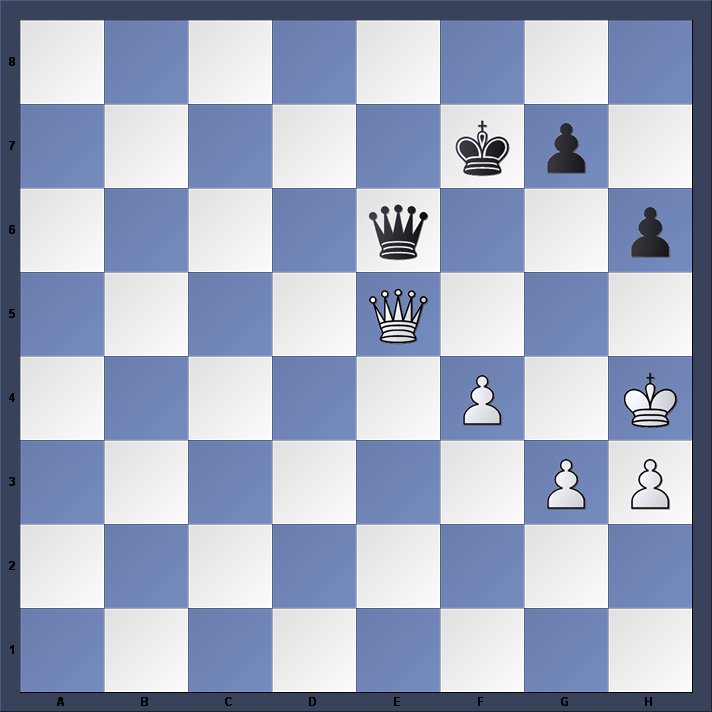
Michael Adams (Black) to win immediately.
Posted in Western Morning News |
Tags: British Chess Championship 2018, Michael Adams |
No Comments »
British Championships Approaching
The British Championships start in a fortnight in Kingston-Upon-Hull’s City Hall, as part of their UK City of Culture activities (2017-2020). Generous support and sponsorship has attracted a healthy entry of 750+ and rising every day. The Championship section of 57 includes 15 GMs and 25 others with a Masters title, and there are 20 other sections available to enter. Check out the ECF website for latest developments.
Cornishman Michael Adams has returned to the fray after missing out last year. At Bournemouth in 2016 he became Champion with the unsurpassed score of 10/11, and in this company will need to be at his very best again to repeat that.
At Bournemouth, the last round pairing was most unusual, almost bizarre. For the final round, Adams should have been paired against one of his closest rivals, but he’d already played all of them, whereas another player, almost 500 rating points lower, had done exceedingly well up to that point and was the only realistic opponent. However, the almost surreal nature of the situation may have got to him, as Adams showed what he can do, given half a chance.
White: M. Brown (2252). Black: M. Adams (2727)
Scotch Game [C45]
1.e4 e5 2.Nf3 Nc6 3.d4 White decides to go for the open Scotch Game, which can lead to complicated positions with lots of activity. exd4 4.Nxd4 Nf6 5.Nxc6 bxc6 6.e5 Qe7 7.Qe2 Nd5 8.c4 White is bound to want to be as aggressive as possible Nb6 9.Nc3 Qe6 10.Qe4? White’s queen now plays little significant part in the game. g6 11.Bd3 Bg7 12.f4 0–0 13.0–0 f5 14.exf6 Qxf6 15.Bd2 d5 16.Qe2 If 16.cxd5 Bf5 17.Qf3 Qd4+ and White would be under severe pressure. 16…Ba6 17.Rae1 Bxc4 18.Bxc4 Nxc4 19.Bc1 a5 20.Qc2 Rae8 Black’s development is now complete, but White’s queen seems to want to run away and hide. 21.Qa4 Qd4+ 22.Kh1 Rxe1 23.Rxe1 Qf2 24.Rg1 It’s too late for the queen to be effective. e.g. 24.Qd1 Nxb2 25.Bxb2 Qxb2 26.Ne2. 24…Bd4 25.Rd1 Re8 26.h3 Re1+ 27.Kh2 Qg1+ 28.Kg3 Ne3 0-1. If 29.Rd2, Black has the choice of 29…h5 or Nf1+ winning more material. A ruthless display by Adams.
Last week’s game was finished off even more ruthlessly by 13 year old Nadia Jaufarally, thus:-
16.Nh6+ Sacrificing a piece with check in order to retain the initiative 16…gxh6 17.Bc4+ Kh8 Now throw in the queen & rook for good measure. 18.Qxe8+ Nxe8 19.Rxe8+ Bf8 Blocking the check with a piece already under attack - feels like a good idea. 20.Rxf8+ Nxf8 21.Be5# Oh dear - the bishops apply the coup de grace. 1–0
In 1910 Alain White published The White Rooks, a collection of 100 positions in which White had only rooks to help administer a swift mate, from which I’ve selected several in recent weeks. The year before, he’d published Knights & Bishops, a collection in which White has no queen or rook, but only the minor pieces in which to finish Black off in short time. This is a 2-mover from that book.
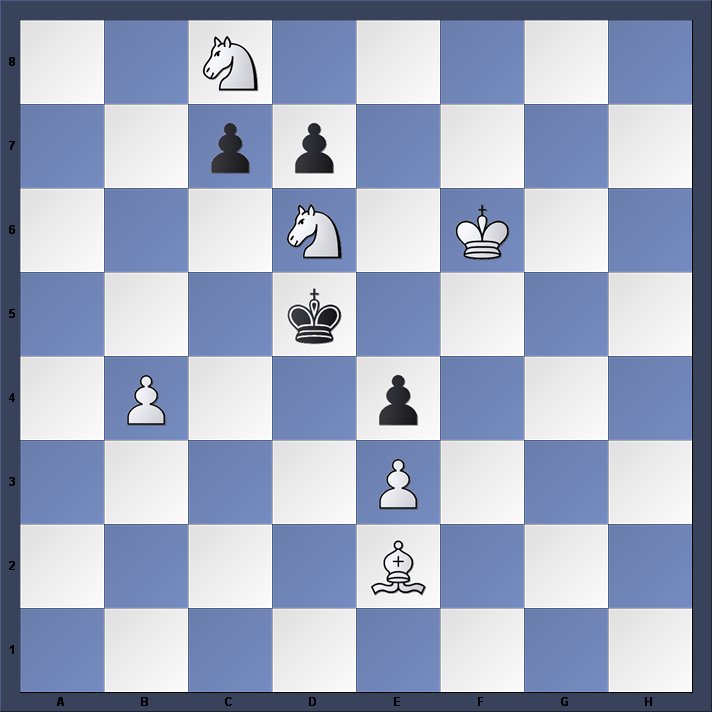
White to mate in 2
Posted in Western Morning News |
Tags: British Chess Championship 2018, Michael Adams |
No Comments »
Success For Torquay Schoolboys (14.10.2017.) 955
Last weekend saw an International Schools Team Tournament at Millfield School, Somerset, in which the Devon representative was Torquay Boys’ Grammar School. The format involved all schools playing 2 preliminary rounds, on the basis of which teams were allocated to the Championship or Major Section for the 5 subsequent rounds.
Having lost their older and more experienced players to tertiary education, Torquay had a younger team than usual and just failed to qualify for the top section, but were well-placed in the Major. Their team comprised the following players, with their final scores out of 7.
Bd. 1: Vignesh Ramesh (3). 2. Ben Sturt (3½). 3. Jakub Kubiac (3½). 4. Ben Sanders-Watt (3½). 5. Luke Glasson (6½). 6. Isaac Kennedy-Bruyneels (6). 7. Toby O’Donoghue (3½). 8.Oliver Mortimer (2½). 9. Evan McMullan (5½). 10 Kiernan Raine (6). 11. James Gibbs (4½) & 12. Surinder Virdee (5½).
Luke, Isaac, Evan, Kieran and Surinder all won prizes for the Best Board performance.
The final school positions in the Major were as follows: 1st TBGS. 2nd Chepstow School. 3rd St. Benildus College, Dublin. 4th St. Andrews College, Dublin. 5th Colaiste Eanna (Dublin ‘A’). 6th Colaiste Eanna (Dublin) ‘B’.
The Championship Section finished as follows: 1st Gonzaga College (Dublin) ‘A’. 2nd Royal GS. Guildford. 3rd Millfield. 4th Winchester. 5th Q.E. School, Barnet & Gonzaga College ‘B’.
The very strong Isle of Man tournament ended a few days ago, with a victory for World Champion, Carlsen. The draw for Rd. 1 was done randomly, which was lucky for some, like Carlsen and Adams who were drawn against much weaker opponents, while the much closer seeds, Caruana and Kramnik were paired together. Here is Adams’ first game.
White: M. Adams (2738). Black: V. Bianco (2086).
Caro-Kann – Arkell-Khenkin Variation [B12]
1.e4 c6 2.d4 d5 3.e5 c5 The Arkell-Khenkin Variation, pioneered by our local player and Russian ex-pat Igor Khenkin. Although a 2nd move by the same piece in the opening would seem to be bad, both had successes with it and pioneered its use. 4.Nf3 cxd4 5.Nxd4 Nc6 6.Nxc6 bxc6 7.Bd3 Ba6 8.e6 fxe6 9.0–0 Bxd3 10.cxd3 g6 11.Bf4 Bg7 12.Qe2 Nf6 13.Nd2 Nh5 14.Be5 0–0 15.Nf3 Bxe5 16.Nxe5 An excellent outpost for the knight. 16…c5 17.g3 Qd6 18.Rac1 Rac8 19.Rfe1 Ng7 20.h4 Rf5 21.b4 Rc7 22.bxc5 Rxc5 23.d4 Rc7 24.Qd2 Rf8 25.Rxc7 Qxc7 26.Rc1 Qb7 27.g4 Ne8 28.Qe3 Nc7 29.h5 Kg7 30.hxg6 hxg6 31.Nd7 Rc8 Completing the desertion of their king by Black’s pieces. 32.Qg5 Threatening e5 and e7. 0–1 Analysis shows that 1…Rf8, although losing the rook is the only move to avoid a quicker forced mate. 1–0
In last week’s position played out in Manchester in 1929, after 1.RxB QxR there followed 2.Ng5 threatening both the queen and Rxh7 mate, so 2…Qg6 is forced, but White continues with 3.RxP+ QxR and 4.Nf7+ is what is called a smothered mate – probably the move that Black overlooked when he originally accepted the “gift”.
In this position White has a move that wins significant material.
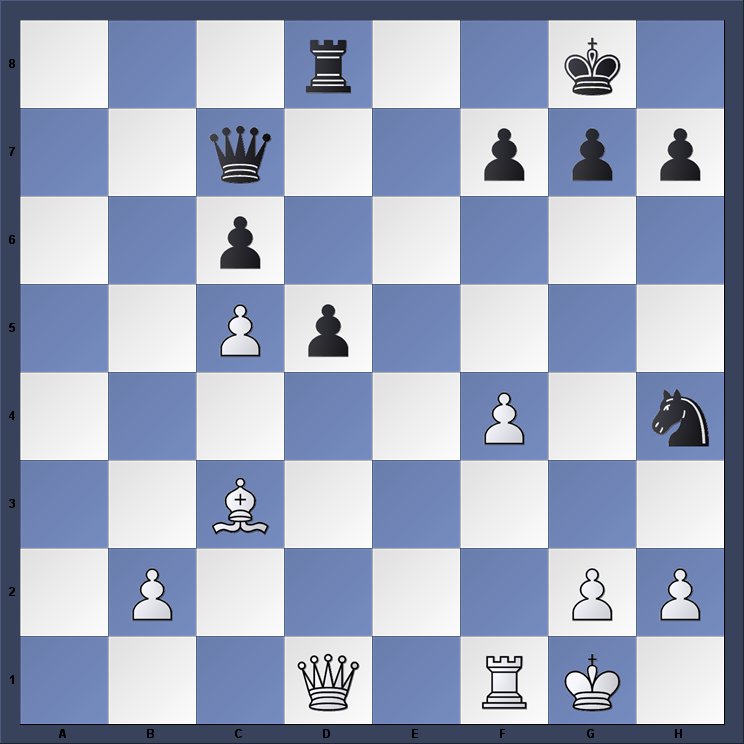
White to play
50th Torbay Congress 2016 - A Short History.
The 1st Torbay Congress took place in November 1966 at the Raleigh Hotel, Dartmouth. Numerate readers will immediately spot that this should then be the 51st Congress, but about a decade ago the planned venue, the Riviera Centre in Torquay, pulled out at the last minute and no suitable alternative venue could be found at short notice, so the 40th Congress had to held over for a year. It was a feature of the Riviera management at that time that although they were happy to pencil in the dates of the Congress, they would delay confirming it until quite late on, in the hope that they might get a better offer. Usually they didn’t, but on this one occasion they did. This policy, coupled with the ever-rising charges for room hire, meant that eventually they lost the Congress for ever.
But to go back to the beginning, how did it all start? The Torbay League had been created by J. E. Jones and started activities on October 5th 1957. The Paignton Congress and Exeter & District League had both been started in 1953, and this was deemed sufficient to cater for players’ needs at the time. Jones would, in time, almost certainly have got around to the idea of Torbay having its own congress, but by 1963, with the prospect of his school, King Edward’s G. S., Totnes, becoming a comprehensive school, he decided to climb further up the promotional ladder, taking a Master’s degree at Birmingham University before joining the staff at Didsbury Training College in Manchester which was eventually absorbed into Manchester University.
So, without Jones’s authoritarian leadership, how did the idea of a Torbay Congress get off the ground? The owner of the Raleigh Hotel at the time was Henry Baguley, but who contacted who? Those of us who were around at the time (and still are) are fairly sure that it was Baguley who originally had the idea and suggested it to the League management. That year, 1966, he was the newly-appointed President of the Dartmouth Rotary club and would have been looking to do something new to help put Dartmouth on the map. Secondly, his hotel was in need of something to boost bookings at the lowest point of the year - between the end of the holiday season and Christmas, and thirdly, his son, John, was a promising junior chessplayer who had enjoyed successes in the Torbay Schools Chess League and was then the current Devon U-18 Champion, so Henry was keen to provide another arena in which his son could shine.
And so it was that 20 players met at the Raleigh Hotel on Dartmouth’s picturesque waterfront in November 1966. The League’s Secretary at this point was Alan B. Cole, of the Teignmouth Club, so their members got full notice of the new up-coming event, and Ivor Annetts was among that small band of 20 for the first Congress. However, no record of this first event can be found in the official records of the time. Ken Bloodworth, Eddy Jones’s successor as the Western Morning News chess columnist, would certainly have covered it, but the black bin-liners of unsorted cut-out columns that he bequeathed to me did not contain any from this period.
From this small beginning, the event was considered a success and continued year on year, although the contact with the Baguleys did not survive long. The Raleigh Hotel went into receivership a few years later and John Baguley was not seen again on the Westcountry chess scene. The Congress ticked along quietly for a few years, mostly unreported nationally, as the congress scene in Devon was dominated by Paignton and Peter Clarke’s Hexagon-organised events in North Devon, the latter attracting up to 200 players. But the post-Fischer-Spassky explosion of 1972 led to a vast increase in the number of weekend congresses nationally and the young generation of prospective GMs.
By the 1980s the Torbay Congress got an occasional mention in the Forthcoming Events column of Chess, where it was recorded in 1986 that the 21st event would be held on November 21st - 23rd at the Templestow Hotel with Bob Liggitt as Entry Secretary. The BCM of 1980 actually had a brief winners’ list showing that some big name title-hunters were showing up. Open: 1st= Murray Chandler (GM in ‘83) & Craig Pritchett (IM in ‘76). 3rd= Mark Hebden (IM in ‘82) & Michael Franklin. Major: 1st= Ken Bloodworth & A. Chapman. 3rd= Brian Boomsma, Robin Cotton & Ken Gunnell. Minor: 1st= Paul Foster (still a prizewinner 36 years later), A. Robins & N. P. Williams.
Also playing that year, though not appearing in the prizelist, was a youngster celebrating his 9th birthday – a lad with a shining future ahead of him, by the name of Michael Adams.
The congress was a rung on his ladder to grandmasterdom, with a record as follows:-
year age section performance
1979 9 Minor 105 15th=
1980 10 Challengers 166 8th=
1981 11 Challengers 155 16th=
1982 12 Open 166 2nd
1983 13 Open 212 1st=
1984 14 Open 199
1985 15 Open 212 2nd
1986 16 Open 238 1st=
Today, that generation of title-hungry aspirants has largely moved on to higher things and the event is left to local players and congress regulars from around the country. It’s now settled at the Livermore House Hotel on Torquay sea-front, the same venue as the Paignton Congress since it was ousted from Oldway Mansion. It hosts both events within weeks of each other, and it suits the players very well as it offers plentiful parking and accommodation, proximity to the town’s railway station and local bus routes, top class service, a bar and restaurant, sea views, spacious playing room etc. For all its grandeur, Oldway Mansion had none of these things.
Anyway, getting back to the point, the 50th Congress, under the leadership of Ken Alexander, a relatively new Congress Organiser, went very well at the Livermead House Hotel. Entries up to 138, but no IMs or GMs among them to scoop the top prizes, which made it more competitive, as witnessed by the prizelist below. Never have more prizes been handed out, whether in cash or kind.
| Torbay Congress 2016 – Prizelist. | ||||
| Prize | Winner | Club | Pts/5 | wins |
| OPEN | ||||
| 1st | W. McDougall | Chichester | 4½ | £225 |
| 2nd | J. Edge | Halesown | 4 | £130 |
| 3rd= | C. Lowe | Exeter | 3½ | £40 |
| J. Menadue | Truro | 3½ | £40 | |
| GPs | ||||
| U-185 | M. Waddington | Dorchester | 3 | £15 |
| R. J. Webster | Calderdale | 3 | £15 | |
| U-175 | O. E. Wensley | Exmouth | 2½ | £15 |
| R. G. Taylor | Wales | 2½ | £15 | |
| 0/2 | W. G. Adaway | Dorchester | 1½ | £30 |
| MAJOR | U-170 | |||
| 1st= | R. Sayers | 4 | £85 | |
| R, Burton | Weymouth | 4 | £85 | |
| M. O’Brien | Plymouth | 4 | £85 | |
| GPs | ||||
| U-159 | A. M. Hibbitt | Banbury | 3 | £6 |
| M. R. Wilson | Teignmouh | 3 | £6 | |
| Y. Tello | Wimbledon | 3 | £6 | |
| R. J. Gamble | Derby | 3 | £6 | |
| I. S. Annetts | Tiverton | 3 | £6 | |
| U-148 | P. Neatherway | 3 | £15 | |
| P. E. Halmkin | Teignmouth | 3 | £15 | |
| 0/2 | N. Mills | Teignmouth | 2 | £30 |
| INTER | U-140 | |||
| 1st | D. J. Jenkins | Penwith | 4½ | £120 |
| 2nd= | S. Williams | Cwmbran | 4 | £65 |
| P. Foster | Medway | 4 | £65 | |
| GPs | ||||
| U-132 | M. A. Roberts | Holmes Chapel | 3 | £15 |
| R. K. Hunt | Seaton | 3 | £15 | |
| U-125 | T. J. Crouch | Kings Head | 2½ | £15 |
| C. B. Peach | S. Hams | 2½ | £15 | |
| 0/2 | M. J. Cuggy | Brixham | 2 | £30 |
| MINOR | U-120 | |||
| 1st= | H. Archer-Lock | Abbey School | 4 | £40 |
| J. D. Madden | Leamington | 4 | £40 | |
| I. Farrow | 4 | £40 | ||
| A. R. Fraser | Beckenham | 4 | £40 | |
| G. Daly | Downend | 4 | £40 | |
| O. Stubbs | Downend | 4 | £40 | |
| R. Greenhalgh | S. Hams | 4 | £40 | |
| GPs | ||||
| U-112 | M. R. Pope | Salisbury | 3 | £10 |
| A. H. Davies | S. Hams | 3 | £10 | |
| P. Saunders | 3 | £10 | ||
| U-106 | M. Maber | Taunton | 3 | £8 |
| D. F. Burt | Bournemouth | 3 | £8 | |
| J. W. Carr | Portsmouth | 3 | £8 | |
| H. Welch | Seaton | 3 | £8 | |
| U-95 | J. Tye | Downend | 3 | £30 |
| U-76 | A. Moorhouse | Teignmouth | 1½ | £8 |
| K. Hayden | Teignmouth | 1½ | £8 | |
| Mrs. W. Carr | Portsmouth | 1½ | £8 | |
| P. Tournier | Hastings | 1½ | £8 | |
| 0/2 | E. Prenton | 2½ | £30 | |
Marian Cox wins one of the first lottery prizes, Brian Gosling's biography of the problemist John Brown, nicely colour-coordinated with her outfit.
Adams Sprints Home (13.08.2016.)
So, Michael Adams won the British Championship for the 5th time with a record score of 10/11 points, comprising 9 wins and 2 draws. The only other player to achieve this was Julian Hodgson at Plymouth in 1993, but the field then was not as strong as this year, as sponsorship had attracted most of the active grandmasters.
In the final round, as he had already played all his main rivals, Adams was paired against someone far lower in the pecking order. Doubtless it was a great thrill for the 22 yr old Brown to be playing Adams on top board, and he had nothing to lose, except the game itself; everything else was a bonus.
White: Andrew Brown (222). Black: Michael Adams (269).
Scotch Game [C45]
1.e4 e5 2.Nf3 Nc6 3.d4 The Scotch Game 3…exd4 4.Nxd4 Nf6 5.Nxc6 bxc6 6.e5 Qe7 7.Qe2 Nd5 8.c4 8.Nd2 would constitute the Cochrane Attack, but White prefers to develop his knight to c3. 8…Nb6 9.Nc3 Qe6 Freeing up his constricted kingside position. 10.Qe4 g6 11.Bd3 The bishop might have had more scope on e2, rather then lining up against Black’s solid fianchetto position. 11…Bg7 12.f4 0–0 13.0–0 White may be shaping up to occupy f5, but Adams decides to get there first, although in itself an unusual move in this position. 13…f5 14.exf6? In the majority of games reaching this position, White usually plays 14.Qe2, as taking en passant gives Black a good open position. 14…Qxf6 15.Bd2 d5 16.Qe2 If 16.cxd5 Bf5 17.Qf3 Qd4+ picking up the bishop. 16…Ba6 17.Rae1 Bxc4 18.Bxc4 Nxc4 19.Bc1 a5 20.Qc2 Rae8 21.Qa4? The queen departs the battlefield, with no threats of her own, which gives Adams the green light for an immediate all-out attack. 21…Qd4+ 22.Kh1 Rxe1 23.Rxe1 Qf2 Threatening mate. 24.Rg1 Bd4 25.Rd1 Re8 Another piece joins the fray to threaten another mate. 26.h3 Re1+ 27.Kh2 Qg1+ 28.Kg3 Ne3 Threatening mate on g2, but White calls it a day anyway 0–1. If 29.Rd2 h5 etc.
The tournament result demonstrated Adams’ continuing supremacy on the British chess scene, and he shows no sign of slowing down or relaxing his grip. On the other hand, Brown has no cause to feel down-hearted; much will be heard of him in future.
If the British Championship marks the climactic end of the old season, the Paignton Congress marks the start of the new. It begins 3 weeks tomorrow at the Livermore House Hotel on the Torbay seafront. Entry forms may be downloaded from chessdevon.co.uk or obtained from Alan Crickmore on 01752-768206 or e-mail [email protected]. It’s his last year as Secretary and a successor is actively being sought.
Last week’s 2-mover was solved by 1.R6a6! when Black has only 2 possible moves. If 1…d3 2.Bg7 mate, or 1…Kxe4 2.Re6 mate.
In this position, both sides have long-ranging pieces, and it could be a case of Who moves wins. In fact it’s White’s move, so is this true? Can he win by
force or be mated himself.
Posted in Western Morning News |
Tags: British Championships 2016, chess, Michael Adams |
No Comments »
Beer & Blitz - A Celebration In Memoriam (23.04.2016.)
A number of leading chess players have died in recent months, among them England Olympiad veteran Peter Clarke (81) from north Cornwall; financier Jim Slater (86) who called Bobby Fischer a “chicken” in the run-up to his famous 1972 world championship match with Spassky, which, together with a £5,000 bonus from Slater, stung the American into actually turning up; Jeremy James (79) who presented chess tournaments on BBC TV in the 1970s under the title “The Master Game”; writer Dr. Colin Crouch (58) and problemist Sir Jeremy Morse (87), former Chairman of Lloyd’s Bank.
A good advert, incidentally, for the longevity of chessplayers.
David Norwood, a grandmaster who abandoned a career in chess to amass a fortune in commodity trading, took it upon himself to commemorate their lives and achievements in the game by organising and underwriting a very strong blitz chess tournament at the King’s Head pub in Bayswater on 27th February. Sixty four of England’s strongest players played in 8 All-Play-All leagues in the early rounds, changing to knockout when it was down to the last 16 players.
The rate of moves was 3 minutes per player for all moves, but with the digital clocks being used, 2 seconds were added each time a move was made. Unfortunately, electronic boards were not available to record the moves automatically, being played at almost lightning speed, but the later games were videoed and may be seen on-line; just visit www.youtube.com and search for “Beer and blitz – Celebration in Memoriam”.
Four grandmasters made the semi-finals, in which Michael Adams beat Luke McShane and Mark Hebden beat Simon Williams. In the final, Cornishman Adams beat Hebden in Game 1 with Black against a Ruy Lopez, and drew Game 2, netting him the £700 first prize. It was another example, if ever one was needed, of Adams’ supreme chess skill - speed of thought and deep knowledge of the game.
Last week’s position was an illustration of the “power of the check”. Whatever else is possible, a check must be dealt with first, which allows White to win a piece with 1.QxB+ KxQ 2.RxQ.
Sir Jeremy Morse, was something of a polymath. After Winchester, he took a Double First at Oxford, and was elected a fellow of All Souls. Not only one of the finest minds of his generation in the City, he was, amongst other things, a classics scholar, a pianist, a lover of poetry and a solver and composer of cryptic crosswords. He was an international chess judge, and in retirement published Chess Problems: Tasks and Records, (Faber & Faber 1995) a collection of some 837 problems, about 50 of them of his own devising. His speciality was the 2-mover, the “purest of all chess exercises”. Here is one of his own compositions from that book.
White to move and mate in 2.
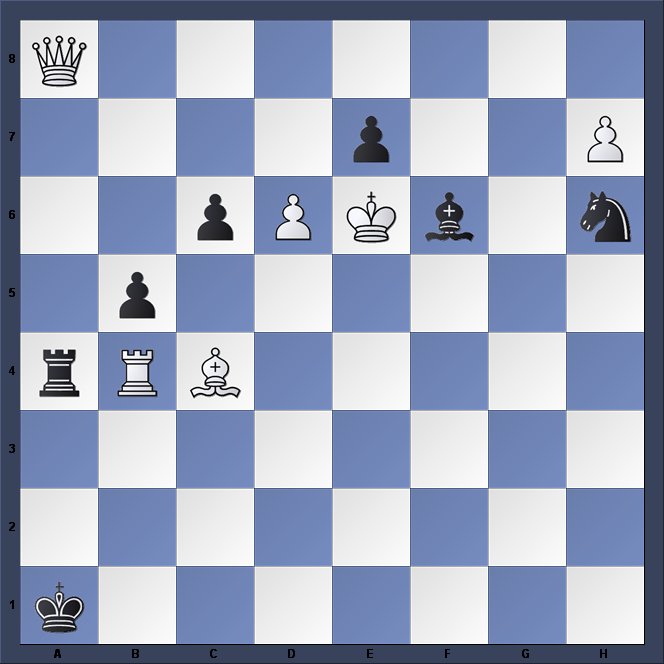
White mates in 2
Posted in Western Morning News |
Tags: Beer and Blitz, chess, Michael Adams, Sir Jeremy Morse |
No Comments »
Big Bucks Bring Bonus? (17.10.2015.)
As reported last week, I came 2nd= in the Minor section of the Bude Rapidplay and received £10 for my efforts, an event as rare as it was pleasing. After all, that’s as much as the great English player J. H. Blackburne won at the super-strong Hastings tournament in 1895. Yet the vast majority of chessplayers don’t play for money, but for the adrenalin rush as an unexpected win comes into view.
Bobby Fischer went some way to correcting this amateur outlook as he fought for vastly increased prize-money and public recognition and consideration for chessplayers. At the time it was, in some quarters, considered somewhat vulgar, but by 1972 he had certainly succeeded in his aims.
Now another American is pushing the cause even further. This is Maurice Ashley, the first African-American Grandmaster, with the support of Amy Lee, an entrepreneur from Vancouver, whose PokerStars company ran its first tournament with a $1,000,000 prizefund in Las Vegas last year, where probably the only UK participant was Exeter’s Tim Paulden who won £1,000 for his efforts. However, his entry fee, or “buy-in”, as they call it, was $1,000.
Last week, they launched into Britain when the prizefund of £35,000 attracted many of Europe’s top players to the PokerStars Isle of Man Tournament, making it probably the UK’s strongest-ever Open International. It finished last weekend in a 3-way tie on 7/11 points between Pentala Harikrishna (India), Laurent Fressinet, (France) and Gabriel Sargissian, (Armenia). After various tie-rules were invoked and win-bonuses added in, Harikrisha got the title and £16,000, while Fressinet got £11,000 and Sargissian £9,000.
Ashley’s argument is that only big money prizes in chess will grab the world-wide general public’s attention. Bude still has some way to go - not that anyone’s worried about that.
In last week’s position White could have won by 1.Rxh7+ Kxh7 2.Rf7+ Kh8 2. Qg6 and Qh7mate cannot be prevented. But he missed it and eventually lost.
In 1996 Michael Adams was invited to take part in the New York Chess-In-The-Schools Tournament, which he won easily. He reported it in British Chess Magazine, noting (a) that the commentary room was full of inner-city children before whom each player had to go through their game afterwards and (b) all players had to wear a suit and tie throughout; (now there’s an idea). He didn’t mention this Rd. 8 game, but the sharp finish does appear in chess literature.
White: M. Adams (2660). Black: Joel Benjamin (2570).
Sicilian Defence – Alapin Variation. [B22]
1.e4 c5 2.Nf3 e6 3.c3 Nf6 4.e5 Nd5 5.d4 cxd4 6.cxd4 b6 7.Bc4 Ba6 8.Bxa6 Nxa6 9.0–0 Be7 10.Nbd2 0–0 11.Ne4 Nac7 12.Bg5 f6 13.exf6 Nxf6 14.Bxf6 gxf6 15.Rc1 d5 16.Ng3 Qd7 17.Nh4 Bd6 18.f4 f5 19.Nh5 Qf7 20.Rf3 Kh8 21.Rh3 Rg8 22.Nf3 Qe7 23.Qe2 Ne8 24.Rc6 Qd7 25.Ne5 Qe7 which brings us to this week’s position. How did Adams now demolish the American Grandmaster?
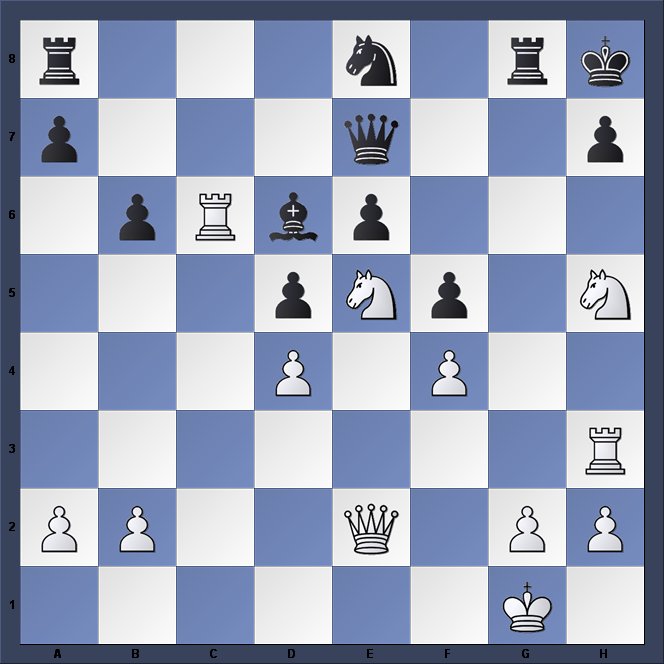
White to play and win.
Posted in Western Morning News |
Tags: Bude RapidPlay, chess, Isle of Man Masters 2015, Michael Adams, PokerStars |
No Comments »
Adams Stars at Olympiad (23.08.2014.)
The recent 41st Olympiad at Tromsø was won by China, who at the outset were seeded 7th of the 177 participating teams of 4, based on the rating of their players. Second were Hungary (5th seed) and 3rd were India (18th seed). This serves to illustrate how the balance of power is moving from west to east. England came a disappointing 28th (10th seed), Ireland were 66th (62nd seed), Scotland were 83rd (65th seed) and Wales were 105th (98th seed).
One bright spot for England was the outstanding performance of Michael Adams, who scored 6½ points from the 9 games he played. Only a split on tie-break denied him the gold medal for the best individual performance on Board 1, and he had to settle for silver. This game from Rd. 5 against Vietnam was probably his best.
White: Le Quang Liem (2710). M. Adams (2740).
Catalan Opening.
1.d4 Nf6 2.c4 e6 3.g3 White goes in for the Catalan Opening, a system named by Tartakover after he tried it in Barcelona in 1929. 3…d5 4.Bg2 Bb4+ 5.Bd2 Be7 6.Nf3 c6 7.Qb3 0–0 8.0–0 Nbd7 9.Rc1 a5 10.Bg5 h6 11.Bxf6 Bxf6 12.Na3 Qe7 13.e3 Rd8 14.Rab1 g6 15.Qc2 Bg7 16.Rd1 Nf6 17.Ne5 Bd7 18.Nxd7 Rxd7 19.Rd2 e5 Breaking open the centre to create space for his pieces. However it also allows White’s knight to join the fray. 20.dxe5 Qxe5 21.Rbd1 Rad8 22.cxd5 Nxd5 23.Nc4 Qe6 24.Bxd5 cxd5 25.Nxa5 d4 26.exd4 Qxa2 27.Nb3 Qa4 28.Ra1 Qb4 29.Qc3 Qb6 30.Ra4 Qe6 31.Nc5 Forking queen and rook, but Black has a vital check available. 31…Qe1+ 32.Kg2 Rc7 33.Rc2 Qe8! Hitting the undefended rook and threatening …b6 winning the pinned knight. 34.Rc4 b5 35.Rb4 Black may be a pawn down, but this is the beginning of the end for White as Adams launches a powerful attack. 35…Rxc5 36.Qxc5 Forced, as the defending pawn was pinned. 36…Bf8 The point of Black’s sacrifice, as becomes clear. 37.Qxb5 Qe4+ Now both rooks are attacked. 38.Kg1 Qxc2 39.Ra4 Qb1+ 40.Kg2 Qe4+ 41.f3 Qc2+ 42.Kh3 Qd1 43.f4 h5 44.Qc4 Rxd4! 0–1 If now 45.Qxd4 Qf1+ forcing 46.Kh4 Be7+. Or if 45.Ra1 Qg4+ 46.Kg2 Rxc4 In fact, White is mated in every variation. Match drawn 2-2.
Vietnam eventually finished level with England on match points but came 27th on tie-break.
The Paignton Congress starts a week tomorrow at the Livermead Hotel. Enquiries about last minute entries should go to Alan and Linda Crickmore on 01752-768206 or e-mail [email protected].
The solution to last week’s problem was 1. Bb8! Here is another 2-mover by Lt. Col. George Kirkpatrick Ansell, who was killed in action exactly 100 years ago next week.
