Archive for September, 2014
Seniors’ Chess (27.09.2014.)
 September 29th, 2014 |
  Author:
 People tending to live longer these days and often retiring early has helped to create one of the expanding areas of sport. Tennis and golf, for example, have long had their seniors circuits, in which past champions compete at a far more leisurely pace than in their heyday.
So too with chess, which has recently introduced European and World individual and team events for seniors only. This year, the world governing body, FIDE, has gone further, by splitting the age eligibility into two sections, 50 – 64 and 65+, thus enabling more players to compete for honours. The first European Championship for the 50 – 64 age group was held earlier this year in Portugal and was won by Paignton resident Grandmaster, Keith Arkell.
The Royal Beacon Seniors event in Exmouth was a pioneer in this aspect of the game. When it started in 2000 it was the only seniors-only event in Britain, and they introduced a special section for the 50-somethings over a decade ago. Now the world has caught up.
The 15th Royal Beacon Seniors event takes place during the week starting Monday 3rd Nov. Entry forms are downloadable from chessdevon.com.
Here is a game from last year’s Beacon Seniors Congress.
White: Ian Heppell (178). Black: Jonathan Wells (180)
Sicilian Defence – Alapin Variation. [B22]
1.e4 c5 2.Nf3 e6 3.c3 Nf6 4.e5 Nd5 5.d4 cxd4 6.cxd4 b6 7.Nc3 Bb7 8.Bd3 Be7 9.0–0 0–0 10.Re1 f5 11.exf6 Black has a choice of 4 pieces with which to retake, but chooses probably the least promising option as it weakens his defensive pawn structure, which White exploits later. 11…gxf6 12.Bh6 Rf7 13.Qe2 Nxc3 14.bxc3 Qc7 15.Be4 Nc6 16.d5 Nd8 If 16…exd5 17.Bxd5 winning the rook. 17.Rad1 f5 18.Bb1 Bd6 Now White’s kingside attack gets going. 19.Ng5 Bxh2+ 20.Kh1 Re7 21.Qh5 Bf4 22.Bxf5 Black’s d-pawn is pinned. 22…Qxc3 Best in the circumstances. 23.Bxh7+ Kh8 If 23…Rxh7 24.Qe8 mate. 24.Qg6 threatening 25.Qg8 mate and Black has to give up the exchange in order to avoid it. 24…Nf7 25.Nxf7+ Rxf7 26.Qxf7 Bxh6 27.Be4 1-0 Black’s only move is 27…Qg7 but after 28.Qxg7+ Bxg7 29.dxe6 Bxe4 30.Rxe4 dxe6 31.Rxe6
Heinz Herschmann, a regular at the Beacon Seniors event and well-known composer, arranger, musician and founder of the music label Apollo Sound, recently died, peacefully at home at the age of 90. As a composer, he achieved considerable acclaim receiving many commissions and in his other work he enjoyed great success in roles as varied as musical director of touring shows, to accompanist to various entertainers.
The solution to Dave Howard’s 3-mover last week was 1.Qh1! and the queen will mate on either a8 or b7.
This 2-mover is similar.
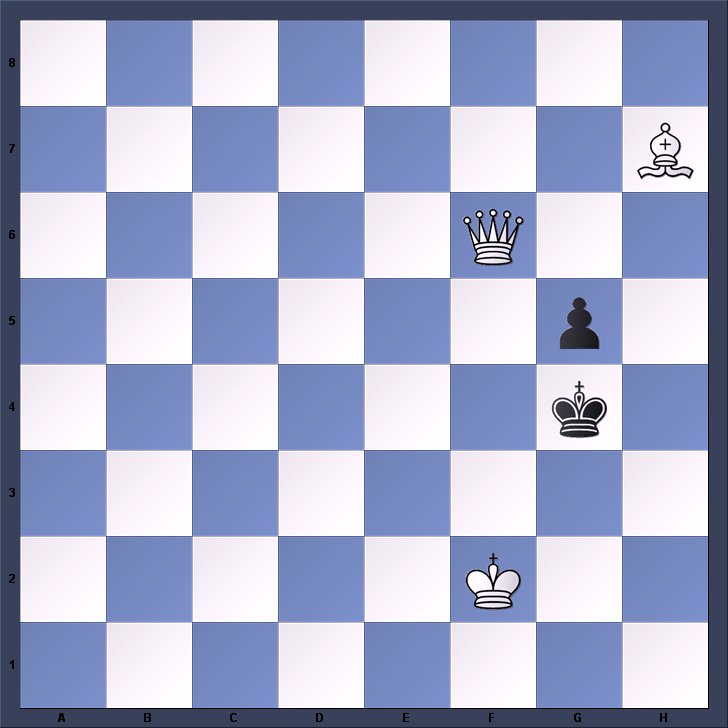
White to mate in 2
 Posted in Western Morning News |
  Tags: Beacon Seniors Chess Congress 2014, chess, Seniors chess |
  No Comments »
The Tacchi-Morris Arts Centre
The Tacchi-Morris Arts Centre
The West of England Chess Union’s annual jamboree has been held at the Tacchi-Morris Arts Centre on the outskirts of Taunton for about a decade, with the host being Taunton Chess Club member, Martin Worrall, who also happens to be a technician at the centre.
I’ve often wondered about the origin of the name/s attached to the centre, though have never quite got round to enquiring about it, assuming that it was probably the surnames of a couple of town councillors – the mayor, perhaps, and some local community activist. However, this year I made a point of asking Martin about it and he drew my attention to a plaque in the corner of the foyer, which told a very different story. (see picture 1 below)
The name, in fact, refers to Mrs. Kathleen Tacchi-Morris who lived for 50 years at Long’s House, a rambling 17th century manor house in North Curry, just 5 miles east of Taunton, until her death in 1993. In their later years she and her husband had set up a trust fund to be used in the promotion of peace and harmony throughout the world. In 1999 the trust donated £1 million, together with a £2.1 million grant from the Arts Council, to create the Tacchi-Morris Arts Centre.
Yet behind this bald fact lies a story of an extraordinary life lived by an extraordinary lady from an exotic family. She was born in 1899 in Johannesburg, the eldest of five children to Percy George Tacchi and his wife, Rebecca Kathleen. Although both Londoners, Percy and Rebecca met in South Africa, where Percy was working as an engineer in the goldfields and Rebecca was training to be a doctor, as there was little chance of that happening in England at the time. After they got to know each other, Percy contracted typhoid and as Rebecca nursed him back to health they fell in love and got married. Shortly after Kathleen was born the combination of life in the goldfields and the Boer War decided the young family to return to the UK.
Percy continued as an inventor, specialising in wheeled vehicles. While in South Africa he had set up a small company, Tacchi and Wright, building bicycles for the indigenous populace. Back in England he developed the first 4-cylinder motorcycle for Wilkinsons. (see picture 2 below).
By this time, Kathleen was 10 years old and attending a school from which she was expelled for organising a pupils’ strike against the excessive corporal punishment that went on there. She was then sent to a boarding school in Manchester and got expelled from there as well after just four weeks, for complaining about the treatment of girls. From then on any education was received at home and was somewhat ad hoc. They lived in semi-rural Acton at this time, where they had a house built in Nemours Road.
In the meantime four siblings arrived on the scene; in order of age they were Percy George junior, Mercia Olga, Maurice Phoebus and Ruby.
Her father was a socialist and a member of the Fabian Society, taking Kathleen to all their meetings, where she got to know many of the founding members, including George Bernard Shaw, H. G. Wells, Annie Besant (future President of the Indian National Congress), Leonard & Virginia Woolf, the Pankhursts and Sidney & Beatrice Webb.
She also went to ballet lessons from an early age, before getting her first paid employment in a drapers shop in Leytonstone at 12½p per week. She spent WW1 at the Hotel Cecil, the HQ of the Air Force doing not a lot, as she confessed. After the war, most women workers had to give up their day jobs to make way for the returning soldiers and Kathleen had to scratch around for work. She phoned around numerous firms saying she’d heard they needed someone in the office, which of course they didn’t. One company challenged her by asking where did you hear that story from? Kathleen took up the challenge by going round to see the person she’s spoken to and on meeting her, gave her a job immediately. It was with a film-making company in Wardour St. and she was suddenly mixed up in the world of film people, socialising with the likes of Douglas Fairbanks and Mary Pickford. She had small parts in a few films utilising her dancing skills, including Coming Through The Rye, a 1923 silent film starrng Alma Taylor and Ralph Forbes, and Men Are Not Gods (1936) directed by Alexander Korda. (see pictures 3 & 4 below).
Her film colleagues urged her to push harder for a foot up the ladder to stardom, which undoubtedly she could have done, but dancing was in her blood, not acting. Partly to escape the cinema circus and to concentrate on the dance she went to Paris in 1922 enrol at the Jacques-Dalcroze school.
Émile Jaques-Dalcroze (1865 – 1950) was a Swiss composer, musician and music educator who developed eurhythmics, a method of learning and experiencing music through movement. Turning the body into a well-tuned musical instrument, Dalcroze felt, was the best path for generating a solid, vibrant musical foundation. The 57 yr old composer was smitten with his young student and regularly took her to the Paris Opéra where she met the likes of Diaghilev, Isadora Duncan and Picasso, who used to do their décor. Kathleen wasn’t entirely convinced with all of Dalcroze’s techniques but was able to adapt them to her own needs. (see pictures 5 & 6 below)
On returning to England she trained groups of dancers who performed at the Hammersmith Palais and the Victoria Palace. In the early thirties there were trips to Antibes where she got mixed up in the Edward and Mrs. Simpson affair. Then in 1936 she married Walter Allan Stagg (1903 – 1984) an Equipment Officer in the RAF. They bought a house in North Curry before Stagg was posted to Malta. Kathleen quickly came to hate her lot, as her efforts to start a children’s dance school were forbidden by the rule that forces personnel should not fraternise with the locals. She gave her husband the ultimatum “Leave the forces or I will leave you – your choice”. He stayed on, Malta took an almighty pounding by the Luftwaffe throughout the war, and he went on to become one of the RAF’s top brass, being awarding the CBE in the Queen’s Coronation honours.
Kathleen went back to their house in North Curry, a village she had come to love in her short time there. She met Richard Rodham Morris (1903 – 88) who came from a long line of auctioneers and estate agents, stretching back in North Curry throughout the 19th century. They married in Exeter in 1945, much against the wishes of his wider family, who were all country Conservatives, while she was cast as a communist atheistic free-thinker. Yet the marriage worked well enough, as “Rod” was in awe of her energy and enthusiasm and just let her get on with whatever she wanted to do.
First of all she sacked all the servants at Longs House and turned over the vacated rooms and outhouses to her pet projects – initially looking after the local mothers of black children who’d been abandoned by their families and US fathers. There were also German Jewish refugees. A large barn was converted into a theatre and Lydia Sokolova from the Diaghilev ballet came down and taught ballet while Kathleen taught eurhythmics.
This went on until 1950 when her life took an unexpected twist, best told in her own words.
“It was an accident really, because I’d had three operations on my hip. I went to lecture on eurhythmics in Bradford and was staying there with friends. There was a newspaper on the breakfast table saying something about a conference on peace in Sheffield. I said “D’you know, I’d like to go to that. “Well let’s go”. I wasn’t allowed in as I hadn’t got a pass, but I waited outside. The doors opened and I could see Picasso on the platform. I thought ‘Goodness gracious me!’ So I wrote a note on the back of an old envelope in my handbag saying ‘Tacchi’s outside – please can she come in?’ I gave it to a policeman and said ‘Would you take that to Picasso?’ He said ‘Who’s Picasso?’ I said ‘He’s the second on the left.’ Picasso said ‘Of course, bring her in!’ So I went in and found myself sitting on the platform, and that was the beginning.
“The place was packed with people; well-known people, writers and all sorts. It was terrific. I said to Picasso, ‘Why aren’t the women in this as well?’ He said ‘Well do something about it’ and I said ‘All right, I will’. He said ‘Promise you will?’ I said ‘Yes’. He said ‘We’re asked to shift this whole thing to Warsaw and I can’t go. Will you go there for me?’ I said ‘I’ve only got ten shillings on me’. I sent a telegram to my husband, saying ‘I’m going to Warsaw’. He sent one back saying ‘I take a dim view of this’, but I took no notice, I just went.’ ….. When I saw the ruins of Warsaw and heard the story of their suffering, I knew that the rest of my life would be devoted to the struggle for peace.’
She founded the organisation Women for World Disarmament which she ran tirelessly until 1987.
In the 1950s her parents came down to live with her. Percy had all the space he needed for his workshops, while Rebecca died there just a few days short of her 100th birthday.
During 1987 she was involved in setting up the trust whereby, after their death, the house and grounds could become an international centre for youth, to promote peace. Also that year, she arranged for her Women for World Peace organisation to be merged with the Campaign for World Disarmament, which allowed her to retire. Rod died in January 1988 aged 85 and she died 5 years later aged 94. (see picture 7 below)
A much fuller account of her remarkable life story may be found in the book Women Remember – An Oral History (Routledge 1989) by Anne Smith, from which I have tried to extract the essence and combine it with other material available on-line. She also wrote a short autobiography entitled I Promised Picasso. Although it was never published there is a typescript version archived in the Somerset Heritage Centre, Brunel Way, Langford Mead, Norton Fitzwarren, Taunton, TA2 6SF. This is kept with her many other papers relating to her long and active life.
It’s not clear whether the Tacchi-Morris Arts Centre is exactly what she had in mind when she made her original legacy plans, though it teaches dance and drama, both dear to her heart. In any case, far from being a white elephant, it is a successful venture with increasing activity year on year, with, for example, the number of technicians required to service it all up from the original 2 to 5.
She would be amused to think that the warfare that is chess is strictly of the non-violent kind, and so accords with her precepts.

The Arts Centre entrance

The inventor with his Wilkinson TAC motor-bike.

(3) Kathleen Tacchi in a publicity film shot.
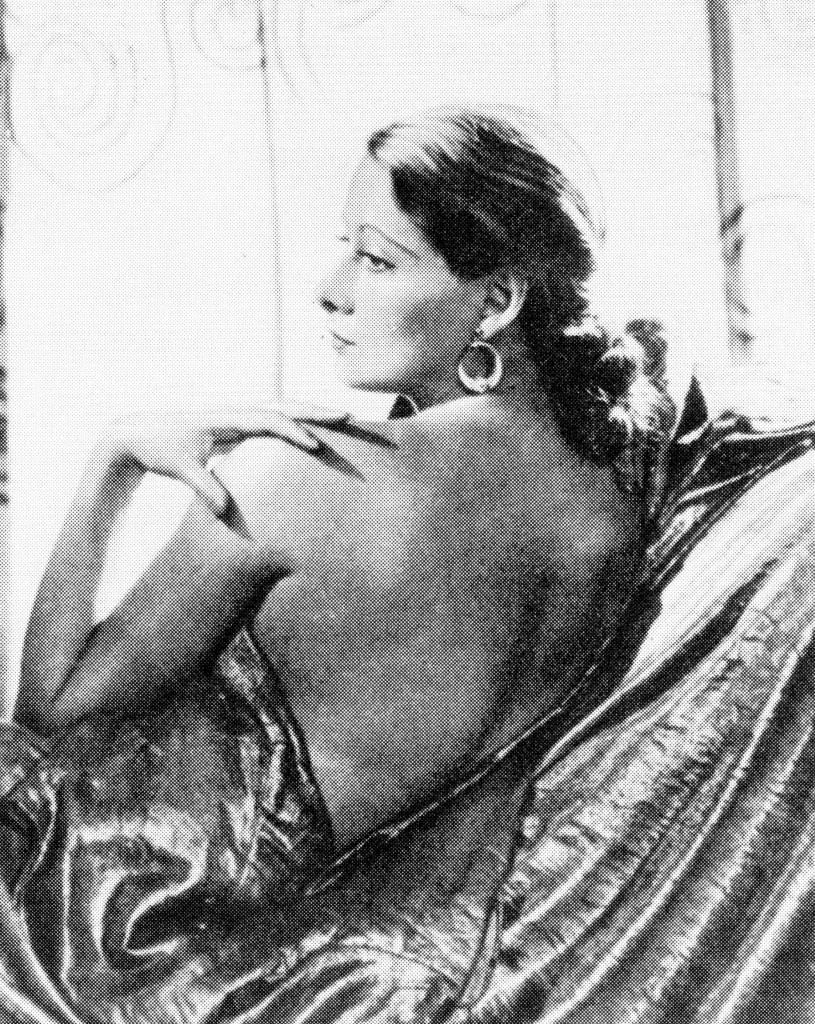
(4) Another publicity film still.

(5) Emile Jaques-Dalcroze

(6) Eurhythmics in action
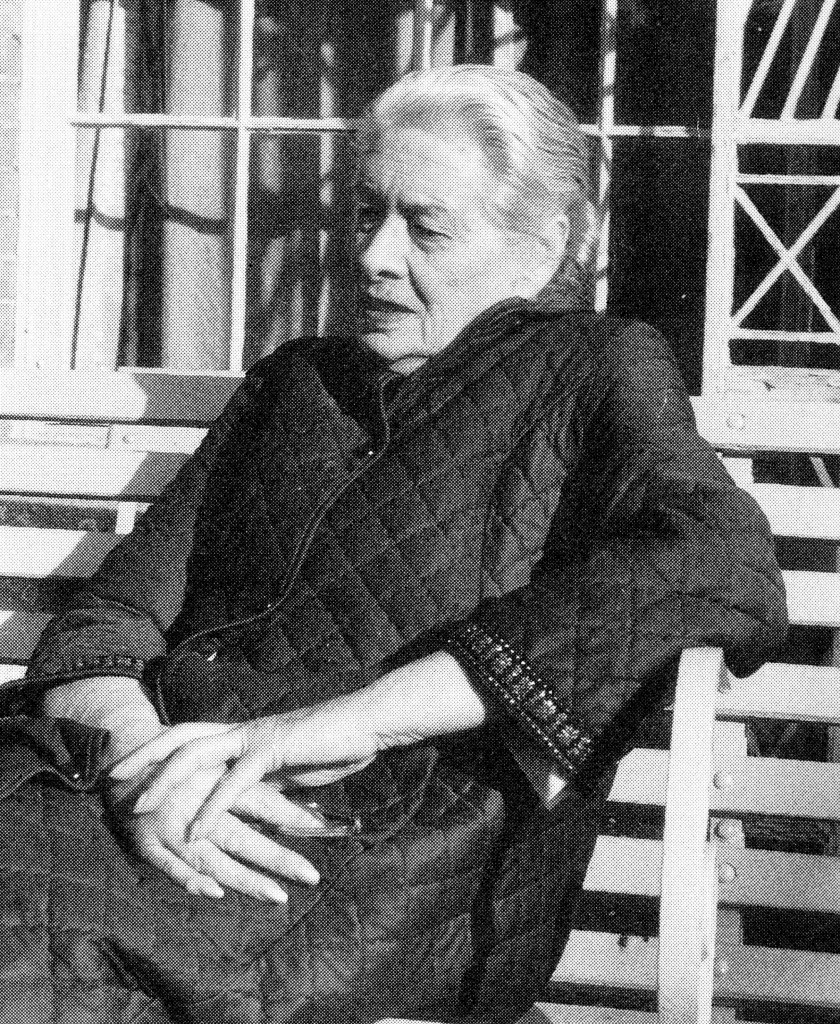
(7) Kathleen Tacchi-Morris reflects on her incredible life.
Posted in Blog |
Tags: Kathleen Tacchi-Morris, North Curry, Percy George Tacchi, Richard Rodham Morris, Somerset, Tacchi-Morris Arts Centre |
No Comments »
West of England Jamboree Results 2014
The West of England Jamboree is an annual occasion for players from all constituent units of the Union to come together in a single event, which in recent years has been held at the Tacchi-Morris Arts Centre in Taunton. On Sunday there were four teams of 12 in the Open Section – Devon, Somerset, Gloucestershire and a welcome return by a resurgent Cornwall. The winners were Devon (8½ pts) ahead of Somerset (7), Cornwall (4½) and Gloucestershire (4). This game from Bd. 6 was a no holds barred affair
White: John Jenkins (176 – Glos.). Black: Peter Chaplin (189 - Somerset).
1.d4 g6 2.e4 d6 3.f4 White certainly intends giving it everything right from the start. 3…c5 4.c3 Bg7 5.Nf3 cxd4 6.cxd4 Bg4 7.Bb5+ There’s no intention of playing conservatively with something like 7.Be2 7….Nc6 8.Qa4 Bxf3 9.gxf3 Kf8 10.Bxc6 bxc6 11.Nd2 Not 11.Qxc6?? Rc8 winning bishop & rook. 11…e5 12.fxe5 dxe5 13.Nc4 Qh4+ 14.Ke2 exd4 15.Qxc6 Rd8 16.Qc5+ Qe7 17.Qxe7+ Nxe7 18.Kd3 correctly blockading the advanced pawn. 18…Nc6 19.Bd2 Ke7 20.b4 Rd7 21.Rab1 Ke6 22.b5 Ne5+ 23.Nxe5 Bxe5 24.f4 Bd6 25.Rhc1 For best use of their powers rooks need open lines, well illustrated by the next few moves. 25…f5 26.e5 Be7 27.Rc6+ Kd5? In the spirit of the game so far, Black doesn’t wish to back off by retreating to f7, but this is a mistake. 28.Bb4 Rb8 29.Bxe7 Rxb5 30.Rbc1 1–0 Black resigned because if he takes the bishop he is mated thus 30…Rxe7 31.Rd6# , so he is effectively a piece down.
There were also four teams in the Grade-limited Section; N & W Somerset, S & E Somerset, the Torbay League and a return to inter-county competition by Wiltshire. This finished as a tie between Torbay and Wilts who will share the cup.
Full details of all players’ results and photographs of the action may be found on keverelchess.com.
The major prizewinners at the recent Paignton Congress were listed last week, so here are the winners of grading prizes. Premier: U-2151 1st= S. Dilleigh (Bristol), A. Brown (Northampton) & P. Kemp (Linton). U-2071. 1st= G. Bolt (Railways) & I. Myall (Chelmsford). U-1981 1st= A. Brusey (Teignmouth), A. Footner (Dorchester) & T. Spanton (Hastings). Challengers: U-161 1st= R. Clegg (Huddersfield) & A. Price (Leamington). U-149 1st= A. Hibbitt (Banbury) & J. Morgan (Exeter). Minor: U-122 M. Harris (Colchester). U-113 1st= A. Fraser (Beckenham), M. Bolan (Ashtead & S. Thacker (W.Notts).
Here is a hitherto unpublished problem by Dave Howard. White can mate on his 3rd move, providing the first (or key) move is correct.
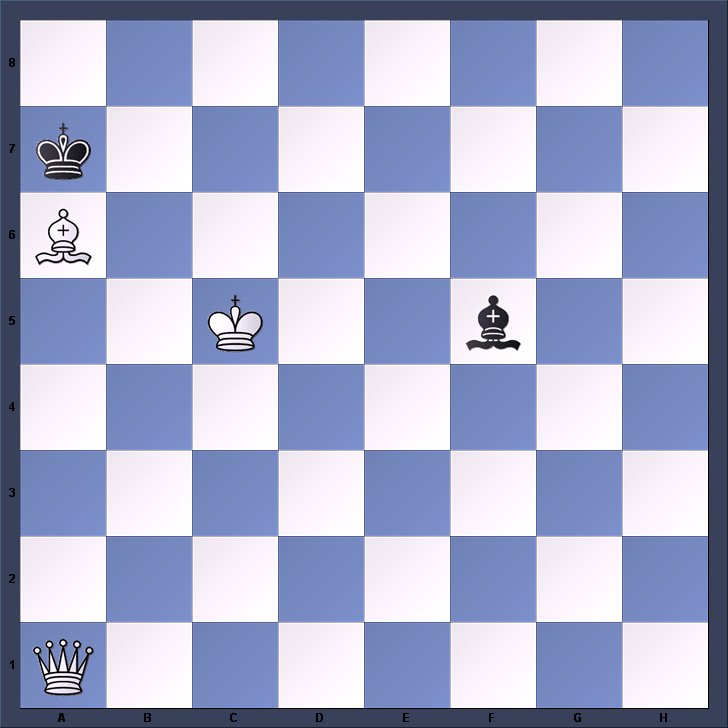
White to mate in 3
Exmouth C.C.’s Buzzer Tournament 2014.
Exmouth Chess Club’s traditional season-starter has, for several decades been its “Buzzer” Tournament. This comprises a small battery-powered device that emits an audible buzz every 10 seconds. This was cobbled together c. 30 years ago by Fred Hodge, and is kept in a small cigar box. Each player has to move on the sound, if it is their move. It’s an all-play-all event involving anyone and everyone who turns up on the night.
It involves a peculiar manifestation of the relativity of time. At the start of each game, the 10 seconds thinking time seems like an eternity, but within 10 moves that same time seems like one second and towards the end it’s like a nano-second as one’s brain struggles to sort the almighty mess one has got into.
Last year’s winner, Meyrick Shaw, started badly with a loss to Malcolm Belt, but thereafter conceded only a single draw.
The results were as follows:
| Name | 1 | 2 | 3 | 4 | 5 | 6 | 7 | 8 | 9 | total | Pos. | |
| 1 | Bob Jones | X | ½ | 0 | 0 | 1 | ½ | 0 | ½ | 0 | 2½ | |
| 2 | Fred Hodge | ½ | X | 0 | 0 | 1 | 1 | 0 | 0 | ½ | 3 | |
| 3 | Chris Scott | 1 | 1 | X | 1 | 1 | 0 | 1 | 0 | 1 | 6 | 2nd |
| 4 | Malcolm Belt | 1 | 1 | 0 | X | 1 | ½ | 0 | 1 | 0 | 4½ | 4th= |
| 5 | Tom Badlan | 0 | 0 | 0 | 0 | X | 0 | 0 | 0 | 0 | 0 | |
| 6 | Simon Blake | ½ | 0 | 1 | ½ | 1 | X | 0 | 0 | ½ | 3½ | |
| 7 | Oliver Wensley | 1 | 1 | 0 | 1 | 1 | 1 | X | 0 | ½ | 5½ | 3rd |
| 8 | Meyrick Shaw | ½ | 1 | 1 | 0 | 1 | 1 | 1 | X | 1 | 6½ | 1st |
| 9 | Steve Murray | 1 | ½ | 0 | 1 | 1 | ½ | ½ | 0 | X | 4½ | 4th= |
WECU Jamboree 2014 Results (15.09.14.)
This year there were four teams of 12 in each section, with Cornwall entering a team in the Open Section for the first time in a number of years, probably decades - and a very competitive team it was, too. In the Grade-limited Section there was a team from Wiltshire, after an absence of c. 20 years - a welcome move in both cases.
Although headed by Somerset in the early stages, Devon’s strength-in-depth made certain of their win in the Open, winning all 6 of their games in the lower half. Gloucestershire scored 3.5 out of 5 at the top of the order, but then fell away, while Cornwall scored 4 pts from their top 7 games.
In the Graded Section, Devon’s Torbay League scored heavily in the lower reaches, while Wiltshire scored at the top and bottom of the order, the two teams coming 1st =. The Wiltshire Captain, Roy Ludlow took the trophy 1st, saying his wife would only allow him to keep it in the house until the Torbay Congress in November, where he’d gladly hand it over to Rob Wilby.
The event was organised by Ben Edgell. Jerry Humphries acted as Arbiter in the Open Section and another colleague did likewise in the other room. Martin Worrell, a member of Taunton C.C. and a technician at the Centre, kindly provided free tea and biscuits all afternoon.
Photographs to follow shortly.
The details were as follows:
| W.E.C.U. | Jamboree | |||||||
| OPEN | SECTION | |||||||
| Bd. | team | player | Grd | team | player | Grd | ||
| 1 | A1 | Jeremy Menadue | 189 | ½ | ½ | B1 | Phil Meade | 182 |
| 2 | C1 | Dominic Mackle | 203 | 0 | 1 | D1 | Jack Rudd | 224 |
| 3 | B2 | Thomas Thorpe | 179 | ½ | ½ | C2 | John Stephens | 194 |
| 4 | D2 | David Buckley | 207 | ½ | ½ | A2 | Theo Slade | 179 |
| 5 | A3 | Mark Hassall | 178 | 1 | 0 | C3 | Kevin Hurst | 191 |
| 6 | B3 | John Jenkins | 176 | 1 | 0 | D3 | Peter Chaplin | 189 |
| 7 | D4 | Mike Richardt | 184 | 0 | 1 | D4 | Peter Kirby | 173 |
| 8 | C4 | Steve Homer | 188 | 1 | 0 | A4 | Grant Healey | 178 |
| 9 | C5 | John Fraser | 182 | ½ | ½ | B5 | Phil Dodwell | 163 |
| 10 | A5 | David Saqui | 173 | 0 | 1 | D5 | Pat Krzyzanowski | 182 |
| 11 | B6 | Barry Whitelaw | 159 | 0 | 1 | A6 | James Hooker | 170 |
| 12 | D6 | David Littlejohns | 178 | ½ | ½ | C6 | John Wheeler | 181 |
| 13 | A7 | Simon Bartlett | 169 | 1 | 0 | B7 | Alun Richards | 136 |
| 14 | C7 | Jon Underwood | 179 | 1 | 0 | D7 | David P-Kooiman | 178 |
| 15 | B8 | Ian Blencowe | 130 | 0 | 1 | C8 | Dave Regis | 176 |
| 16 | D8 | James Byrne | 165 | 1 | 0 | A8 | Gary Trudeau | 155 |
| 17 | A9 | John Wilman | 154 | 0 | 1 | C9 | Alan Brusey | 176 |
| 18 | d/f | 0 | 1 | D9 | Gerry Jepps | 163 | ||
| 19 | D10 | Andrew Gregory | 158 | 1 | 0 | B10 | Jim Caterer | 128 |
| 20 | C10 | Bill Ingham | 176 | 1 | 0 | A10 | Richard Smith | 149 |
| 21 | C11 | Brian Hewson | 174 | 1 | 0 | B11 | Peter Bending | 122 |
| 22 | A11 | Martin Jones | 121 | 0 | 1 | D11 | Darren Freeman | 158 |
| 23 | B12 | John Harris | 115 | ½ | ½ | A12 | Barry Childs | 107 |
| 24 | D12 | Alex Conway | 156 | 0 | 1 | C12 | Meyrick Shaw | 170 |
Summary
| Open | 1 | 2 | 3 | 4 | 5 | 6 | 7 | 8 | 9 | 10 | 11 | 12 | Tot. | Pos. | |
| A | Cornwall | ½ | ½ | 1 | 0 | 0 | 1 | 1 | 0 | 0 | 0 | 0 | ½ | 4½ | 3rd |
| B | Glos | ½ | ½ | 1 | 1 | ½ | 0 | 0 | 0 | 0 | 0 | 0 | ½ | 4 | 4th |
| C | Devon | 0 | ½ | 0 | 1 | ½ | ½ | 1 | 1 | 1 | 1 | 1 | 1 | 8½ | 1st |
| D | Somerset | 1 | ½ | 0 | 0 | 1 | ½ | 0 | 1 | 1 | 1 | 1 | 0 | 7 | 2nd |
| GRADED | SECTION | |||||||
| Bd. | team | player | Grd | team | player | Grd | ||
| 1 | A1 | Andy Bellingham | 154 | 0 | 1 | B1 | Chris Purry | 152 |
| 2 | C1 | Trefor Thynne | 161 | 0 | 1 | D1 | Jim Sherwin | 198 |
| 3 | B2 | Roger Knight | 152 | ½ | ½ | C2 | Mike S-Brownbridge | 164 |
| 4 | D2 | Andrew Cooper | 174 | 1 | 0 | A2 | Adrian Champion | 151 |
| 5 | A3 | Neville Senior | 150 | 1 | 0 | C3 | Paul Brooks | 154 |
| 6 | B3 | Jim Fewkes | 150 | ½ | ½ | D3 | Ricardo Rei | 168 |
| 7 | D4 | Tim Woodward | 146 | 1 | 0 | D4 | Chris Fewtrell | 149 |
| 8 | C4 | Andrew Kinder | 146 | 0 | 1 | A4 | Chris Strong | 148 |
| 9 | C5 | Rob Wilby | 140 | 0 | 1 | B5 | Mark Baker | 147 |
| 10 | A5 | Tristan West | 147 | ½ | ½ | D5 | George Georgiou | 139 |
| 11 | B6 | Simon Pickard | 121 | 1 | 0 | A6 | Stan Wojcik | 140 |
| 12 | D6 | Roy Ludlow | 128 | 0 | 1 | C6 | John Allen | 132 |
| 13 | A7 | John Wilkinson | 115 | 1 | 0 | B7 | Simon Gray | 114 |
| 14 | C7 | Vignesh Ramesh | 131 | 1 | 0 | D7 | Gareth Williams | 118 |
| 15 | B8 | Stan Hill | 114 | 0 | 1 | C8 | Ben Wilkinson | 129 |
| 16 | D8 | Richard Carver | 116 | 0 | 1 | A8 | Roger Waters | 112 |
| 17 | A9 | Mike Cooper | 119 | 0 | 1 | C9 | John Dean | 119 |
| 18 | D10 | David Brown | 102 | 0 | 1 | D9 | Geoff Berryman | 108 |
| 19 | C10 | Tony Tatam | 107 | 1 | 0 | B10 | Mike Ward | 93 |
| 20 | C11 | Roy Greenhalgh | 100 | 1 | 0 | A10 | Roger Fenton | 98 |
| 21 | A11 | Vic McAndrew | 91 | 0 | 1 | B11 | Mike Walters | 101 |
| 22 | B12 | d/f | 0 | 0 | D11 | d/f | ||
| 23 | D12 | Robert Sparks | 72 | 1 | 0 | C12 | Nandaja Narayanan | 101 |
| 24 | B9 | Ivan Stringer | 110 | ½ | ½ | D9 | Gordon Chapman | 104 |
Summary
| Graded | 1 | 2 | 3 | 4 | 5 | 6 | 7 | 8 | 9 | 10 | 11 | 12 | Tot. | Pos. | |
| A | N & W Somerset | 0 | 0 | 1 | 1 | ½ | 0 | 1 | 1 | 0 | 0 | 0 | 0 | 4½ | 4th |
| B | S & E Somerset | 1 | ½ | ½ | 0 | 1 | 1 | 0 | 0 | ½ | 1 | 0 | 0 | 5½ | 3rd |
| C | Torbay League | 0 | ½ | 0 | 0 | 0 | 1 | 1 | 1 | 1 | 1 | 1 | 0 | 6½ | 1st= |
| D | Wiltshire | 1 | 1 | ½ | 1 | ½ | 0 | 0 | 0 | ½ | 0 | 1 | 1 | 6½ | 1st= |

Bd. 1 in the Open - Menadue vs Meade - game drawn.

Thorpe vs Stephens - a placid start before a frantic finish.

Homer (W) beat Healey in a clever endgame combination.
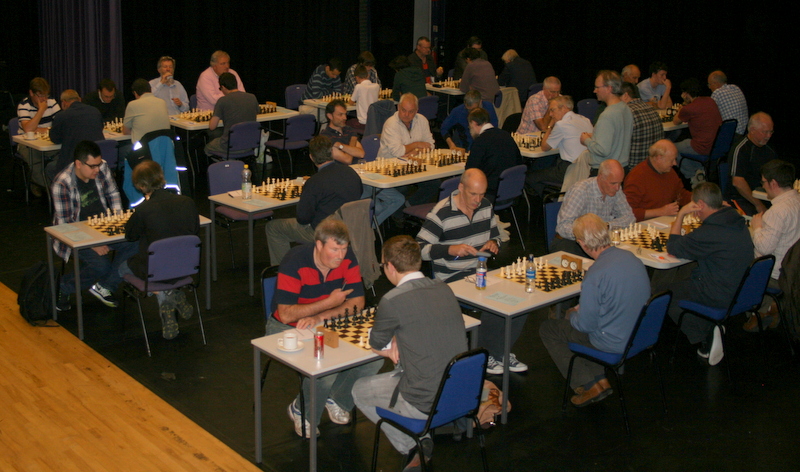
General view of the Open Section - Conway vs Shaw nearest.
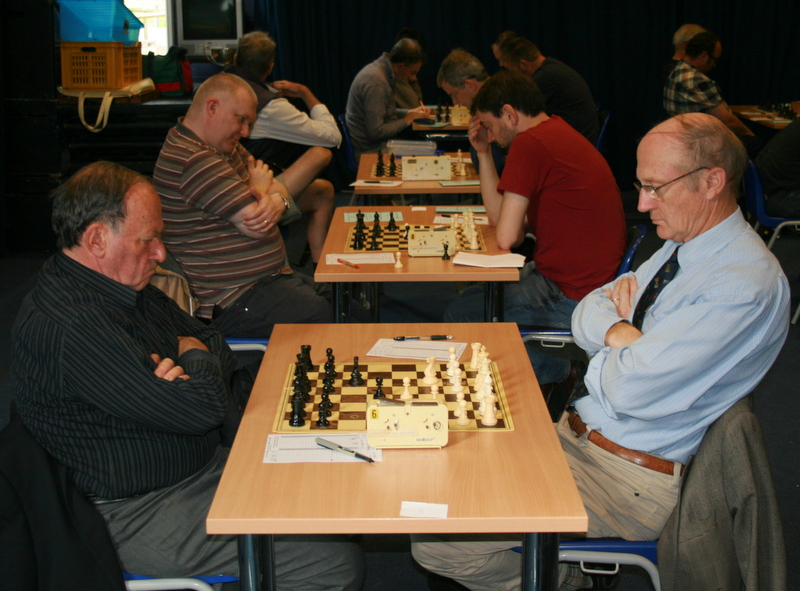
James T. Sherwin vs T. F. Thynne - quite a game in the Graded Section.
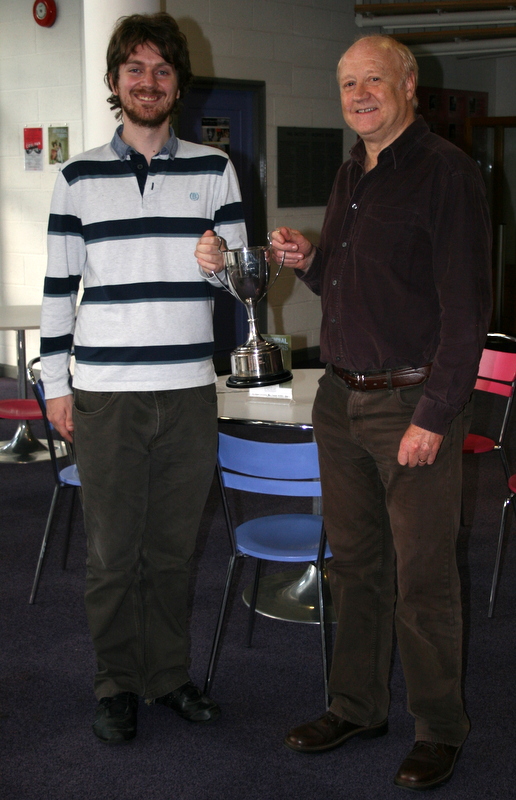
Devon Captain and WECU President elect receives the Jamboree Cup from Organsier Ben Edgell (l)
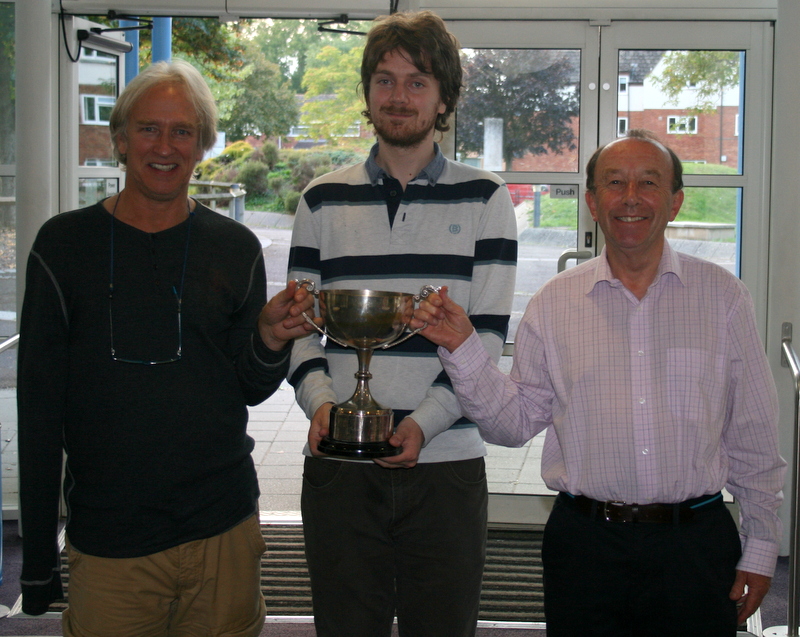
Rob Wilby (l) & Roy Ludlow share the Graded Cup
Paignton Congress 2014 - Final Day (Rd. 7)
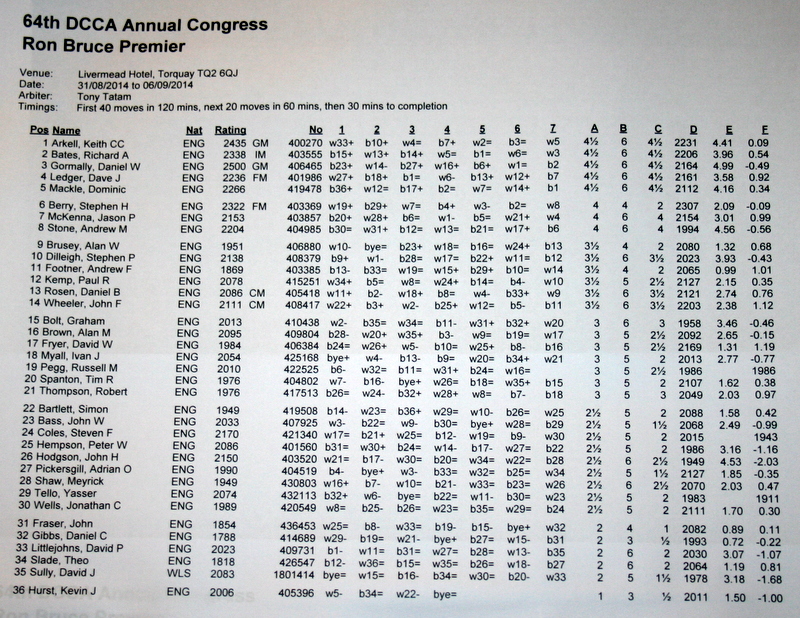
At the start of the final round, there was a tie between the five top-rated players in the Premier Section, - Gormally, Arkell, Ledger, Mackle & Bates - all on 4.5/6. Any one of the 5 could win it outright, while other possibilities included double ties, triple ties or, if they all drew, a 5-way tie. The possibilities ran into double digits, and the only certainty was that would be no quick draws in this round.
The pairings were Arkell vs Mackle; Bates vs Gormally and McKenna vs Ledger. Arkell played an open game and managed at several points in the game to create small threats, forcing Mackle to exchange pieces, and it wasn’t long before an endgame was reached, an aspect of the game in which Arkell is an acknowledged master. With R+2 minor pieces each left on the board, Black at least had some activity, but he chose to exchange off the rooks, after which White had most of the attacking options and Mackle resigned. Arkell could relax as the leader in the clubhouse and watch the other three slug it out. He relaxed even more when Bates and Gormally agreed a draw. This left Ledger fighting for a win in order to share 1st prize. And strive he did as the game went on for hour after hour, finishing long after the room was empty of players. After 6 hours play, McKenna avoided a loss on time at the 2nd time control by seconds, and it went down to R vs R+P. The pawn was on the a-file, protected by K + R and far away from the White king, but McKenna managed to find just enough resources to prevent the queening, so a draw was agreed. Thus Arkell, the Paignton veteran, won his 20th 1st place in the 22 consecutive years he’s entered - doubly pleasing for him.
The second-to-last game to finish was Bd. 1 in the Challengers, where Mike Waddington, who had 6/6 points and had already won the section with a round to spare, was trying very hard to make it a clean sweep. But he was faced by the ever-steady Martin Page who had no intentions of falling in with his plans, and after many hours play, a draw was agreed. Although he failed in his bid for a 100% score, he finished with the highest score by any player in any section.
The full prize list was as follows.
| Ron Bruce Premier | Rating | Pts/7 | £ | ||
| 1st | K. C. Arkell | 2435 | Cheddleton | 5½ | 600 |
| 2nd= | D. W. Gormally | 2500 | Cheddleton | 5 | 150 |
| R. A. Bates | 2338 | Hackney | 5 | 150 | |
| S. H. Berry | 2322 | Wimbledon | 5 | 150 | |
| D. J. Ledger | 2235 | Bedford | 5 | 150 | |
| GPs | |||||
| U-2151 | S. P. Dilleigh | 2138 | Horfield | 4 | 17 |
| A. Brown | 2095 | Northampton | 4 | 17 | |
| P. R. Kemp | 2078 | Linton | 4 | 17 | |
| U-2071 | I. J. Myall | 2054 | Chelmsford | 3½ | 17 |
| G. Bolt | 2013 | Railways London | 3½ | 17 | |
| A. Pickersgill | 1990 | Hastings | 3½ | 17 | |
| U-1981 | A. W. Brusey | 1951 | Teignmouth | 4½ | 25 |
| A. F. Footner | 1869 | Dorchester | 4½ | 25 | |
| 0/2 | T. R. Spanton | 1976 | Hastings | 20 | |
| Rowena Bruce Challengers (U-180) | Grd. | ||||
| 1st | M. P. Waddington | 172 | Dorchester | 6½ | 300 |
| 2nd = | G. Body | 169 | Exeter | 5 | 75 |
| M. C. Page | 163 | Insurance | 5 | 75 | |
| D. A. Patrick | 159 | Courier | 5 | 75 | |
| P. S. Morton | 153 | Hammersmith | 5 | 75 | |
| GPs | |||||
| U-161 | R. Clegg | 160 | Huddersfield | 4 | 25 |
| A. Price | 155 | Leamington | 4 | 25 | |
| U-149 | A. M. Hibbitt | 147 | Banbury | 4 | 25 |
| J. Morgan | 147 | Exeter | 4 | 25 | |
| U-136 | J. Robertson | 123 | E. Kilbride | 4 | 50 |
| 0/2 | A. M. Hibbitt | 147 | Banbury | 4 | 10 |
| J. Morgan | 147 | Exeter | 4 | 10 | |
| Walker Minor (U-130) | |||||
| 1st | R. J. Kearsley | 125 | Wimbledon | 6 | 300 |
| 2nd= | K. R. Alexander | 126 | Seaton | 5½ | 150 |
| R. P. Hamilton | 124 | Metropolitan | 5½ | 150 | |
| GPs | |||||
| U-122 | M. R. Harris | 120 | Colchester | 5 | 50 |
| U-113 | A. R. Fraser | 108 | Beckenham | 3½ | 17 |
| M. Bolan | 107 | Ashtead | 3½ | 17 | |
| S. Thacker | 105 | West Notts | 3½ | 17 | |
| U-104 | R. Burroughs | 86 | Malvern | 4½ | 50 |
| 0/2 | R. G. Waters | 112 | Taunton | 3½ | 20 |
NB: Grading prize winners do not quaify for a prize in a higher section, even though they might have a higher score.
| 5-Rd. AM | Grd | Boniface U-180 | Pts/5 | £ | |
| 1st= | B. G. Gosling | 153 | E. Budleigh/Exmouth | 4 | 150 |
| R. A. Dean | 158 | Undercliffe | 4 | 150 | |
| 3rd= | R. R. Sanders | 178 | Sudbury | 3½ | 60 |
| R. J. Gamble | 161 | Derby | 3½ | 60 | |
| D. A. Patrick | 159 | Courier | 3½ | 60 | |
| B. O’Gorman | 157 | DHSS | 3½ | 60 | |
| A. M. Hibbitt | 147 | On a barge somewhere | 3½ | 60 | |
| U-161 | D. Siddall | 157 | Austin Friars | 3 | 50 |
| U-154 | N. G. Andrews | 157 | York | 3 | 50 |
| U-143 | Ms G. A. Moore | 142 | Southampton | 2½ | 50 |
| 0/2 | M. Adams | 130 | Sidmouth | 1½ | 20 |
| 5-Rd. A.M. | Thynne U-130 | ||||
| 1st | R. J. Nash | 125 | Barnstaple | 4 | 300 |
| 2nd= | J. B. Farrell | 128 | Metropolitan | 4 | 50 |
| A. Collins | 126 | Cowley | 4 | 50 | |
| M. J. Gunn | 126 | Guildford | 4 | 50 | |
| M. R. Harris | 120 | Colchester | 4 | 50 | |
| C. A. Fraser | 113 | West Bridgford | 4 | 50 | |
| Ms. J. Goldsmith | 104 | Harrow | 4 | 50 | |
| U-126 | P. P. Sartain | 123 | Guildford | 2½ | 25 |
| J. E. Dean | 119 | Plymouth | 2½ | 25 | |
| U-119 | P. Harrington | 118 | Blackburn | 2½ | 25 |
| Ms. J. Gardiner | 114 | Hemel Hempstead | 2½ | 25 | |
| U-111 | A. R. Fraser | 105 | Beckenham Bromley | 2½ | 50 |
| 0/2 | J. G. Davis | 128 | Guildford | 2½ | 20 |
The state of play after Rd. 6 in the Premier
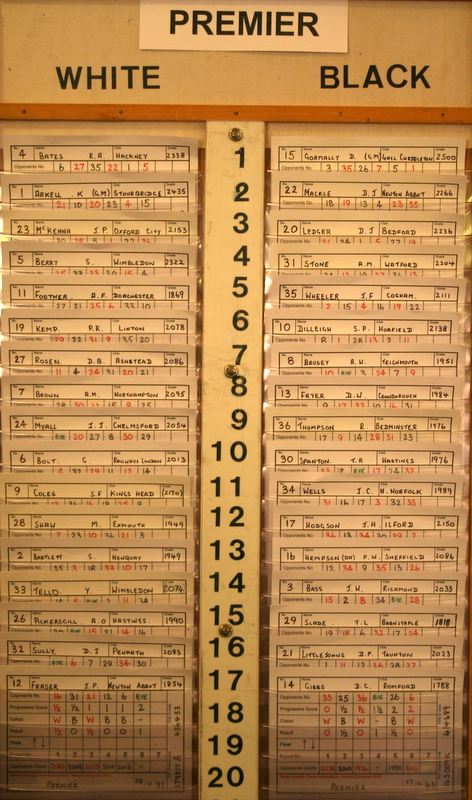
The draw for the final round in the Premier.
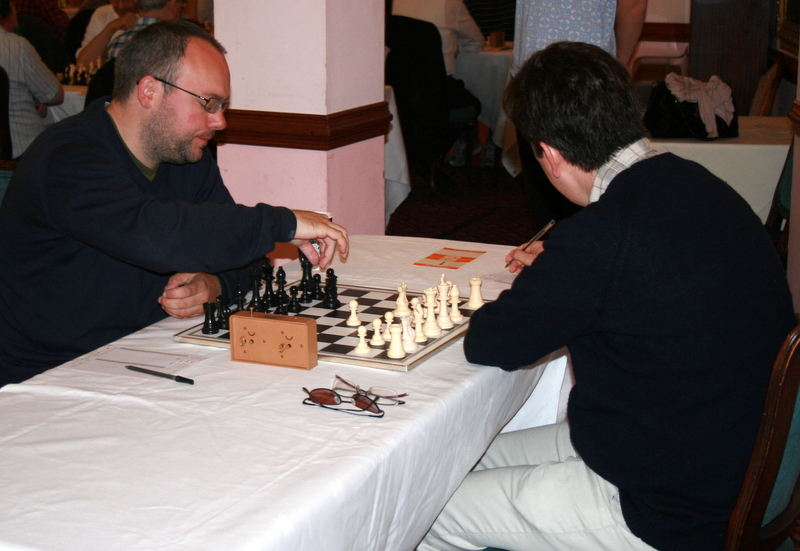
Top board: Bates vs Gormally - destined for a draw.
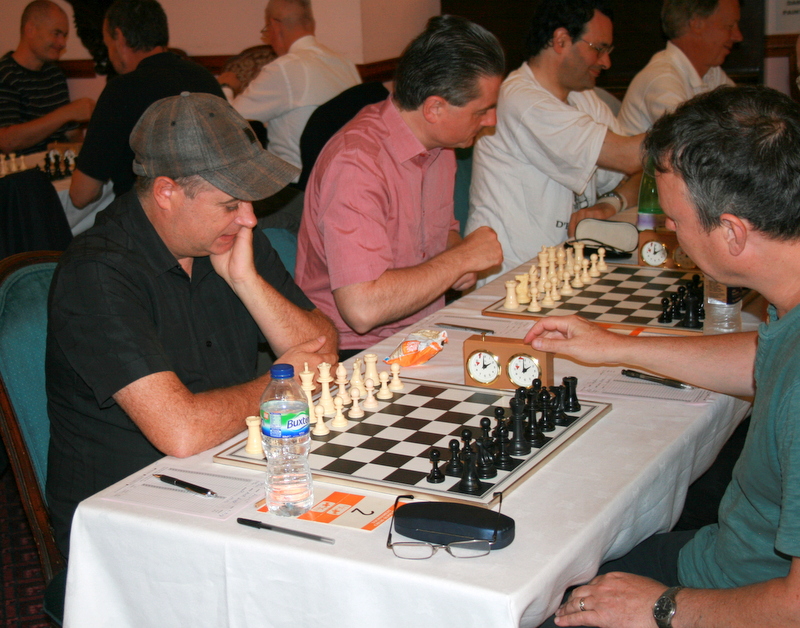
Mackle starts White's clock - game on!
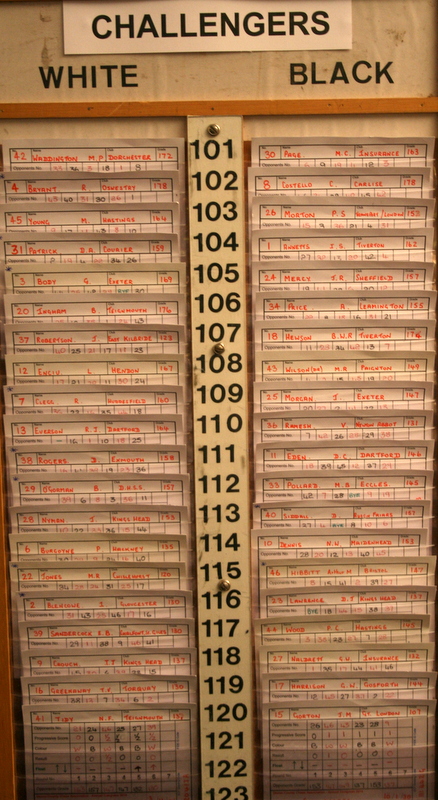
Final round draw for the Challengers.

Mike Waddington, who has already won the Challengers Section, wants to make it a perfect score but is faced by the redoubtable Martin Page.
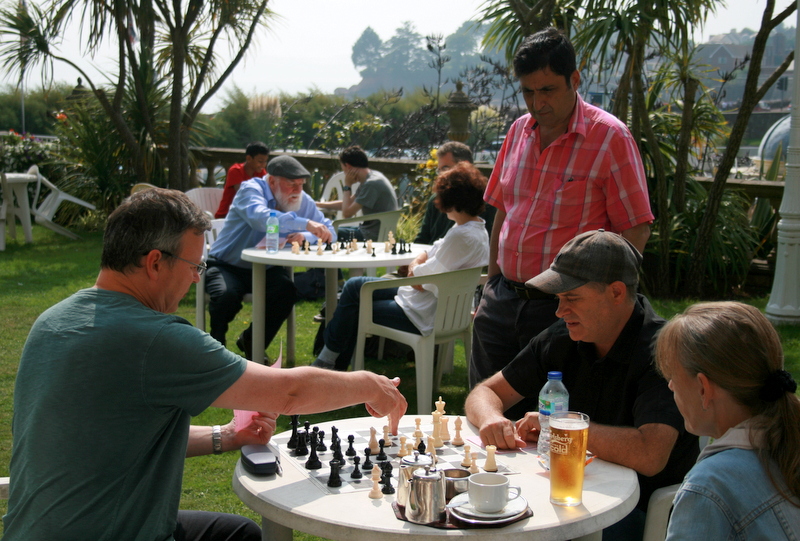
So pleasant is the weather, post-game analysis can be held in the hotel gardens
Paignton Congress - Day 6
| 5-Rd. AM | Boniface U-180 | Pts | £ | ||
| 1st= | B. G. Gosling | 153 | E. Budleigh/Exmouth | 4 | 150 |
| R. A. Dean | 158 | Undercliffe | 4 | 150 | |
| 3rd= | R. R. Sanders | 178 | Sudbury | 3½ | 60 |
| R. J. Gamble | 161 | Derby | 3½ | 60 | |
| D. A. Patrick | 159 | Courier | 3½ | 60 | |
| B. O’Gorman | 157 | DHSS | 3½ | 60 | |
| A. M. Hibbitt | 147 | On a barge somewhere | 3½ | 60 | |
| U-161 | D. Siddall | 157 | Austin Friars | 3 | 50 |
| U-154 | N. G. Andrews | 157 | York | 3 | 50 |
| U-143 | Ms G. A. Moore | 142 | Southampton | 2½ | 50 |
| 0/2 | M. Adams | 130 | Sidmouth | 1½ | 20 |
| 5-Rd. A.M. | Thynne U-130 | ||||
| 1st | R. J. Nash | 125 | Barnstaple | 4 | 300 |
| 2nd= | J. B. Farrell | 128 | Metropolitan | 4 | 50 |
| A. Collins | 126 |
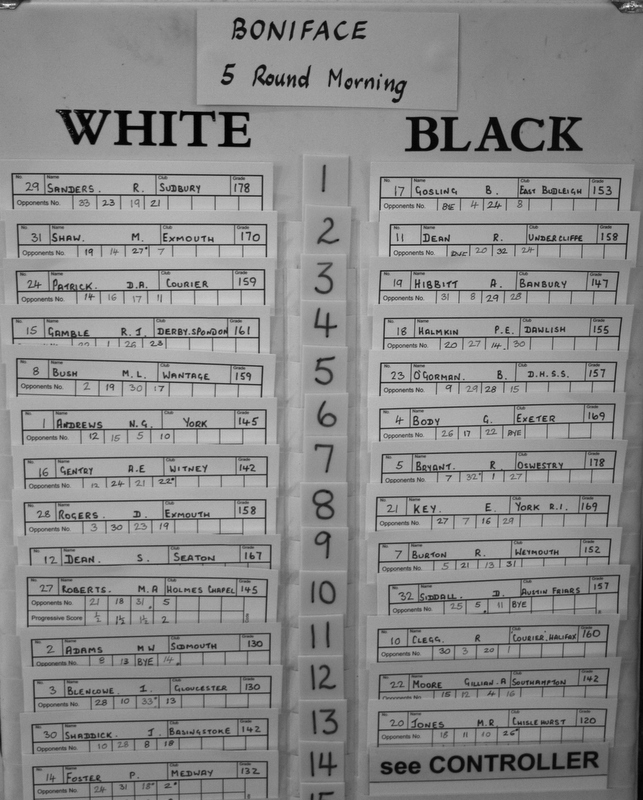
Last Rd. Draw
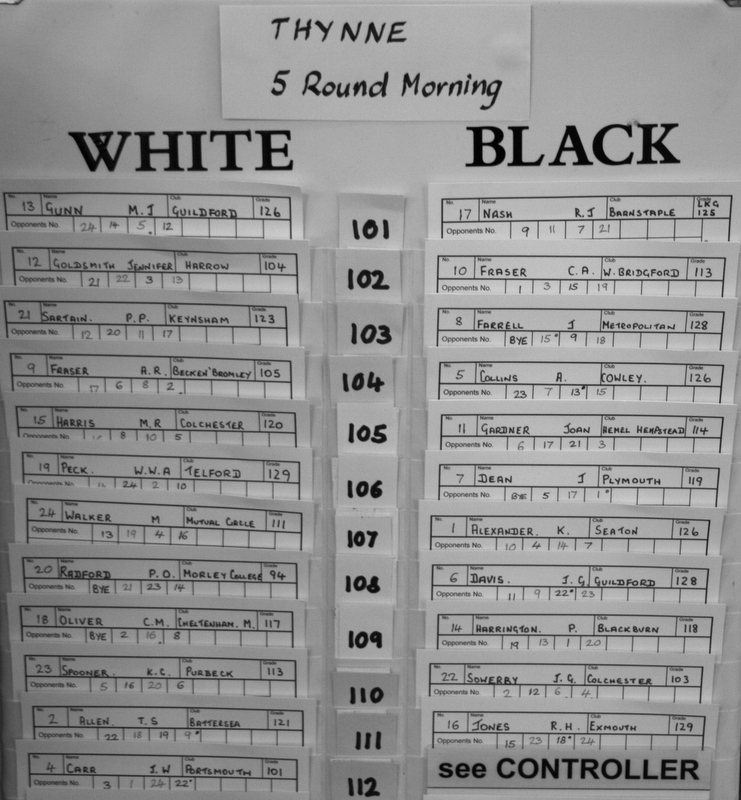
Last Rd. Draw
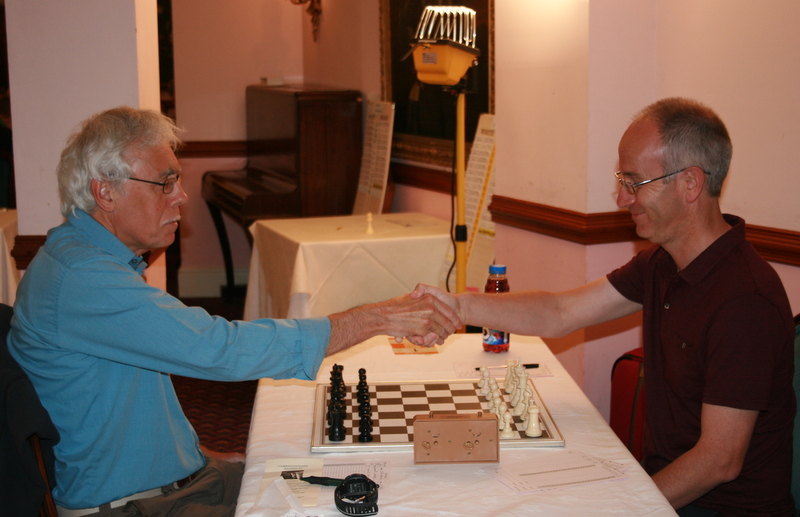
A formal handshake between Dean & Gosling got things under way.
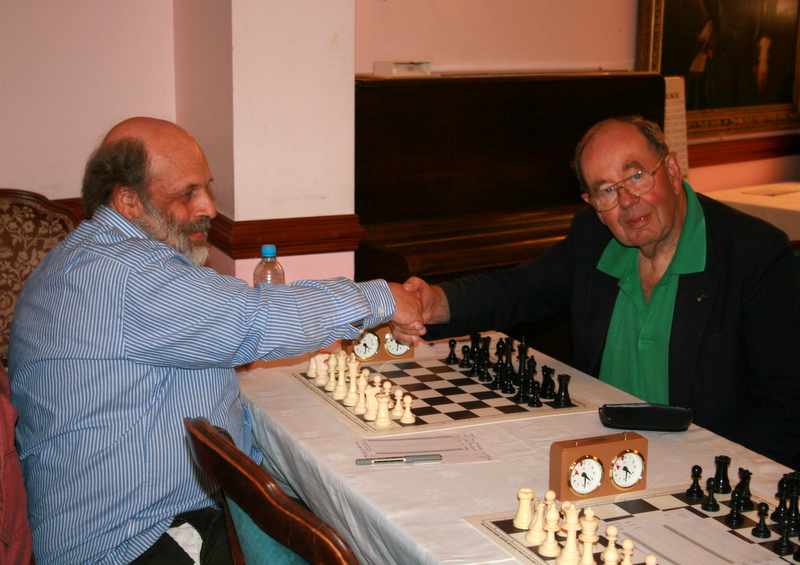
Mike Gunn & Richard Nash start their final game
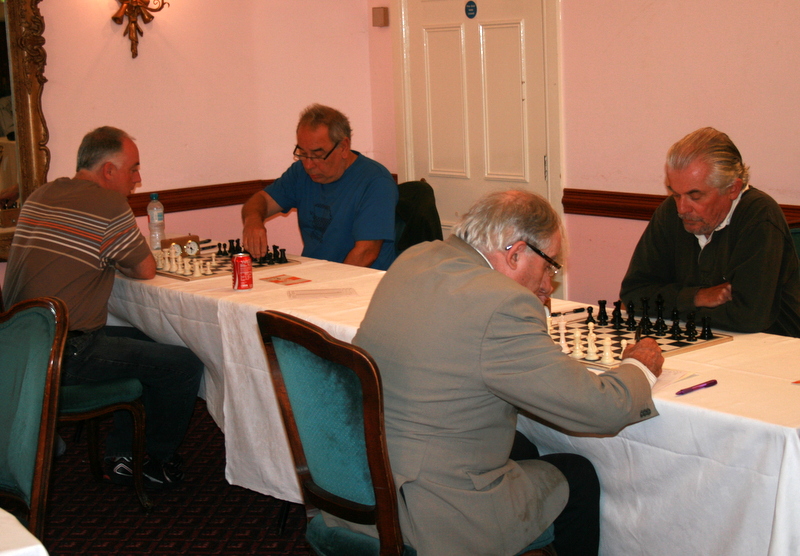
Patrick vs Hibbert (furthest) and Gamble vs Halmkin
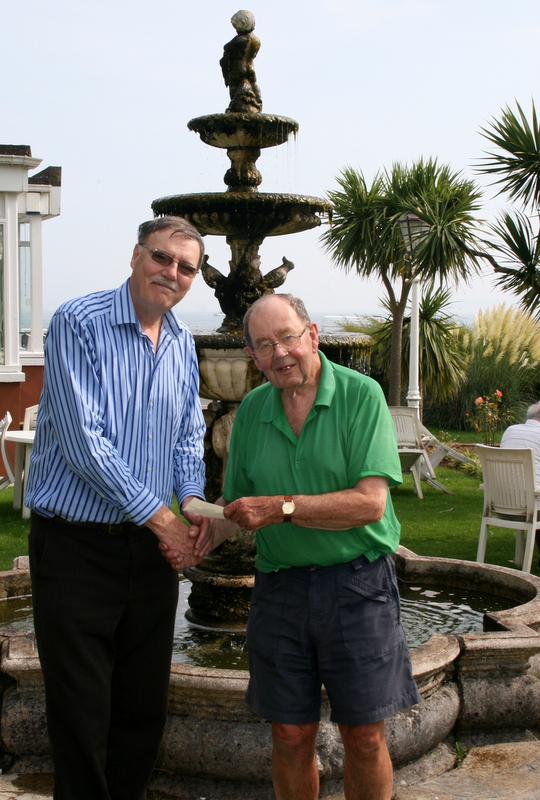
Nash gets his cheque from Congress Organiser, Alan Crickmore.
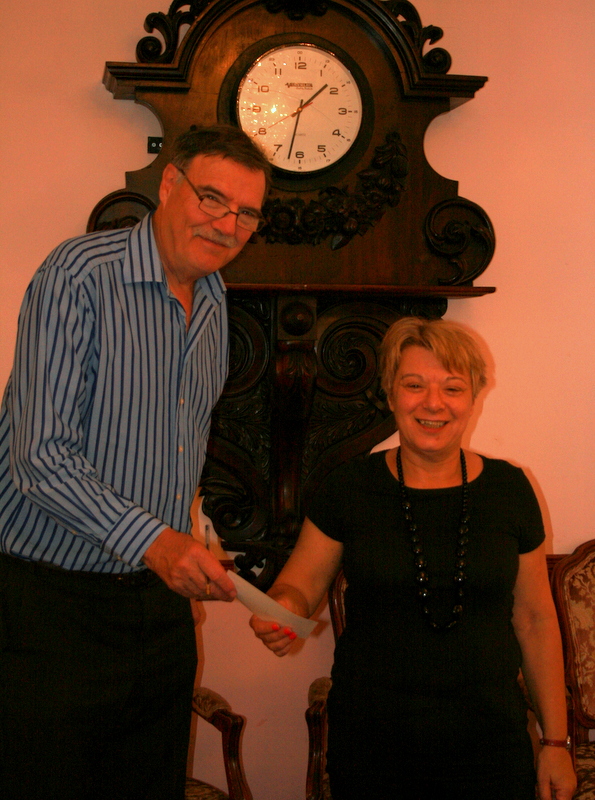
Jennifer Goldsmith collects her prize
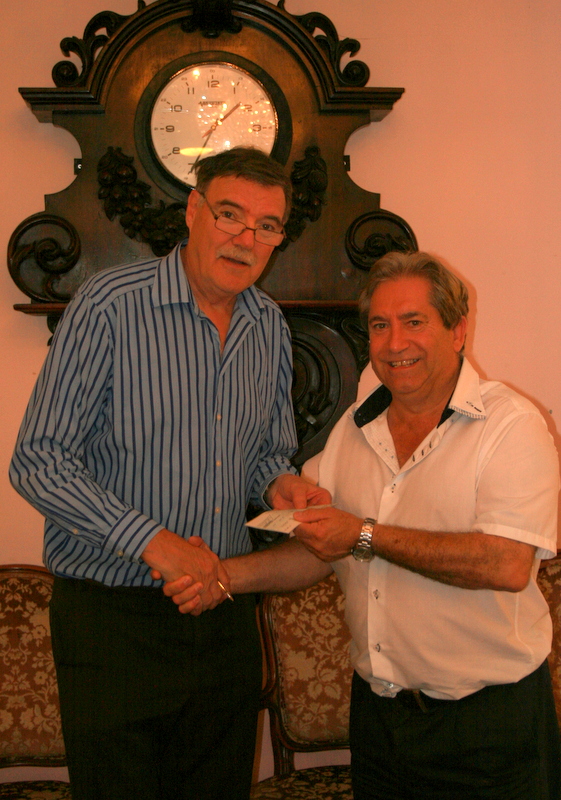
Patrick Sartain collects his cheque.
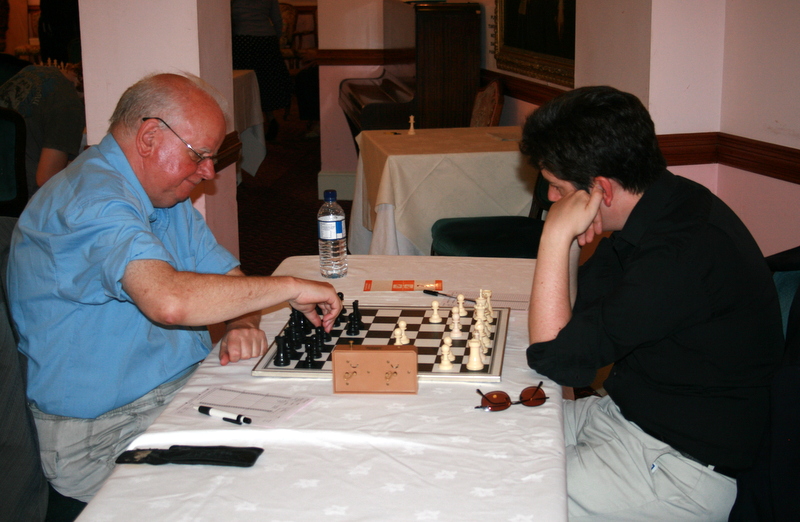
Gormally vs Arkell on their changed table.
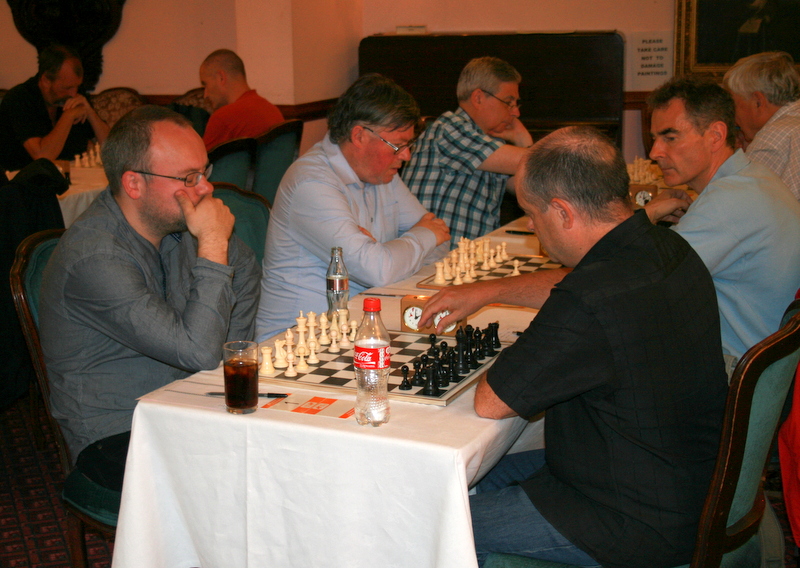
Bates vs Berry in their penultimate game.
Paignton Congress 2014 - Day 5
This is the time when the finishing line starts to beckon for both the 5 Rd. morning sections and the main event in the afternoons.
However, before the serious stuff got under way at 2 p.m. there was an amusing diversion. It has become a little tradition at Paignton that any regular competitor who reaches the grand old age of 90 gets a presentation book. This year it was the turn of John G. Sowerby who passed this particular milestone a few days ago. He had the pick of the bookstall to choose from, and opted for a copy of Arkell’s Odyssey, as he felt it was a bit late in life for him to wrestling with some heavy tome on the openings. He agreed to be present at the start of the afternoon round, even though he was only playing in the mornings. Unknown to him it was arranged that Keith himself should present John with a signed copy, to a round of generous applause. Immediately, then, Keith was himself surprised that it was announced that he had recently won the vote for the ECF’s Player of the Year award, by a country mile - again, to generous applause.
Then the focus was back on John. At the start of play on Tuesday morning, John got him game under way but slowly became aware that all was not well on the board. By move 8 the players realised that John’s king and queen were on the wrong squares. But not before the photographs were taken, and if one looks closely at the final photograph on the previous entry, one can just make this out. Young Theo Slade and his father went to some trouble to crop the picture, blow up the image of John at the board, print off a nice copy and frame it for presentation to him at this moment. A photograph of the three players involved was taken outside shortly after.
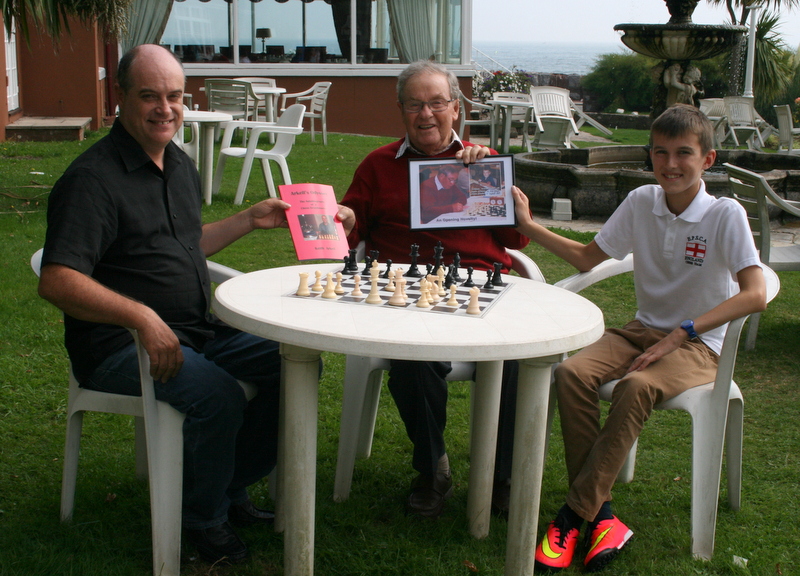
John Sowerby with Keith Arkell (l) and Theo Slade.
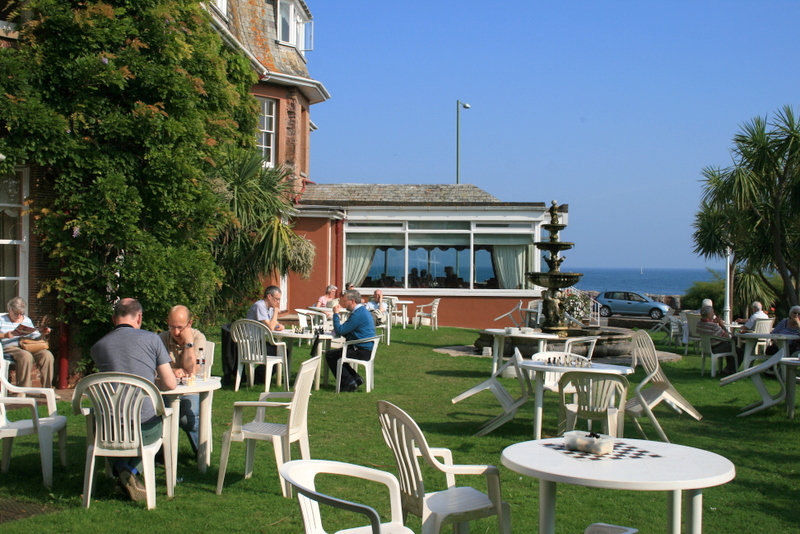
The long-promised better weather finally arrived and allowed post-game analysis to be carried on outside.
Paignton Congress 2014 - Day 2
Monday may be Day 2 of the congress, but it marks the start of the 5 Rd. Morning Tournament. Three factors encouraged the organisers to split the entry into 2 section, for the first time. Firstly, the entry for the morning event has been slowly growing over the years, as some players prefer to get the torture over by midday and have the rest of the day to relax, while others prefer to have two games a day, morning and afternoon. Secondly, the grade ceiling for the morning has gradually been raised, in order to increase the entry, and thirdly, there was a feeling among the lower ranks that they stood little chance of any prize against this stiffer opposition.
Therefore, the Boniface Section went from grades 179 down to 130, while the newly-named Thynne Section was open to all players U-129 and below, and with a £750 prize fund for them alone. This appears to have been a popular move.
However, the shock of the day, if not the congress so far, was found in the afternoon’s Premier, where top seed, Grandmaster Danny Gormally, lost to WECU’s retiring President, John Wheeler. On the adjacent board the other GM, Keith Arkell, was being met with stout resistance from Steve Dilleigh until early evening.

The morning sections get under way. with the Boniface on the right and the Thynne forming the left column.
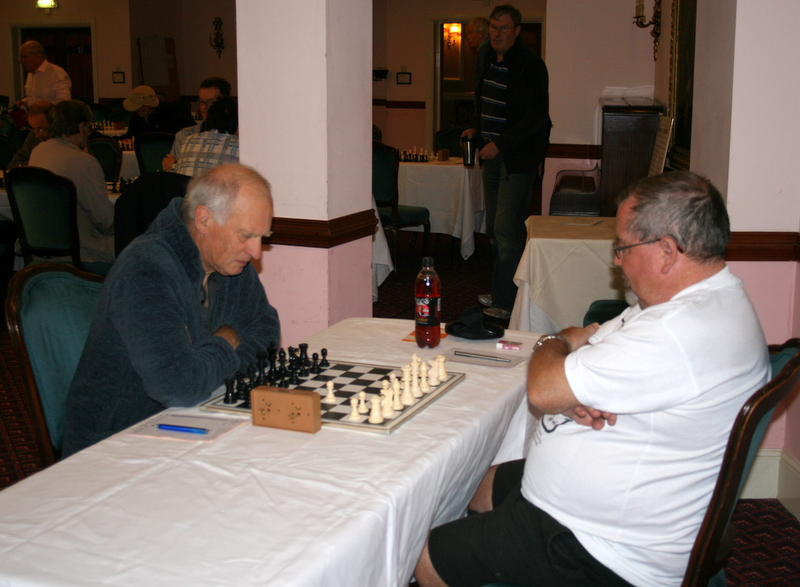
Bd. 1 in the Boniface involved Ronnie Burton (W) vs R. Bryant.
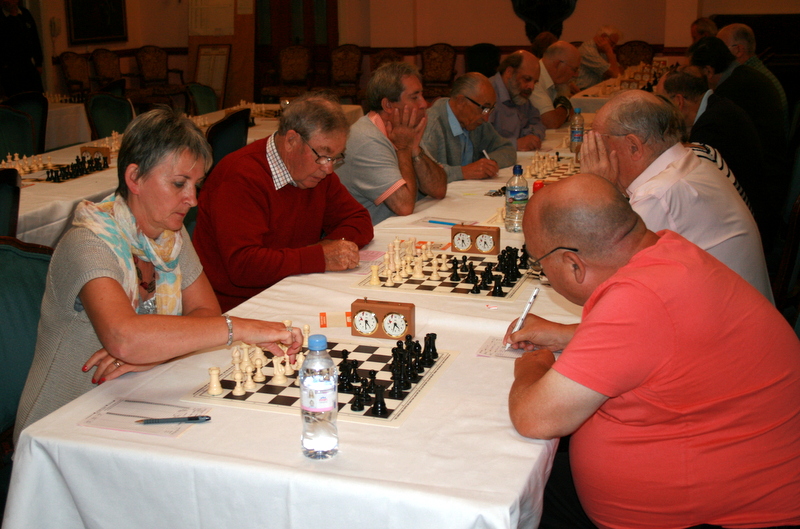
At the lower end of the Thynne Section, Jacquie Barber-Lafon makes an opening move against J. W. Carr, while seated next to 90 year old John Sowerby of Colchester.