Archive for August, 2018
Royal Beacon Seniors Congress 5th - 9th Nov. 2018 - Entries
 August 25th, 2018 |
  Author:
 This is the entry for the Beacon Seniors Congress, as at the date on the chart.
New entries will be added in periodically, as and when they come in.
| Royal Beacon Seniors Congress - 5th – 9th Nov. 2018 | |||||||
| Entries as at Sat. 25th Sept 2018 | |||||||
| Seniors 65+ | Grd | Club | Juniors 50+ | Grd | Club | ||
| 1 | Annetts, Ivor | 150 | Tiverton | Blencowe, Ian | 126 | Wootton Hall | |
| 2 | Egan, Bill | 126 | York | Heppell, Ian | 182 | Wimbledon | |
| 3 | Hurn, Bob | 130 | Caerphilly | Jackson, Paul | 146 | Christchurch | |
| 4 | Lovell, Stan | 127 | Braille C.C. | Errington, Paul | 123 | Bournemouth | |
| 5 | Lucas, Peter | Eastbourne* | Markey, Kevin | 103 | Dursley* | ||
| 6 | Norman, Dinah | 130 | Wokingham* | ||||
| 7 | Norman, Ken | 191 | Wokingham* | ||||
| 8 | Page, Martin | 155 | Insurance | ||||
| 9 | Roberts, Malcolm | 134 | Holmes Chapel | ||||
| 10 | Welch, Hazel | 88 | Seaton | ||||
| 11 | |||||||
| 12 | |||||||
| NB: * = place of residence, not club. | |||||||
MMmmm…. 1,000 down and counting
In the final round of the recent British Championship in Hull, 3-times champion David Howell (2009; 2013 & ’14) was drawn against Luke McShane, and one of them had to win if either was going to try to catch Michael Adams and force a play-off.
White: D. Howell (2687). Black: L. McShane (2669).
Ruy Lopez – Steinitz Defence Deferred. [C72]
1.e4 e5 2.Nf3 Nc6 3.Bb5 This was not the moment to be experimenting with unusual openings in the hope of catching one’s opponent unawares, as it’s always liable to rebound on one’s head, so familiar, well-trodden ground should be safer, in this case the centuries-old Ruy Lopez. 3…a6 4.Ba4 d6 Key move in the Steinitz Defence Deferred, but McShane knows most variations in this opening well and is well-versed in this one. 5.0–0 Bd7 6.d4 exd4 7.Nxd4 Nxd4 8.Bxd7+ Qxd7 9.Qxd4 Nf6 10.Nc3 Be7 11.Bf4 0–0 12.Rad1 Qc6 13.Nd5 Nxd5 14.exd5 Qxc2 15.Rc1 Qf5 16.Rxc7 Attack and… 16…Bf6 counter-attack. 17.Qd2 Rfc8 18.Rfc1 Rxc7 19.Rxc7 Re8 Theatening …20.Qb1+ 21.Qc1 QxQ+ 22.BxQ Re1#. 20.h3 Playing a “safe” opening is all very well, but someone has to get aggressive at some point, and Black takes up the challenge. 20…h5 21.b3 g5 22.Be3 Re5 winning the d-pawn 23.Rxb7 Rxd5 24.Qc1 Be5 Black is now throwing almost everything he’s got at the White king’s position. 25.Rb4 Qd3 Mate alert! 26.f4 Qe2 threatening Rd1 winning the queen, after …Rd1+. 27.Kh2 gxf4 28.Bxf4 Rd2 29.Qc6 Kg7 30.a3 h4 31.Rc4 Qe3! Utilising the pin on White’s bishop. 32.Qe4 Qg3+! 0-1 resigned in view of 33.Bxg3 Bxg3+ 34.Kg1 Rd1+ mate.
In the subsequent play-off, McShane and Adams played 2 games at RapidPlay speed, resulting in 1-all, necessitating another two games at Blitz speed, both of which Adams won. So the £10,000 1st prize went to him, while McShane had to be content with £5,000. But it wasn’t just about the money. However, McShane could be proud of his play under that maximum pressure.
The 68th Paignton Congress starts a week on Sunday, 2nd September, at the Livermead House Hotel, and entry forms can be downloaded, and entries even paid for, at the event website dccapaigntonchess.com.
The solution to the starter problem for the next British Solving Championship has been announced. The best responses were, not unnaturally, from the big national dailies, while those from the Western Morning News were the only ones from any provincial newspaper.
The answer to last week’s problem was 1.f4! and depending on what Black tries, White will have 3 mates available viz. 2.Qb4; Nxb7 or b8=Q.
As this is my 1,000th column I have chosen a 2-mover in the shape of the letter M, the Roman numeral for a thousand, which was composed by Mrs. W. J. Baird née Edith Elina Winter-Wood (1859 – 1924) whose ancestral home was at Hareston in Brixton, near Plymouth.
 Posted in Western Morning News |
  Tags: British Championships 2018, David Howell, Luke, Michael Adams, Mrs. W. J. Baird |
  No Comments »
Saved From Deportation. 18.08.2018. 999
From some of my recent reports, it will have been clear that England currently contains a large number of outstandingly talented junior players who are winning tournaments and championships not only in this country but throughout Europe.
The latest to emerge is 9 year old Shreyas Royal from Woolwich, who is ranked 2nd in the world for his age group, and has represented England in international events. Former British Champion, Chris Ward, said “He is the next Michael Adams or Nigel Short”.
Shreyas came to London aged 3 after his father was granted a permit to work as an IT project manager. This having run its course, the family was due to be deported back to India, but approaches to the Government by top chess officials fell on deaf ears. Immigration minister, Carolyn Nokes, tried to explain that “there is no route, within the rules,” and when it was pointed out that, in a similar situation, she had recently granted a young musician to remain in the UK, she replied that the musician’s application was “within the rules”. In her defence it could be argued that she was overworked trying to cope with, among other things, the “Windrush” fiasco and the Good Friday Agreement.
Quite apart from the chess aspect, there seems little sense in deporting a senior IT project manager when IT is the future.
Then, on Tuesday, when all seemed lost, the Home Secretary, Sajid Javid, overruled Nokes and said Shreyas could apply to have his visa extended.
Here is a win of his from Easter, against a strong former Plymouth College pupil. One has to admire his mature play.
White: Sheyras Royal. Black: Chris Archer-Lock.
1.d4 d5 2.Nf3 e6 3.c4 f5 4.Nc3 Nf6 5.Bg5 c6 6.e3 Be7 7.Bxf6 Bxf6 8.Bd3 Qe7 9.Qb3 Na6 10.a3 dxc4 11.Bxc4 b5 12.Be2 0–0 13.0–0 Nc7 14.Rac1 Bd7 15.Bd3 Kh8 16.Rfd1 Nd5 17.Nxd5 exd5 18.Rc5 f4 19.Re1 Qd6 20.Qc2 g6 21.e4 dxe4 22.Bxe4 Bxd4 23.Nxd4 Qxd4 24.Rd1 Qg7 25.Rxd7 Qxd7 26.Bxc6 Qe7 27.Qc3+ Qg7 28.Qxg7+ Kxg7 29.Bxa8 Rxa8 30.Rxb5 Kf6 31.g3 fxg3 32.hxg3 h5 33.Kg2 a5 34.a4 g5 35.f4 gxf4 36.gxf4 Rg8+ 37.Kf3 h4 38.Rxa5 Rg3+ 39.Kf2 Rg4 40.Kf3 Rg3+ 41.Ke4 h3 42.Rh5 Rb3 43.a5 Kg6 44.Rh4 Rxb2 45.Rxh3 Ra2 46.f5+ Kg7 47.Rh5 Ra4+ 48.Kd3 Kf6 49.a6 Kg7 50.Rg5+ Kf6 51.Rg8 Kxf5 52.Ra8 Ke6 53.a7 1–0
In last week’s position, Adams won by 1.Rh8 inviting Black to take the pawn, though 2.Rh7+ would win the rook and the game.
In 1951, the prolific composer, Kenneth S. Howard of New York, published a collection of 200 of his own problems to illustrate various themes within that genre. To each one he gave the date it was first published and the paper or magazine in which it first saw the light of day. Interestingly, 21 of them first appeared in the Western Morning News, more than any other source in that book, which demonstrates the fine, long-standing tradition this paper has for the art of chess problems. This 2-mover is taken from that book, in the chapter entitled Pinning and unpinning and was first seen here in 1935.
Posted in Western Morning News |
Tags: Carolyn Nokes, Kenneth S. Howard, Sajid Javid, Shreyas Royal |
No Comments »
Adams Wins Again…. but it wasn’t easy!
The final 3 rounds of the British Championship finished with the result most people would have expected, but not without a few twists and turns along the way. In Rd. 7 Adams beat the defending champion, Gawain Jones and thereafter, maybe thinking “job done”, played steadily to get draws against Nick Pert and Danny Gormally. Meanwhile, Luke McShane drew against Hebden in Rd. 7 but finished strongly to beat Fodor and, perhaps surprisingly, former champion David Howell, leaving Adams and McShane tied on 7/9 pts, necessitating a Rapidplay play-off.
Adams won the first game (see this week’s position) and only needed another steady draw to clinch the title. But no; McShane hit back to inflict Adams’ only loss in all the games he’s played in this event since 1989. So, at 1-1 this meant 2 further play-off games had to be played at an even quicker pace - Blitz games, so fast that the computerised board and internet couldn’t keep up with transmitting the moves on screen, but not too fast for Michael who won them both.
This was Michael’s 6th title, having first been champion in 1989 in Plymouth, - the greatest number since Jonathan Penrose won his 10th in 1966. Here is his solitary loss, played at the speed of 20 minutes for all moves, plus an extra 10 seconds per move, which for this game is an average of 18 seconds per move.
White: L. McShane (2669). Black: M. Adams. (2706).
Guioco Pianissimo [C50]
1.e4 e5 2.Nf3 Nc6 3.Bc4 Bc5 Also called the Italian Game. 4.d3 This constitutes the quietest form of this opening. Nf6 5.0–0 0–0 6.h3 h6 7.c3 d6 8.Re1 a6 9.Bb3 Re8 10.Nbd2 Be6 11.Nf1 Bxb3 12.axb3 d5 13.Qe2 Qd7 14.b4 Bf8 15.Ng3 Rad8 16.Kf1 g6 17.Qc2 Re6 18.Qa4 dxe4 19.dxe4 Qd3+ 20.Kg1 Red6 21.Be3 Qc4 22.Rac1 Kh7 23.b3 Qe6 24.c4 R6d7 25.c5 Rd3 26.Rc4 Na7 27.Bc1 Nd7 28.Qa2 Nb8 29.Bd2 Nbc6 30.Nf1 Nb5 31.Ne3 Nbd4 32.Nxd4 Nxd4 33.Bc3 Nb5 34.Bb2 c6 35.Ba1 h5 36.Rc2 Bh6 37.Nc4 Nd4 38.Bxd4 R8xd4 39.Qb2 h4 40.Rce2 Bf4 41.Qc2 Kg7 42.Rf1 Kg8 43.Ree1 Qd7 44.Nd6 Rd2 45.Qc3 R2d3 46.Qc2 Rd2 47.Qb1 Rxb4 48.Nc4 Rd4 49.Rd1 Rb5 50.b4 a5 51.Rxd4 Qxd4 52.Nd6 Trapping Black’s rook. 52…Qxb4 53.Nxb5 Qxc5 54.Nc7 White is now a rook up, but if his 3 connected passed pawns can get moving there may yet be a chance, especially at this speed. 54…b5 55.Rd1 a4 56.Qd3 Bg5 57.Qd7 Qc4 58.Qe8+ Kh7 59.Qxe5 Qc2 60.Rf1 Qd2 61.Ne8 Bh6 62.Nf6+ Kg7 63.Ng4+ Kh7 64.Qf6 Bg7 65.Qxh4+ Kg8 66.Nf6+ Bxf6 67.Qxf6 a3 68.e5 Qc3 Black defends his c-pawn at the expense of allowing the rook to grab the d-file. 69.Rd1 Kh7 70.Rd8 and Black can’t avoid mate on h8. 1–0
In last week’s position, Adams (B) was let off the hook by playing 1…g5+ 2.PxP would lose his queen, so he must play 2…Kh5, but then Black has 2…Qxh3 mate.
Here is the final position from the 1st play-off game against McShane. Adams (W) to move and seal the win.

Posted in Blog, Western Morning News |
Tags: British Chess Championship 2018, Luke McShane, Michael Adams |
No Comments »
Progress in the British (04.08.2018.) 997
The draw for Rd. 1 of the British Championship will keep the Grandmasters apart, as they should be meeting in the later rounds, which gives them an easier chance to get warmed up. However, one player they might not wish to meet in those circumstances is Jack Rudd of Bideford, whose sharp and mercurial style is guaranteed to unsettle and test any of them, as in this game.
White: Ameet Ghasi (2494). Black: Jack Rudd (2244).
1.Nf3 Nf6 2.g3 b5 An unusual early move, but the open b-file later becomes the scene of decisive action. 3.Bg2 Bb7 4.d3 e6 5.0–0 Be7 6.c4 bxc4 7.dxc4 0–0 8.Qc2 White makes a number of move sequences that are easily repulsed and seem to do little to help his overall development. 8…Be4 9.Qd2 c6 10.Nc3 d5 11.Nxe4 Nxe4 12.Qc2 Bf6 13.Nd2 Nxd2 14.Bxd2 Qb6 15.Rab1 Nd7 16.b3 g6 17.e4 Rac8 18.Be3 This bishop continues to flit all over the board to no great effect. 18…d4 19.Bd2 a5 20.Qd1 Be7 21.h4 Bb4 22.Bg5 Rfe8 23.Kh1 f6 24.Bh6 Ne5 25.Bf4 Rcd8 26.Bc1 Its 7th move finds him back on its original square. 26…h5 27.Bh3 d3 28.Be3 Bc5 29.Bxc5 Qxc5 30.f4 Nf7 31.Qd2 Rd4 32.Rbe1 Nd6 33.Bg2 f5 34.e5 Ne4 35.Bxe4 fxe4 Black now has a menacing pair of central passed pawns as opposed to White’s immobile pawns. 36.Re3 Black now needs to break up White’s Q-side pawns. 36…a4 37.Rfe1 axb3 38.axb3 Rb8 39.Rxe4 Rxb3 40.Rxd4 Qxd4 41.f5 Qc3 Black would like to exchange queens, freeing up his advanced pawn. 42.Qf2? Rb2 43.Qe3? Qc2 Resigns, in view of 44.Qg1 Qxc4 45.Qf1 Qd5+ 46.Kg1 gxf5 and Black is totally dominant 0–1.
After 6 of the scheduled 9 rounds the leading pack consisted mostly of the usual suspects, namely 1st= Michael Adams & Gawain Jones 5/6. 3rd= David Howell; Tomas Fodor; David Eggleston; Luke McShane & Mark Hebden. With, at the time of going to press, 3 rounds still to play, and these leaders due to fight it out among themselves, and every likelihood of a play-ff, it’s a question of who can best hold their nerve, but most money will be on either Adams or Jones.
In last week’s position, White won a piece, and with it the game, after 1.Rd7! when Black can’t take it because of 2.Ra8+. He can only defend his rook by 1…Bb6 but then there’s 2.RxR+ BxR and 3.Ra8 pins the bishop which can be taken at leisure next move.
As I wrote last week, Samuel Boden was one of Hull’s master players in the 19th century, and he had a maxim which ran “He who strives to win a drawn game, will invariably lose”. An example of this arose on Tuesday evening at the end of the Rd. 3 game on Bd. 1 between Tomas Fodor (W) and Michael Adams. After being on the back foot for much of the first half of the game, Fodor recovered and himself started pressing, winning a pawn before playing 61.Qe5 to reach this week’s position, probably harbouring thoughts of a win against the top seed, possibly after exchanging queens and utilising his extra pawn. But Boden was right, he had striven too much and resigned next move. Why?
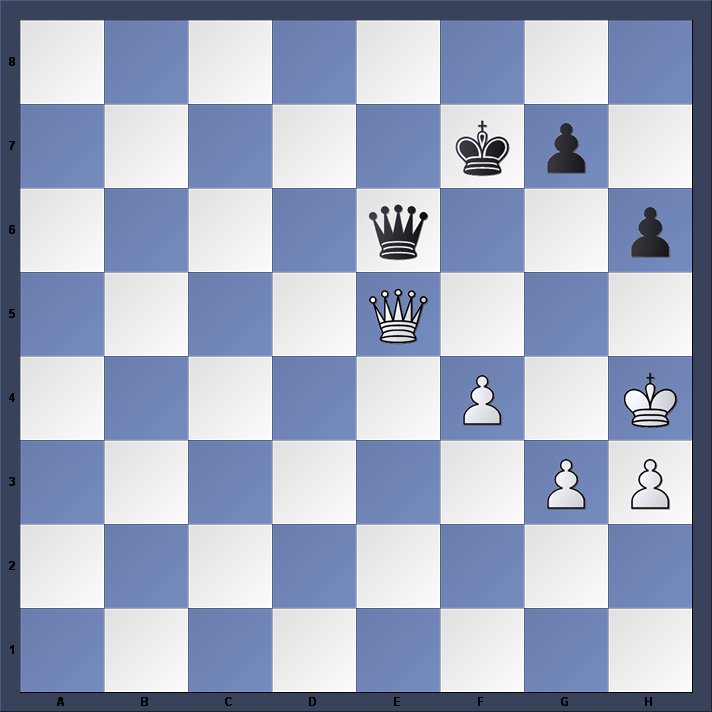
Michael Adams (Black) to win immediately.
Posted in Western Morning News |
Tags: British Chess Championship 2018, Michael Adams |
No Comments »