Archive for the ‘Pioneers of Devon Chess’ Category
Passmore, S. (1864 - 1928)
 January 16th, 2010 |
  Author:
 Samuel Passmore (1864 - 1928)
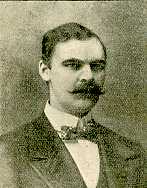
Samuel Passmore was born in 1864 to Edmund and Lydia Passmore. For generations the Passmores had farmed in the parish of Bishop’s Nympton, between South Molton and Witheridge (Comins Mansfield’s birthplace) in the heart of rural mid-Devon. Edmund Passmore ran Mornacott Farm of 520 acres, and was one of the biggest landowners in the area.
Samuel was the 2nd child and first son, but any idea of being thereby a bit special was somewhat diluted as siblings continued to appear at the approximate rate of one every other year, until by 1881 he was one of ten children.
As the eldest son of a landowning farmer, he might have been expected to take over the family estate at some point, but the attraction of the country life were not for him and he decided to move to London, where he could better utilise his talent for music. He moved in 1884 and was part of the great 19th century migration from the countryside to the towns. In 1888 he married Mary Louisa from Uttoxeter, Staffordshire, a year older than him and similarly involved in music.
It was not until 1889 that he knew anything of serious chess, when an acquaintance, Dr. Stephen Francis Smith (1861 – 1928) introduced him to a member of the City of London Chess Club which at that time met the Salutation Hotel in Newgate Street. He played a trial game with the club secretary, George Adamson, who announced that Mr. Passmore “was a very strong player and would be a great acquisition to the club”. The size and strength of his new club may be gauged by the fact that the entry for its winter tournament that year was 144!
After a few weeks he was picked to play against Cambridge University and his draw in the last game to finish sealed a win for the City Club. For the return match the following year, he was promoted to Board 1 and faced a young undergraduate of great promise, H. E. Atkins, and was happy to accept the proffered draw.
He then joined the Athenaeum Club in Camden Road, and played for them regularly in the London League. Of the 50 games he played on top board in his first 5 seasons for them he won 30 and drew 13 and lost only 7. This record led him to be nominated as reserve for the annual cable match between Britain and the USA 1900 – 1903, though he was never called on to play.
In 1900 he played a match against Britain’s second best player after Blackburne, Francis Lee, which he lost; won 3 drawn 2 lost 5. He had a 5 game match against one of the world’s top 10 players, Richard Teichmann (1868 – 1925); won 0; drawn 2; lost 3. In spite of these losses, he notched up wins against most of the country’s top players in match play.
The 1891 census records him as living at No. 9, Fonthill Road, near where the Arsenal football ground was later built in north London, where he was earning, or trying to earn, a living as a teacher of music. Whatever his degree of success at this stage, he was able to supplement his income by having one of his younger brothers as a lodger. This was Herbert Passmore, 20, who was studying to be a vet, and things couldn’t have been too bad financially as Samuel could afford a live-in servant.
Indeed, this formula must have been deemed within the family as being very successful for by 1901, he had moved a short distance to 10, Yerbury Road, and was giving lodging to three more of his unmarried brothers; William, 28, an engineer working for himself; John, 22, a civil servant at the India Office and Leonard, 20, a bank clerk. From their ages and occupations, it looks as if these brothers were not just passing through. Clearly, the attraction of farm life was not strong among the male Passmores, and it could have been an arrangement that suited all parties.
Also, he had become a father to a 6 year old daughter, Christine. Samuel himself was listed as a “Teacher of Music” on his “own account”. If this means his main income was from private tuition it would mean his income would be limited and that his work commitment would be at unsocial times; that is, he worked when others had the leisure to take lessons. So fitting in chess play in the evenings would not necessarily be easy. At this time, one of the leading male singers with the D’Oyly Carte Opera Company was a Walter Passmore, and it is not clear whether there was any connection between the two, or whether they moved in the same musical circles.
Whatever difficulties he may have had in combining work and leisure, he became a leading member of the Athenaeum Club and competed regularly in the City of London Club championship.
His obituary writer recalled him as being “always an opponent to be feared with a fine attacking style”. In trying to gauge his playing strength more accurately, a useful source is the Chessmetrics website of Jeff Sonas, who calculates that Passmore’s best world ranking was in June 1904 when he was ranked No. 48 in the world. His highest rating was gained in January 1904 when, at the age of 42, he reached 2481 (ECF 235)
Unfortunately for him, the best documented tournament in which he took part was that of London 1900 when the City of London Club organised a competition, inviting 6 London-based masters and 6 leading local amateurs, and held at their clubrooms at 7, Grocer’s Hall Court, Poultry.
City of London Invitation Tournament
5th May - 5th June 1900
| 1 | 2 | 3 | 4 | 5 | 6 | 7 | 8 | 9 | 10 | 11 | 12 | 13 | |||
| 1 | Teichmann | X | 1 | ½ | 1 | ½ | 0 | 1 | 1 | ½ | 1 | 1 | 1 | 1 | 9½ |
| 2 | Gunsberg, I | 0 | X | 0 | 1 | 1 | ½ | 1 | 1 | 1 | 1 | 1 | ½ | 1 | 9 |
| 3 | Mason, J. | ½ | 1 | X | ½ | 0 | 1 | 1 | 1 | 1 | 1 | 1 | 1 | 0 | 9 |
| 4 | Ward, W. | 0 | 0 | ½ | X | ½ | 1 | 1 | ½ | 1 | 1 | 1 | 1 | 1 | 8½ |
| 5 | Vleit L. van | ½ | 0 | 1 | ½ | X | 1 | ½ | ½ | 1 | ½ | 1 | ½ | 1 | 8 |
| 6 | Blackburn, J. | 1 | ½ | 0 | 0 | 0 | X | ½ | ½ | 1 | 1 | 1 | 1 | 1 | 7½ |
| 7 | Lawrence, T. F. | 0 | 0 | 0 | 0 | ½ | ½ | X | 1 | 1 | 1 | 0 | 1 | 1 | 6 |
| 8 | Lee, F. J. | 0 | 0 | 0 | ½ | ½ | ½ | 0 | X | 0 | ½ | 1 | 1 | 1 | 5 |
| 9 | Loman, R. J. | ½ | 0 | 0 | 0 | 0 | 0 | 0 | 1 | X | 0 | 1 | 1 | 1 | 4½ |
| 10 | Tietjen, A. E. | 0 | 0 | 0 | 0 | ½ | 0 | 0 | ½ | 1 | X | 0 | 1 | 1 | 4 |
| 11 | Jones E. O. | 0 | 0 | 0 | 0 | 0 | 0 | 1 | 0 | 0 | 1 | X | 1 | ½ | 3½ |
| 12 | Physick, T. | 0 | ½ | 0 | 0 | ½ | 0 | 0 | 0 | 0 | 0 | 0 | X | 1 | 2 |
| 13 | Passmore, S. | 0 | 0 | 1 | 0 | 0 | 0 | 0 | 0 | 0 | 0 | ½ | 0 | X | 1½ |
This event was something of a disaster for him, except that his sole win was against James Mason, depriving him of clear 1st place. This may be an indication of how dangerous an opponent he could be, given half a chance, or how drunk Mason was that day, or both. Playing through the game, Mason certainly seemed to have taken Passmore a little too lightly in their Round 1 game. This early loss seems to have had the double effect of bringing Mason to his senses, and possibly going to Passmore’s head.
That same year he took 8th board in a 50 man S.C.C.U. team against the Northern Counties Union ahead of his fellow Pioneer, Charles Lambert, on Bd. 15.
|
|
S.C.C.U. |
|
|
N.C.C.U. |
| 1 | Gunston, W. H. |
½ |
1½ |
Burn, A |
| 2 | Locock, C. D. |
2 |
0 |
Schott, G. A. |
| 3 | Ward W. |
2 |
0 |
Downey, F. T. |
| 4 | Mills D. Y. |
1½ |
½ |
Spedding, F. E. |
| 5 | Trenchard, H. W. |
1 |
1 |
Wildman, F. P. |
| 6 | Physick, T |
0 |
2 |
Carroll, F. C. |
| 7 | Elwell, F. J. H. |
2 |
0 |
Palmer, W. C. |
| 8 | Passmore, S. |
2 |
0 |
Wilson, J. |
| 9 | Brewer, H |
0 |
2 |
Atkinson, W. |
| 10 | Cheshire, H. F. |
1½ |
½ |
Birks, J. |
| 11 | Tietjen, A. E. |
2 |
0 |
Wallwork, C. H. |
| 12 | Howell, P. |
0 |
2 |
Brunton, W. |
| 13 | Tattersall, C. E. C. |
1½ |
½ |
Woollard, J. A. |
| 14 | Pierce, W. T. |
2 |
0 |
Sergeant, E. G. |
| 15 | Lambert, C. J. |
0 |
2 |
Wright, H. E. |
| (50 boards) |
|
|
Although Charles Lambert had been elected Devon’s match captain at the Association’s A.G.M. in 1903, for some unknown reason he did not take up those duties, and the captaincy was taken over by Henry Bremridge, already the Secretary and Treasurer. He was certainly pro-active in getting players to turn out for Devon, and to this end, established a contact with Passmore in London. For the Devon v Somerset match, planned for Saturday 26th March 1904, Passmore was willing to play but couldn’t get to Taunton. Bremridge got round this by arranging with the Somerset captain that Passmore could play at the City of London Club against H. W. Trenchard, another London-based westcountryman, who was born in the village of Thorncombe, near the point where Devon, Dorset and Somerset all meet. It was evident that Passmore’s pre-eminence was recognised at the time as he played on top board, above Lambert, the County Champion. The top 5 results were as follows:
|
|
Somerset |
|
|
|
Devon |
|
| 1 | H. W. Trenchard | Unattached | ½ | ½ | S. Passmore | Exeter (sic) |
| 2 | H. C. Moore | Bath | ½ | ½ | C. J. Lambert | Exeter |
| 3 | H. Parsons | Bridgwater | 0 | 1 | T. Taylor | Plymouth |
| 4 | Rev. C. F. Bolland | Bridgwater | ½ | ½ | C. Tracey | Exeter |
| 5 | S. Price | unattached | 0 | 1 | H. Maxwell Prideaux | Plymouth |
| 16 boards |
total |
5 | 11 |
The contact at this time extended to Bremridge inviting Passmore to his local Winkleigh Chess Club where he put on a simultaneous display. Passmore’s game with Bremridge from this event is in the Pioneers’ database.
In June 1904 he played an 8 game match against the Pole, Paul Saladin Leonhardt, (1877 - 1934) followed by 2 more games, all of which are in the Pioneers database.
|
|
1 |
2 |
3 |
4 |
5 |
6 |
7 |
8 |
9 |
10 |
Total |
| Passmore | ½ | 0 | 0 | ½ | 1 | 0 | 0 | 0 | ½ | ½ |
3 |
| Leonhardt | ½ | 1 | 1 | ½ | 0 | 1 | 1 | 1 | ½ | ½ |
7 |
Judging by the game scores, something was amiss somewhere along the line, as in Game 3, Leonhardt simply played 1. Nf3 and got the full point. Did Passmore simply fail to turn up? In Game 8, Passmore played 3.Bb5 in a Ruy Lopez, and his opponent was then awarded the full point. In game 10, there are actually no moves at all, yet a draw was recorded. What was going on? Have the actual moves played been lost over time, or were some other irregularities involved?
By 1911, both he and his wife Mary, now approaching their Silver Wedding, were listed in the census as “Professors of Music”, both working on their “own account from home”. Their eldest daughter, Christine Mary, now 16 was a music student, and Margaret Lydia was 9. They had moved to 30, Anson Road, Tufnell Park, North London, and had been joined by Samuel’s father, Edmund, 74 and now widowed.
If his job as music teacher possibly affected the amount of time he could devote to club chess, he was further distracted from the classical game when he became attracted to the chess variant Kriegspiel. This was developed by his exact contemporary, Michael Henry Temple (1862 - 1928), who introduced it at the Knight Lights Club, held in the Cock Tavern, Fleet Street, London in 1898.
In this version of the game, each player has sight of their own board but not their opponent’s and there is a referee with a third board and sight of the other two. Neither player knows what their opponent has played and tries to construct a game. The referee will say if a proposed move is illegal.
Complex though it sounds, it was immediately popular with many famous players dabbling in it, Lasker, Marshall and Kashdan included. BCM and the new Chess Amateur magazines both devoted space to the game, and it appears that Passmore was also smitten, and his obituarist remarked on his skill. A regular kriegspiel circle was formed at the Gambit Chess Rooms and this is where Passmore was involved.
His health suffered greatly in his final years and he died in a nursing home in Epsom, Surrey, on Christmas Day 1928, after a long illness, at the age of 64.
In his book Chess Personalia, Gaige reports Passmore’s birthplace as “St. Thomas”, which probably refers to that part of Exeter, but from 19th century census returns we know this is incorrect. For the Devon v Somerset match in 1904, he was listed as “Exeter”, which may simply refer to a notional club subscription having been paid to allow him to play for Devon. Also, some of the older members of the Exeter Chess Club remember in the1950s two middle-aged Miss Passmores, who were talented and somewhat eccentric. Richard Hitchcock recalls them thus… “Perhaps the most singular member I recall was Miss Jane Passmore. Her sister, Katie, was reputedly a stronger player had also been a member of the club. Miss Passmore would walk from her home in St. Leonards, was never without her floral hat which she wore indoors and out, and she was partial to Queen sacrifices.”
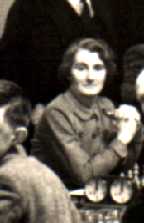
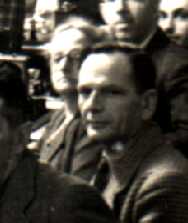
Could these have been related to him? The name, age, location and ability all fit. Did Passmore have some specific connection with Exeter?
The pictures on the left show the Passmore sisters playing at the West of England Congress at Newquay in 1951. The younger one appears full face, while the older one can just be seen behind a male neighbour. For them to have travelled from Exeter to Newquay in those days indicates more than a passing interest in the game. Samuel’s first child was born in 1895, which would have made her 56 at this time.
If Passmore had remained in Devon he might have been much more involved in the creation and early years of the DCCA, although it could be argued that it was only his move to London that uncovered the true extent of his ability. He was undoubtedly a well-respected attacking player, but his predilection for risky play, blitz chess and chess variants, probably took the edge off his tournament results. Whatever the truth of this, he was the strongest Devon-born player of his day and fully deserves his place among our Pioneers.
(c) R. H. Jones - 2010
Bibliography:
Sergeant, P. W: A Century of British Chess Hutchinson 1934
Gaige, J: Chess Personalia McFarland 1987
Forster, R: Amos Burn McFarland 2004
Regis, D. 100-Odd Years of Exeter Chess Club 1998
Pritchard, D: The Encyclopaedia of Chess Variants Games & Puzzles 1994
Various 19th century directories for Devon - e.g. Kelly’s and White’s
Contemporary newspaper accounts at the Devon & Exeter Institute.
British Chess Magazine.
Prideaux, H. Maxwell (1857-1925)
Henry Maxwell Prideaux (1857 - 1925) 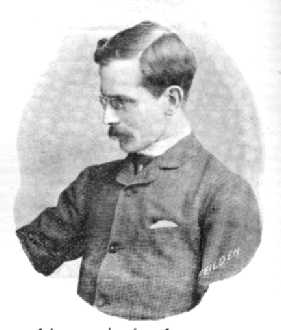
H. Maxwell Prideaux, as he became known, was recorded as having been born on 14th October, 1857, at Westbrook near Plymouth. No settlement with that name can be found on any general map, but it may have been a large house or estate in the Holbeton area of the South Hams. His father, Henry, had been born in 1810 to Walter and Sarah (née Hingston). The Hingstons had been resident in Kingsbridge since at least 1600. The Prideaux family were a well-established Devon clan who had been strong Parliamentarians in the Civil War.
Henry Prideaux had married Agnes Maxwell Morris and they had our Pioneer, ensuring that he carried his mother’s family name of Maxwell. This puts her in line with the Maxwell family of Devon who, in the 20th century, produced several war heroes, and then became the Maxwell-Hyslops, one of whose sons, Robin, (1931 - 2010) became Member of Parliament for Tiverton. This goes some way to explain why our Pioneer reduced the Henry part of his name to an initial, preferring the Maxwell connection.
He acquired a fondness for the game in his early 20s, but with no opposition nearby, was forced, like so many in rural Britain in the 19th century, to concentrate on solving problems. He moved on to composition, and his strength was in 4-movers, many of them involving a solitary Black King. Most were published in the Morning Post.
Unfortunately for him, the opportunities for over the board chess were growing quickly at the same time and chess addicts had increasingly less time for these complicated problems. So his best work was often under-appreciated, then as now. Also, as his opportunities for actually playing increased, he devoted less and less time to composition, with the result that the quantity of his body of work does not match its quality - not the worst of faults, though.
In fact, there are records of him playing on a high board for Gloucestershire in the 1890s. For example, on 14th April, 1898 he played on Bd. 8 for Gloucestershire against Somerset. On this occasion, the 1st Women’s World Champion, Mary Rudge, played next to him on Bd. 7. It was noted at the time that of the 20 Gloucestershire players, all but 2 lived in Bristol, and of the Somerset players all but 2 lived 5 miles away in Bath. As the two non-Bristolians were named in the match report, we can deduce that Prideaux was a Bristol resident at this time. On 9th March 1901 he played against Wiltshire on Bd. 5. There is no absolute proof to hand that it was he, though the number of chess-playing H. M. Prideauxs in the westcountry in 1901 must be sufficiently limited to make it almost certain it was our Pioneer.
Kelly’s Directory for 1919 shows him as living at Holcome Rogus, near the M5 where it cuts through the Blackdown Hills. His house was called appropriately, “Bluehills”.
He was a solicitor by profession, but gave that up early, saying he knew more about music, books and chess than the law. He wrote several learned articles that appeared in the magazine Notes & Queries. The books in his extensive library bore the family motto, “Toujours prêt” - always ready.
He spent the last few years of his life in Exeter and died there aged 68 on 14th November 1925 at his home, 20, Pennsylvania Road. He had been a fully paid-up Member of the DCCA (12½ p p.a.) for a number of years up to time of his death.
© R. H. Jones 2010
Bibliography:
Gittins, F. R. The Chess Bouquet. Feilden 1897
Gaige, J: Chess Personalia McFarland 1987
Kelly’s Directory for Devon & Cornwall 1919
Post Office Directories of Exeter held at the Devon & Exeter Institute.
Mansfield, C (1896-1984)
Comins Mansfield.
(14th June 1896 - 28th March 1984)
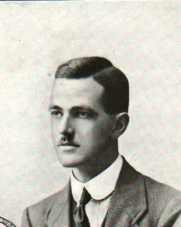
Mansfield in his mid-20s at the height of his playing and composing powers.
Asked who was the first Briton to be awarded the FIDE title Grandmaster, most people, if they had any idea at all, would probably guess Tony Miles. Yet Mansfield had been awarded the title 4 years earlier in 1972, almost as soon as FIDE broadened their title range to include problem composition, firstly to Master level and then later to GM. So eminent was he in this field that Mansfield was an almost automatic first choice.
Comins Mansfield was born on 14th June 1896, in the village of Witheridge, a few miles from Tiverton in mid-Devon, the son of Herbert John Mansfield. In his childhood, Herbert had been looked after by a Miss Comins, and named his son after her. Strangely, although his date and place of birth are recorded in all the literature, the family does not appear anywhere in the 1901 census.
From the age of 13, Comins attended Blundell’s School in Tiverton, during which time he began to absorb his father’s interest in the game. Herbert had played correspondence chess for Devon from an early stage. In 1910, for instance, he took Board 49 of 50 for Devon v Yorkshire, where he was listed as living at Morchard Bishop, 5 miles south west of Witheridge. Incidentally, at the same time, Devon was involved in another 50 board match against Suffolk, half of that team not being involved in the Yorkshire match; i.e. 75 Devonians were playing postal chess for Devon at the same time. In the 1920s Herbert was paying his annual subscription of 52p to be one of the 21 Vice Presidents of the County Association.
Like many Devonians living in rural parts at this time, opportunities for over-the-board play were rare and many were forced to turn their attention to problem-solving, and for the keener ones, to composition. If his father was limited to solving and postal chess, his son’s innate ability pushed him into composition while still at school. He saved his pocket money to buy the BCM and in 1910 they ran a series of articles by Alain C. White under the heading First Steps In The Classification of Two-Movers. One particular article, containing problems by Laws, Bettman, Taverner and Mackenzie, caught the imagination of the 14 year old Comins, and he was inspired to try his hand at composition.
Within months, he had won 1st Prize for a 2-mover in Carslake Winter-Wood’s column in the Plymouth-based the Illustrated Western Weekly News. (His column in the Western Morning News had been transferred there in March 1906). The following year Comins won a 2nd Prize in the Brisbane Courier, fame for the 17 year old having rapidly become world-wide.
From the first, he was interested only in 2-movers, saying life was too short for anything more. He invented the term “half-pin”, first used in a letter of 1915 to fellow composer, Murray Marble, a term that has subsequently entered mainstream chess from problem terminology. By half-pin is meant an arrangement where two Black pieces stand in line in such a way that if either moves, it leaves the other pinned by a White piece standing behind both.
He sent his compositions to wherever competitions were held, one outlet being the Hampshire Telegraph & Post, where Guy Wills Chandler was the chess editor, although only seven years older than Mansfield. They inspired each other and became life-long friends, both surviving to the early 1980s. It is a matter of conjecture whether Chandler was connected in some way with the Wills tobacco business, giving the couple even more common ground. For, on leaving school, he joined the tobacco firm of W. D. & H. O. Wills in Bristol, with whom he stayed for 45 years, with a break for service in the Great War. In 1901 the Wills firm had become the founder of the giant Imperial Tobacco when it merged with the Glasgow firm of Stephen Mitchel & Son, and they were noted as a family-run company with a benevolent policy towards its employees.
In September 1915 he joined the Royal Artillery, and carried a small travelling set at all times, with which to while away the long hours spent in the trenches. He never lost contact with Chandler during the war, even though the latter was involved in a rather messy British invasion of Iraq, (then Mesopotamia), and the two combined on problems by post, one of which won 1st Prize in the Good Companions magazine in January 1918. Shortly after, he was temporarily blinded by mustard gas, requiring 12 months in hospital.
On his release from hospital, the war was over and he re-joined Wills in Bristol and his local chess club, Bristol & Clifton. His skill over the board should not be overlooked - he soon became established in Gloucestershire as a very strong player, winning his club championship for the first time in 1920 and the county championship continuously from 1927 - 34. From his return to Bristol he played for the county regularly, never lower than Bd. 3 and from the time of his first county championship, always on top board. From 1926 to the time of his move to Scotland he was also the Problem Editor of the Bristol Times and Mirror .
During this time he got married and had three children.
His last game for Gloucestershire was against Norfolk in March 1934, as later that year he transferred to the Wills branch in Glasgow. Problem production dried up for a few months, but early in 1936 they started appearing again in publications, headed “Mansfield - Glasgow”. Soon after his move, he played for Glasgow on Board 3, behind the soon-to-be British Champion, W. A. Fairhurst, but there is little evidence that he played much in Scotland.
The significance of this period in his life was intensified by a decision of the unofficial lord of the problem world, the American millionaire, Alain C. White. He had the finances to fund a private publication each year, which became known as The Christmas Series. He underwrote the printing costs and gave copies to his friends. He did this for 32 years until he decided to make the 1936 edition the last of the series. For this special book, he chose to concentrate on the work of Mansfield, entitling the book A Genius Of The Two-Mover. In his introduction, White describes how for about 20 years, one of Mansfield’s tasks for the New Year had been to send him all his compositions from the previous 12 months, usually between 10 and 20 in number, altogether about 300 by that time, which White cut down to 100 for inclusion in his book.
White’s other remarks included:-
“Comins Mansfield celebrated his 40th birthday last June, and in his quarter century of composition he has never lost the extraordinary spontaneity he revealed in his earliest masterpieces . The key-note of his style lies in this freshness of outlook and in a clarity of vision with which few composers have been gifted”…
He also quotes from Brian Harley, “The general opinion, with which I concur, is that no greater two-move composer than Comins Mansfield has existed”.
After this, it would not have been surprising if Mansfield had, perhaps, run out of gas or rested on his many laurels. Certainly, his time in Scotland seems to have coincided with a lessening of chess activity, for whatever reason. The war years would doubtless have had a bearing on this. In 1944, A. C. White published Mansfield’s Adventures In Composition -The Art of the Two Move Chess Problem, using Frank Altschul’s private press, the Overbrook Press, in an edition limited to 400 copies. Four years later, it was re-published in the UK by Barry Wood’s Chess. Mansfield used about 100 problems, none found in White’s 1936 book, and it is regarded as an excellent guide to the art of composing.
By 1950, he had moved to one of Wills’ London subsidiaries, and was living in Carshalton Beeches, near Croydon in South London.
It can be deduced that he retired about 1960, and moved to Paignton in his home county. Now free to budget his own time, he was able to become involved in international affairs, and honours were heaped upon him in his twilight years. In 1959, he was awarded FIDE’s title of Master for Chess Composition as soon as the title was created. In 1963, he became President of FIDE’s Problem Commission. In 1964 he took over as chess columnist of the Sunday Telegraph, a post he held for 14 years. In 1972, FIDE approved the plan to extend the Grandmaster title to problem composers, and Mansfield was an automatic first choice. In 1976 he was awarded the MBE for his services to chess.
In the early 1970s, he could be found visiting the Paignton Congress, walking round watching play, especially in 1972, that of his grandson, R. Mansfield, who was playing in the Open Swiss. Bill Frost, the Congress Secretary at the time, recalls chatting to him from time to time, but as he was a very quiet, reserved man, too modest to dwell on his own achievements for long, these were fairly brief moments. On one occasion, a very young John Nunn and Michael Stean saw Bill talking to Mansfield and asked to be introduced. As Bill took them over, it was as if they were being introduced to the Pope, and after a 10 minute chat they thanked Bill effusively. The moment was certainly not lost on Nunn who went on to become one of the world’s best solvers, becoming only the 3rd person to hold two Grandmaster titles, for playing and solving.
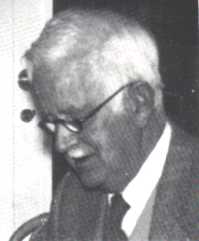
At Paignton, Mansfield seemed to know Milner-Barry quite well, but Golombek kept his distance. It is noticeable that Golombek’s Encyclopaedia of Chess (Batsford 1977) is almost unique of its kind in containing no individual entry for Mansfield; even a long 3½ page article on the history of chess problems, which mentions numerous half-forgotten composers, contains no reference to him. This is surely no oversight and must be interpreted as some kind of inexplicable snub.
Comins Mansfield died on 27th March 1984, aged 87, for most of his life almost universally recognised as one of the world’s three best composers of all time, and surely the most eminent of all our Devon Pioneers.
© R. H. Jones 2010
Bibliography:
Gaige, J: Chess Personalia McFarland 1987
Watts, W. H: Chess Pie No. 1 Printing Craft 1922
White, A. C: A Genius Of The Two-Mover Chess Amateur 1936
Botterill, G (ed.) British Chess Pergamon 1983
Sunnucks, A: The Encyclopaedia of Chess Hale 1970
Divinsky N: Chess Encyclopaedia Batsford 1990
Hooper & Whyld: Oxford Companion To Chess OUP 1992
Mansfield: Adventures In Composition Chess 1948
 Posted in Pioneers of Devon Chess |
  Tags: chess, chess problems, Comins Mansfield, Devon |
  No Comments »
Mallison, H. V. (1897 - 1980)
Harold Vincent Mallison
11th Dec. 1897 -18 th May 1980.
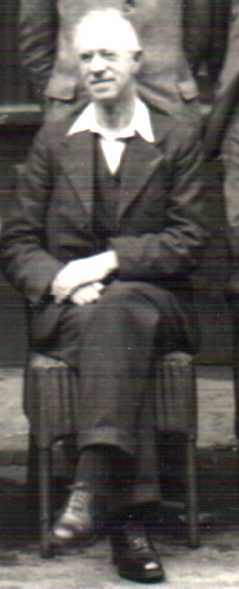
Mallison aged c. 50
Harold Mallison was born in Leicester in 1897, the eldest child of George Robert Preston Mallison, a tailor’s cutter, and his wife Anne Wilks Mallison. In 1901 they lived at 49, Loughborough Road, and had two other children, Wilfred Gordon and baby Lillian Anne. At that time George was 33 and his wife 30.
Tragedy struck shortly after when their mother died in 1904, leaving three children under 7. One of George’s unmarried sisters came to look after them, but she was a somewhat stern character and the children’s home life was less than convivial. In fact, Wilfred was so keen to leave home that he lied about his age in order to join up and fight in the Great War. After taking a B.Sc in Mathematics from London University Harold also joined up, and both were badly injured, Harold receiving shrapnel wounds which temporarily blinded him, and left his sight permanently at risk.
After the war, Harold went up to Cambridge University where he spent a year taking an M.A. In the 1920 Varsity Match, he played on Bd. 2 below Lionel Penrose, the father of Jonathan, future many times British Champion, and Oliver.
| Oxford | Cambridge | |||||
| 1 | C H. Tylor | Balliol | 0 | 1 | L. S. Penrose | St. John’s |
| 2 | H G. Rhodes | New | ½ | H. V. Mallison | Trinity | |
| 3 | H R.Bigelow | Balliol | ½ | ½ | J. H. Barnes | St. John’s |
| 4 | D M. Morrah | New | 0 | 1 | C.M. Precious | St. John’s |
| 5 | T A. Staynes | Brasenose | ½ | ½ | N. H. Smith | Caius |
| 6 | H T. Burt | Balliol | 1 | 0 | M. H. A. Newman | St. John’s |
| 7 | E. S. Woodley | St. Edmund’s | 1 | 0 | W. J. Chalk | Queen’s |
| 3½ | 3½ |
The Cambridge University Championship that year consisted of two 7 man American sections, with a final between the two section winners. In Mallison’s section was Penrose, A. A. Marls, C. M. Precious. C. Rister and R. H. Thouless, all of whom he beat, and J. H. Barnes against whom he lost. finishing on 5/6. Barnes and Penrose were equal 2″d, half a point behind, mainly through earlier having agreed a draw after just one move. The other section was won by N. H. Smith. Mallison beat him in the final after 56 moves, becoming University Champion 1920. All the games were played without clocks.
At Cambridge, he began his career-long practice of writing the scores of all his own games into booklets that he made himself. He used sheets of heavy, unlined, plain white paper, almost A4 in size, folded them double, and stitched them together. On the left hand page he wrote the moves and filled the opposite page with detailed analysis of the game in neat, minute handwriting. He compiled 20 books of his own games, each containing about 30 games. In addition, there are about 44 similar booklets of varying thickness, containing games from tournaments and matches around the world. They are mostly of the years 1913 - 15, which suggests that this was the period when he first became absorbed with the game and was his method of learning. In his will, he bequeathed them to the Exeter Chess Club where they still reside. All his games will eventually be typed into his games database, although this will take some time. Many of them involve hitherto unpublished and lost games against better-known opponents.
Immediately after graduating, he was appointed as an Assistant Lecturer in Mathematics at Exeter College, and he remained there for the rest of his working life, exactly the same career pattern as his near contemporary, A. R. B. Thomas - Cambridge degree in Mathematics, followed by 40 years in the same Devon educational establishment.
This was very far from the university set-up that we have become familiar with today. At the time of his arrival, the college had about 300 students and was struggling financially, to the point where its closure was a distinct possibility. However the authorities were striving to have it upgraded to the status of university college, and their application was finally accepted by the University Grants Committee in August 1922, the biggest single milestone in the university’s history. Never the less, Mallison’s salary as assistant lecture was still less than an ordinary schoolmaster on the Burnham Scale at the time.
He was elected as a member of the Exeter Chess Club in 1921 and won the club championship in his first two seasons. He went on to win the club championship ten times in all up to 1946 - 47, and it would doubtless have been more were it not for two reasons; the years that he did not win in the 1920s were those in which he did not participate. This may have been due to the pressure of work as he got established at the University-College, or because he felt it bad for the club if he won it every year for a decade, as he almost certainly could have done. He competed regularly in the 1930s, but his run was then interrupted by the 6 year gap for the 2nd world war. He was undoubtedly Exeter’s strongest player between the wars. A. R. B. Thomas was nearby at Tiverton from 1925, but for some reason chose not to get involved in Devon chess until after the war.
As the future of the university college was looking rosier, in 1925 he purchased a house in a new development off Ladysmith Road, which became known as First, Second and Third Avenues. The address was originally 104, Ladysmith Road, becoming 29, Third Avenue in 1933, and being re-numbered to No. 9 the following year. He lived there till his death in 1980. He was promoted to Lecturer in 1927, at which level he remained until 1955, when he became a Senior Lecturer.
9, Third Avenue, Exeter.
During the inter-war years, Devon was affiliated to the S.C.C.U. the area of which stretched from Penzance to Great Yarmouth, a distance of over 400 miles. To enable a reasonable programme of inter-county matches, the western counties competed in their own section for the Montague-Jones Cup, which was regarded as something of a 2nd Division, while the metropolitan counties competed for the Shannon Cup. The winner of each section would meet for the overall SCCU championship and a place in the National Inter-County Final.
The 1930 - 31 season was markedly successful for the Devon team generally. They had won the Montague-Jones Cup and met Middlesex at Salisbury on 31st May 1931, to decide the SCCU county championship. The BCM reported the match in the following manner:-
Middlesex won the championship of the SCCU, but Devonshire put up a fine resistance, and had the match been 12-a-side, would have finished up winners. The last 4 Middlesex players, however, all won their games, giving the Metropolitan County the match by 10 - 6. We have great pleasure in giving a picture of the Devonshire team, the first time we believe we have portrayed this sporting County.
It is most encouraging to find so good a team so far from London and the great mercantile centres. Devonshire have an efficient and hard-working secretary in H. V. Mallison, a 1st class top board player in R. M. Bruce (he has won 4½ out of 5 in this year’s championship matches), a sturdy veteran in T. Taylor, and a loyal and enthusiastic team. The members have considerable travelling for nearly every match, and sometimes cannot return home the same night. We wish the best of luck to the chessplayers of the West, and hope that the Montague Jones Cup will often rest there…”
The Devon team that contested the final of the Southern Area Championship - 1931.
Seated l - r: Tom Taylor; Harold Mallison; Ron Bruce; Frank Pitt-Fox and the Rev. A. Seymour.
Standing: Jack Goodman; A. B. Treloar; F. Mather; Prof. S. B. Slack; H. J. H. Cope; H. J. Stretton; R. W. Hornbrook; W. C. Rickard; G. B. Crowther; Dr. C. L. Lander & J. W. Catling.
The match went as follows:-
|
|
Middlesex |
|
|
Devon |
Club |
|
1 |
R. C. Griffith |
0 |
1 |
R. M. Bruce | Plymouth |
|
2 |
G. W. Richmond |
1 |
0 |
F. Pitt-Fox | Paignton |
|
3 |
A. West |
0 |
1 |
H. V. Mallison | Exeter |
|
4 |
J. du Mont |
½ |
½ |
J. B. Goodman | Plymouth |
|
5 |
W. H. Watts |
1 |
0 |
T. Taylor | Plymouth |
|
6 |
P. I. Wyndham |
0 |
1 |
H. J. H. Cope | |
|
7 |
A. Wykeham-George |
0 |
1 |
H. J. Stretton | Exeter |
|
8 |
W. E. Bronwick |
½ |
½ |
F. Mather | Plymouth |
|
9 |
A. E. Mercer |
½ |
½ |
R. W. Hornbrook | Plymouth |
| 10 | A. T. Stow |
1 |
0 |
Dr. C. L. Lander | Plymouth |
| 11 | A. G. Kershaw |
1 |
0 |
A. B. Treloar | Tavistock |
| 12 | H. Israel |
½ |
½ |
Prof. S. B. Slack | Teignmouth |
| 13 | C. E. Ford |
1 |
0 |
W. C. Rickard | |
| 14 | T. I. Casswell |
1 |
0 |
G. D. Crowther | Plymouth |
| 15 | J. M. Holford |
1 |
0 |
Rev. A. Seymour | Exeter |
| 16 | S. H. Crockett |
1 |
0 |
J. W. Catling | |
|
10 |
6 |
Devon’s problems were alluded to in the report. In addition to the distances travelled, Jack Goodman, for example, was an orthodox Jew and if the match was on a Saturday, as it usually was, had to travel to each venue the day before and return the day after, and someone had to write down his moves. Pitt-Fox was physically disabled, as one can detect from his posture in the picture. Professor Slack, incidentally, was great friends with A. R. B. Thomas’ father, the two having been at Oxford University together, and 33 years later, Andrew was to marry Slack’s niece, Liddy - (see A.R.B.’s biography).
The following year, Mallison played in the BCF Congress in London, but for some reason was placed in a section far too easy for a player of his ability - in the 7th of 9 twelve man American sections. He won by a country mile, dropping just a half point in the process. Interestingly, the Runner-Up in his section, Nikolai Worobjeff, was himself no mean player, having got a draw against Capablanca in a simultaneous match when just 13 years old. Later in the 1930s he changed his name to Nicholas Worthing, and eventually retired to Budleigh Salterton, where he joined the Exmouth Club. (See the Exmouth Club section site for his biography).
25th B.C.F. Congress - London 15th - 27th August 1932.
|
|
2nd Class: |
1 |
2 |
3 |
4 |
5 |
6 |
7 |
8 |
9 |
10 |
11 |
12 |
Tot. |
|
1 |
Mallison, H. V. |
X |
1 |
1 |
1 |
1 |
1 |
½ |
1 |
1 |
1 |
1 |
1 |
10½ |
|
2 |
Worobjeff, N |
0 |
X |
1 |
0 |
1 |
1 |
0 |
1 |
1 |
1 |
0 |
1 |
7 |
|
3 |
Caw, D. H. |
0 |
0 |
X |
1 |
½ |
1 |
1 |
1 |
1 |
0 |
½ |
½ |
6½ |
|
4 |
Hardy, W. A. |
0 |
1 |
0 |
X |
0 |
½ |
1 |
0 |
1 |
1 |
1 |
1 |
6½ |
|
5 |
Henderson, W. B. |
0 |
0 |
½ |
1 |
X |
0 |
½ |
1 |
0 |
1 |
1 |
1 |
6 |
|
6 |
Hollingdale W. E. |
0 |
0 |
0 |
½ |
1 |
X |
1 |
1 |
0 |
0 |
1 |
1 |
5½ |
|
7 |
St. John-Brooks, H. |
½ |
1 |
0 |
0 |
½ |
0 |
X |
0 |
1 |
1 |
1 |
0 |
5 |
|
8 |
Mrs. Healey, M. |
0 |
0 |
0 |
1 |
0 |
0 |
1 |
X |
½ |
1 |
½ |
½ |
4½ |
|
9 |
Marsden, F. S. |
0 |
0 |
0 |
0 |
1 |
1 |
0 |
½ |
X |
½ |
1 |
½ |
4½ |
|
10 |
Tidball, H. W. |
0 |
0 |
1 |
0 |
0 |
1 |
0 |
0 |
½ |
X |
½ |
1 |
4 |
|
11 |
Castello, D. |
0 |
1 |
½ |
0 |
0 |
0 |
0 |
½ |
1 |
½ |
X |
1 |
3½ |
|
12 |
Church. W. W. |
0 |
0 |
½ |
0 |
0 |
0 |
1 |
½ |
½ |
0 |
0 |
X |
2½ |
The following extract from the Devon & Exeter Daily Gazette of 28th January 1932, gives an idea not only of his ability and expertise, but also his willingness to share that with others around the county.”Mr. H. V. Mallison, President of the Exeter Chess Club, paid a visit to the Teignmouth Chess Club last Saturday. He had a large and appreciative audience for his lecture on the Ruy Lopez in which he demonstrated the fine attack and the difficulty Black has in meeting it. He analysed various defences, particularly the Steintiz, the Steinitz Deferred, the Berlin and the counterattack by P-KN4.
The members were keenly interested as the Ruy Lopez is this year’s tourney opening. No-one in the district is better qualified than Mr. Mallison to impart such instruction, and the thoroughness of his analysis is proved by the exactitude of his practical examples.
After tea, Mr. Mallison gave a simultaneous exhibition, giving all eight opponents the odds of a knight. He won every game!”
In 1934, he played in the BCF congress at Chester, entering the Major Open Reserves. He came joint 1st ahead of 25 year old Barry Wood and the 56 year old William Watts.
27th B. C. F. Congress - Chester 30th July - 11th August 1934.
|
|
Major Open Reserves | 1 | 2 | 3 | 4 | 5 | 6 | 7 | 8 | 9 | 10 | 11 | 12 | Tot. |
|
1 |
Lenton, A. | X | 0 | 1 | 1 | 1 | 1 | 0 | 1 | 1 | 1 | ½ | 1 | 8½ |
|
2 |
Mallison, H. V. | 1 | X | 1 | 1 | 0 | 0 | 1 | ½ | 1 | 1 | 1 | 1 | 8½ |
|
3 |
Scott, J. E. | 0 | 0 | X | 0 | 1 | 1 | ½ | 1 | 1 | 1 | ½ | 1 | 7 |
|
4 |
Wood, B. H. | 0 | 0 | 1 | X | 1 | 0 | ½ | ½ | 1 | 1 | 1 | 1 | 7 |
|
5 |
Collins, F. G. T. | 0 | 1 | 0 | 0 | X | 1 | 1 | 1 | ½ | 1 | ½ | ½ | 6½ |
|
6 |
Jameson, F. N. | 0 | 1 | 0 | 1 | 0 | X | 1 | ½ | 1 | 0 | ½ | ½ | 5½ |
|
7 |
Mitchell, W. M. P. | 1 | 0 | ½ | ½ | 0 | 0 | X | 0 | 1 | 0 | 1 | 1 | 5 |
|
8 |
Watts, W. H. | 0 | ½ | 0 | ½ | 0 | ½ | 1 | X | ½ | 0 | ½ | 1 | 4½ |
|
9 |
Eva, A. | 0 | 0 | 0 | 0 | ½ | 0 | 0 | ½ | X | 1 | 1 | 1 | 4 |
|
10 |
Lacy-Hulbert, A. P. | 0 | 0 | 0 | 0 | 0 | 1 | 1 | 1 | 0 | X | 1 | 0 | 4 |
|
11 |
Watson, A. T. | ½ | 0 | ½ | 0 | ½ | ½ | 0 | ½ | 0 | ? |
X |
½ | 3 |
|
12 |
Jellie, E. M. | 0 | 0 | 0 | 0 | ½ | ½ | 0 | 0 | 0 | 1 | ½ |
X |
2½ |
Around 1934 he married Grace Lydia Pepper, 7 months younger than Harold and from his home town of Leicester. Though not in her husband’s class, she was a player of some ability and won prizes in the lower sections at the Exeter Club. She even played him in the Exeter Club Championship each season from 1935 up to the outbreak of war. As ever, he recorded the games in great detail, making no mention of any relationship between the two. In March 1939, for example, he recorded that at the outset of the Round 7 game against her, that “Black only needed a draw to win the Championship” - and a draw it duly was; she got a draw against one of Devon’s top players and he won the championship - satisfaction all round.
In August 1935 she went with him to Great Yarmouth to take part in the B.C.F. Congress, and clearly inspired him to great success.
Gt. Yarmouth - Major Open Reserves:
|
|
1 | 2 | 3 | 4 | 5 | 6 | 7 | 8 | 9 | 10 | 11 | 12 | Tot | |
|
1 |
H. V. Mallison (Exeter) | X | ½ | ½ | ½ | 1 | 1 | 1 | 1 | ½ | 1 | 1 | 1 | 9 |
|
2 |
C. A. S. Damant (Boxmoor) | ½ | X | 0 | 1 | ½ | 1 | 1 | 1 | ½ | 1 | 1 | 1 | 8½ |
|
3 |
D. I. Croker (London) | ½ | 1 | X | 0 | 0 | ½ | 1 | 1 | 1 | ½ | 1 | 1 | 7½ |
|
4 |
S. H. Crockett (London) | ½ | 0 | 1 | X | 0 | 1 | 0 | ½ | 1 | 1 | 1 | 1 | 7 |
|
5 |
W. H. Watts (London) | 0 | ½ | 1 | 1 | X | ½ | 1 | 0 | 1 | 0 | ½ | 1 | 6½ |
|
6 |
R. L. Aldis (Birmingham) | 0 | 0 | ½ | 0 | ½ | X | ½ | 1 | ½ | 1 | ½ | 1 | 5½ |
|
7 |
W. M. Parker-Mitchell (USA) | 0 | 0 | 0 | 1 | 0 | ½ | X | 1 | 1 | 0 | 1 | 1 | 5½ |
|
8 |
W. A. Davidson (Sidcup) | 0 | 0 | 0 | ½ | 1 | 0 | 0 | X | 1 | 1 | 1 | 0 | 4½ |
|
9 |
A. Eva (Stockport) | ½ | ½ | 0 | 0 | 0 | ½ | 0 | 0 | X | 1 | 1 | 1 | 4½ |
|
10 |
M. Ellinger (London) | 0 | 0 | ½ | 0 | 1 | 0 | 1 | 0 | 0 | X | ½ | 1 | 4 |
|
11 |
S. D. Ward (Bury St. Edmunds) | 0 | 0 | 0 | 0 | ½ | ½ | 0 | 0 | 0 | ½ | X | 1 | 2½ |
|
12 |
A. T. Watson (Brighton) | 0 | 0 | 0 | 0 | 0 | 0 | 0 | 1 | 0 | 0 | 0 | X | 1 |
Gt. Yarmouth 3rd Class (Div II)
|
|
1 | 2 | 3 | 4 | 5 | 6 | 7 | 8 | 9 | 10 | 11 | 12 | Tot | |
|
1 |
Aird-Thompson, A | X | 1 | 1 | 1 | 1 | 1 | 1 | 1 | 1 | 1 | 1 | 1 |
11 |
|
2 |
Veglio, Gene | 0 | X | 1 | 1 | 1 | 1 | 1 | 1 | 1 | 1 | 1 | 1 |
10 |
|
3 |
Miss Dibley, D | 0 | 0 | X | 1 | 1 | 1 | 1 | 1 | 1 | 1 | 1 | 1 |
9 |
|
4 |
Martindale, A | 0 | 0 | 0 | X | ½ | 1 | 1 | 1 | 1 | 1 | 1 | 1 |
7½ |
|
5 |
Blanchflower, L | 0 | 0 | 0 | ½ | X | ½ | 1 | 1 | 1 | 1 | 1 | 1 |
7 |
|
6 |
Mrs. MacVean, G | 0 | 0 | 0 | 0 | ½ | X | 0 | 1 | 0 | 1 | 1 | 1 |
4½ |
|
7 |
Mrs. Mallison, G. L. | 0 | 0 | 0 | 0 | 0 | 1 | X | 1 | 0 | ½ | 1 | 1 |
4½ |
|
8 |
Aldis, H. G. | 0 | 0 | 0 | 0 | 0 | 0 | 0 | X | 1 | 1 | 1 | 1 |
4 |
|
9 |
Miss Goodacre E. M. | 0 | 0 | 0 | 0 | 0 | 1 | 1 | 0 | X | 0 | 1 | 1 |
4 |
|
10 |
Trimnell, A. | 0 | 0 | 0 | 0 | 0 | 0 | ½ | 0 | 1 | X | 1 | 1 |
3½ |
|
11 |
Mrs. Benson C. I. | 0 | 0 | 0 | 0 | 0 | 0 | 0 | 0 | 0 | 0 | X | 1 |
1 |
|
12 |
Mrs. Simpson, F. | 0 | 0 | 0 | 0 | 0 | 0 | 0 | 0 | 0 | 0 | 0 | X |
0 |
In 1935 & ‘36, Sir George Thomas toured the country giving a series of simultaneous matches in order to raise funds for the proposed great international congress at Nottingham. In Devon he visited the Exeter and Plymouth clubs, and in the process raised not only funds but also enthusiasm for the event among Devon. Mallison and his wife both played and other Devonians included Ron Bruce and his future wife, the 17 yr old Rowena Dew, Jack Goodman and R.W, A. W. & F. C. Hornbrook from Plymouth, Kathleen Passmore of Exeter and Douglas Egginton of Teignmouth.
Mallison’s final score can only be described as respectable. The solitary half point from the top 4 players indicated a slight difference in class between him and the leaders. Mrs. Mallison played with five other ladies in the 3rd Class Division 2 “A” where she scored 4 wins and 2 draws from her 10 games.
Nottingham Congress 1936: Major Open B:
|
|
1 | 2 | 3 | 4 | 5 | 6 | 7 | 8 | 9 | 10 | 11 | 12 | Tot | |
|
1 |
Cuiperman, J. I. | X | 0 | 0 | 1 | ½ | 1 | 1 | 1 | 1 | 1 | 1 | 1 | 8½ |
|
2 |
Reynolds, A. | 1 | X | 1 | 1 | 1 | 1 | 0 | 0 | 1 | ½ | 1 | 1 | 8½ |
|
3 |
Abrahams, G. | 1 | 0 | X | ½ | 1 | ½ | 1 | 0 | 1 | ½ | ½ | 1 | 7 |
|
4 |
Opocensky, K. | 0 | 0 | ½ | X | 1 | 1 | 1 | ½ | 1 | 1 | ½ | ½ | 7 |
|
5 |
Mallison, H. V. | ½ | 0 | 0 | 0 | X | 1 | 1 | ½ | ½ | 1 | 1 | ½ | 6 |
|
6 |
Lenton, A. | 0 | 0 | ½ | 0 | 0 | X | 1 | 1 | 0 | 1 | 1 | 1 | 5½ |
|
7 |
Wood, B. H. | 0 | 1 | 0 | 0 | 0 | 0 | X | 1 | 1 | 0 | 1 | 1 | 5 |
|
8 |
Menchik, Mrs. V. | 0 | 1 | 1 | ½ | ½ | 0 | 0 | X | 0 | ½ | 1 | 0 | 4½ |
|
9 |
Watts, W. H. | 0 | 0 | 0 | 0 | ½ | 1 | 0 | 1 | X | 1 | 0 | ½ | 4 |
|
10 |
Craddock, J. M. | 0 | ½ | ½ | 0 | 0 | 0 | 1 | ½ | 0 | X | 0 | 1 | 3½ |
|
11 |
Collins, F. G. T. | 0 | 0 | ½ | ½ | 0 | 0 | 0 | 0 | 1 | 1 | X | ½ | 3½ |
|
12 |
Coggan, S. S. | 0 | 0 | 0 | ½ | ½ | 0 | 0 | 1 | ½ | 0 | ½ | X | 3 |
It was different at the British Championships at Blackpool the following year, 1937, where he came clear 1st in the Major Open, thus qualifying for the Championship itself the following year.
BCF Congress 1937 - Blackpool:
|
|
1 |
2 |
3 |
4 |
5 |
6 |
7 |
8 |
9 |
10 |
11 |
12 |
Tot. | |
|
1 |
Mallison, H. V. |
X |
½ |
½ |
½ |
1 |
1 |
1 |
0 |
1 |
1 |
1 |
1 |
8½ |
|
2 |
Bowen, A. W. |
½ |
X |
0 |
½ |
1 |
1 |
½ |
1 |
½ |
1 |
1 |
1 |
8 |
|
3 |
Butcher, A. J. G. |
½ |
1 |
X |
0 |
½ |
1 |
½ |
1 |
½ |
½ |
1 |
1 |
7½ |
|
4 |
Cole H. H. |
½ |
½ |
1 |
X |
0 |
½ |
½ |
1 |
1 |
1 |
½ |
1 |
7½ |
|
5 |
Israel, H. |
0 |
0 |
½ |
1 |
X |
½ |
1 |
1 |
1 |
0 |
1 |
1 |
7 |
|
6 |
Eva A. |
0 |
0 |
0 |
½ |
½ |
X |
1 |
1 |
½ |
½ |
1 |
1 |
6 |
|
7 |
O’Donovan, J. F. |
0 |
½ |
½ |
½ |
0 |
0 |
X |
½ |
1 |
1 |
1 |
1 |
6 |
|
8 |
Rometti, B. |
1 |
0 |
0 |
0 |
0 |
0 |
½ |
X |
½ |
1 |
1 |
1 |
5 |
|
9 |
Mercer, A. E. |
0 |
½ |
½ |
0 |
0 |
½ |
0 |
½ |
X |
0 |
½ |
1 |
3½ |
|
10 |
Peters, A. J. |
0 |
0 |
½ |
0 |
1 |
½ |
0 |
0 |
1 |
X |
0 |
½ |
3½ |
|
11 |
Watson, A. T. |
0 |
0 |
0 |
½ |
0 |
0 |
0 |
0 |
½ |
1 |
X |
½ |
2½ |
|
12 |
Snowden, H. J. |
0 |
0 |
0 |
0 |
0 |
0 |
0 |
0 |
0 |
½ |
½ |
X |
1 |
Grace played in the Third Class Division 2, where she came 6th= on 5/11, just half a point behind Mrs. Mary Dew, mother of Rowena Bruce, who won the British Ladies Championship with the massive score of 10 points.
The late summer of 1938 was a period of great activity for Mallison, and in one sense can be considered the peak of his playing career. He went to Brighton in early August to play 11 games in the British Championship, followed in early September by Plymouth’s Golden Jubilee Congress which consisted of an 8 player American. In these few days his opponents included Alekhine, twice each against Menchik, Sir George Thomas, Milner-Barry, and, for good measure, C. H. O’D. Alexander, Golombek, T. H. Tylor, Aitken, Sergeant, and Dr. List among others.
British Championship 1938 - Brighton:
| BRITISH Ch. 1938 | 1 | 2 | 3 | 4 | 5 | 6 | 7 | 8 | 9 | 10 | 11 | 12 |
Total |
|
|
1 |
C. H. O’D. Alexander | X | 1 | ½ | 1 | ½ | 0 | ½ | 1 | ½ | 1 | 1 | 1 | 8 |
|
2 |
H. Golombek | 0 | X | ½ | 1 | ½ | ½ | 1 | 1 | 1 | ½ | ½ | 1 | 7½ |
|
3 |
E. G. Sergeant | ½ | ½ | X | 0 | 1 | ½ | ½ | 1 | 1 | 1 | 1 | ½ | 7½ |
|
4 |
P. S. Milner-Barry | 0 | 0 | 1 | X | ½ | 1 | ½ | 0 | ½ | 1 | 1 | 1 | 6½ |
|
5 |
Sir G. A. Thomas | ½ | ½ | 0 | ½ | X | 0 | ½ | 1 | 1 | 1 | ½ | ½ | 6 |
|
6 |
T. H. Tylor | 1 | ½ | ½ | 0 | 1 | X | ½ | ½ | 0 | 1 | ½ | ½ | 6 |
|
7 |
Mrs. V. Stevenson | ½ | 0 | ½ | ½ | ½ | ½ | X | ½ | 0 | ½ | 1 | 1 | 5½ |
|
8 |
Dr. J. M. Aitken | 0 | 0 | 0 | 1 | 0 | ½ | ½ | X | 1 | 1 | 0 | 1 | 5 |
|
9 |
A. Reynolds | ½ | 0 | 0 | ½ | 0 | 1 | 1 | 0 | X | 0 | ½ | 1 | 4½ |
| 10 | A. Lenton | 0 | ½ | 0 | 0 | 0 | 0 | ½ | 0 | 1 | X | 1 | ½ | 3½ |
| 11 | F. Parr | 0 | ½ | 0 | 0 | ½ | ½ | 0 | 1 | ½ | 0 | X | ½ | 3½ |
| 12 | H. V. Mallison | 0 | 0 | ½ | 0 | ½ | ½ | 0 | 0 | 0 | ½ | ½ | X | 2½ |
Some of Mallison’s eminent opponents at Brighton; l - r: Golombek; Frank Parr (tieless) ; C. H. O’D. Alexander; Sir George Thomas (partly hidden), Milner-Barry; E. G. Sergeant & A. Lenton.
The Plymouth Club had reached its 50th year in 1938 and to commemorate the fact organised a special tournament. This attracted the World Champion and a number of bright young English players. Ron Bruce was the Plymouth champion and although heavily involved in the organisation was not going to pass up the chance of meeting the masters. Mallison was invited on the strength of being the current Exeter Champion and Devon’s champion of champions, holder of the Winter-Wood Trophy. Bruce paid the price for his work overload. The Tuesday was the only day to have a double round; in the morning, Bruce was badly beaten in 12 moves by Alekhine, and then had to face Vera Menchik in the afternoon. He dined for over half a century on the story of how he was the only person to have played two world champions on the same day.
Mallison had better luck against Menchik, when he offered a draw, which she accepted. They shook hands, before noticing that the lady’s flag had fallen. He got the full point.
| PLYMOUTH 1938 |
|
||||||||||
| 1 | 2 | 3 | 4 | 5 | 6 | 7 | 8 |
total |
|||
| 1 | Sir G. A. Thomas | X | ½ | 1 | 1 | ½ | 1 | 1 | 1 | 6 | 1st= |
| 2 | Dr. A. A. Alekhine | ½ | X | 1 | ½ | 1 | 1 | 1 | 1 | 6 | 1st= |
| 3 | P. S. Milner-Barry | 0 | 0 | X | 1 | 0 | 1 | 1 | ½ | 3½ | 3rd= |
| 4 | Dr. P. M. List | 0 | ½ | 0 | X | 1 | ½ | ½ | 1 | 3½ | 3rd= |
| 5 | Miss V. Menchik | ½ | 0 | 1 | 0 | X | ½ | 0 | 1 | 3 | |
| 6 | G. S. A. Wheatcroft | 0 | 0 | 0 | ½ | ½ | X | ½ | 1 | 2½ | |
| 7 | H. V. Mallison | 0 | 0 | 0 | ½ | 1 | ½ | X | ½ | 2½ | |
| 8 | R. M. Bruce | 0 | 0 | ½ | 0 | 0 | 0 | ½ | X | 1 |
The Women’s World Champion, Vera Stevenson in play at Brighton. She played there under her married name, and a few days later at Plymouth under her maiden name, and was recorded in Mallison’s scorebook as Vera Menchik-Stevenson.
His results were far from impressive, and although he was doubtless past his best in terms of playing strength, this was, as events subsequently turned out, a glorious Indian summer in terms of the arenas in which he found himself.
The outbreak of war the following year brought an end to the usual pattern of chess activity, and on resumption, by the mid-1940s, his scorebooks alone tell the story of a serious illness. The last of his neatly done booklets was done in 1946. After that, the sheets of paper are only held together with a paperclip; the handwriting is much larger and there is no minutely-written analysis. The games become increasingly spaced out in time and by 1956, the handwriting is that of another person. The last two games were in University Staff v Students matches in January 1962 and February 1963.
The reason for this decline in his usual impeccable standard of recording games is undoubtedly related to an illness that he incurred in the summer of 1947. In April he clinched the Club Championship yet again with 9½/10, with Frank Kitto 2nd on 9. However, as usual writing about himself in the third person, on the back of the scoresheet he records, “Owing to ill-health, H. V. Mallison resigned from completing the Winter-Wood Trophy in favour of F. E. A. Kitto, who subsequently won it”. He was also due to play in the Devon Individual Championship, and on 2nd June 1947 he beat Ron Bruce after two draws, but wrote on the back of the scoresheet “After this game H. V. Mallison resigned from the Championship Tourney owing to ill-health“.
The exact nature of his illness is not known, but whatever it was, it marked the end of his involvement with the Exeter Club’s internal affairs. Their minute books show no mention of him again after this, except to say that he once attended an A.G.M. His presence alone was sufficiently unusual to merit a special mention.
He was forced to give up the captaincy of the Devon that he had done since he took over on the death of Thomas Taylor in 1934, and Ron Bruce took over, a job he held for the next 40 years. This led to the remarkable statistic that for the best part of the 20th century, between 1904 and 1987, Devon had only 3 match captains, Taylor, Mallison and Bruce.
His chess activities were far from over, however. Although his playing was greatly restricted, he still played for Devon in county matches. His playing strength doesn’t seem to have been affected by his illness as he still played on a high board, usually around Bds. 4 - 6. He played for Exeter in important matches such as the National Club Championship and the Bremridge Cup. He continued to record his games at the end of each season, but the handwriting was suddenly very large, and there was no attempt to add analysis or sew the loose pages into a neat booklet - the sheets were merely paper-clipped together. From 1955, the scores are in a lady’s hand, which show that he had by that time lost most of his vision, and Grace had to do this herself, although by then he played only a handful of games each season.
He was elected President of the DCCA in 1948 and continued in that office for a 13 year unbroken run until 1961. At this point, a further decline in his health forced him to give up this post, and he was succeeded by his Cambridge contemporary Andrew Thomas. The new President’s first job was to circulate all Devon’s club with the following letter, which in itself is an excellent summary of his contribution to Devon chess.
1, Wilcombe Villas,
Tiverton,
15th October 1961
Dear Club Secretary,
At a meeting of the council of the DCCA, held at Exeter on 7th October, it was the general wish that the Association should make a presentation to Mr. H. V. Mallison in acknowledgement of his long and outstanding contribution to Devon chess.
Mr. Mallison’s services to Devon, not only as a distinguished player, a generous patron and as an office holder, cover a period of over 35 years. In 1928 he was Match Conductor for the county team and a delegate to the Southern Counties Chess Union, both of which offices he retained for many years, but in addition, he was an outstanding chess player in National and County events. Between 1922 and 1946 he won the Winter-Wood Trophy on nine occasions and the County Individual Championship on six occasions. In 1950 (sic) he was elected to the office of President of the Association and in this office which he held till this year, he earned the respect of all who came into contact with him. Due to declining health he has had to give up much of his chess, and by doing so we lose a President for whom we hold a great affection and a player of outstanding ability.
The council approved the suggestion that a subscription list be opened to provide a gift worthy of the occasion for presentation to Mr. Mallison at the County Match to be held at Taunton on the 25th November and I am sure your members will desire to support this appeal. ….
Yours sincerely,
A.R. B. Thomas.
President.
The Exeter Secretary duly responded with a postal order for £1.35p.
It seems strange that even after these two bouts of serious illness, forcing him to give up the game he loved, he still lived another 20 years, reaching the ripe old age of 82. For example, from 1968 to his death in 1980, he was listed as Devon’s Vice President, as opposed to the long list of vice-presidents, serving a rotation of presidents.
He was far more than a journeyman maths lecturer, as throughout his teaching career he regularly contributed learned articles to the Mathematics Journal and Mathematical Gazette, bearing such diverse and intriguing titles as, for example, “The Involute of the Astroid”, “Tracing the Conic”, “Elements at Infinity” and “The Rule of Signs” (all from the 1920s), and “Pedal Circles and the Quadrangle” and “The Coincidence of Locus and Envelope” from the 1950s, to name but a few. Some of these are drawn on as source material in the book Concise Encyclopaedia of Mathematics by Eric Weisstein (1998), so have stood the test of time.
He was a keen musician and played the piano. In this way he was a perfect example of the unity of the three activities; chess, music and maths. Skill at chess is often matched by an equal skill at one or both of the other two. His contemporary A. R. B. Thomas, was another fine example of this. (see his biography).
Grace Mallison died in January 1970, and Harold’s spinster sister, Lillian, came down from Leicester to look after him.
In 1980, he died suddenly on one of his annual visits to St. Dunstan’s in Brighton. He was buried in Exeter Higher Cemetery in grave no. HJ 170, next to his wife and barely a stone’s throw from his home.
Above right: The pleasant and well-kept surroundings of Exeter Higher Cemetery, looking towards the Mallison headstone.
There was a number of bequests in the terms of his will. He left £600 in trust to be used “to provide intensive training at appropriate levels” for Devon’s junior chess players. A Trust was set up and registered with the Charity Commissioners. There were to be three Trustees and up to two other persons whom the trustees might wish to co-opt. The inaugural meeting of the Trust took place on 19th February 1982 at the Teignmouth home of Reg Thynne, with Ken Schofield (Exmouth), elected hon. Chairman, Les Wade (Torquay), as hon. Treasurer and Thynne being Secretary.
By 1989, the time of the fourth and most recent training session at Torquay Boys’ Grammar School, funds had risen to approximately £1,000. On this occasion, 38 juniors, mostly under-11s, attended who were divided into three groups according to ability, and instruction was given by a team consisting of I.M. Gary Lane, Chris Heath, Vic Cross, Eddy Jones and Bob Jones. An attendance fee of £1 was charged so the Trust’s expenditure was less than the allocated sum of £80.
A substantial bequest was made to Exeter City Council to set up the Harold Vincent and Grace Lydia Mallison Memorial Fund to be used in any way it thought fit for the benefit of the people of Exeter. It decided on a small wooden footbridge across the Higher Leat, where it re-enters the Exe near the Customs House on the Quay. A suitable design was done by D. J. Howard of the City Council, and the bridge was eventually opened on 19th September 1984 by his nephew Roger Mallison. It is called the Mallison Bridge and a small plaque commemorates his generous donation. The council also named a road after him, Mallison Close, on a new housing estate in the Exwick area of the city, not far from St. David’s Station. The rest was spent on the Arts Centre in Gandy Street.
Above left & right: The Mallison Bridge in the pleasant surroundings of the quayside on the Exeter Canal terminus.
Below: The small plaque on the bridge walkway.
He left his house to Exeter University, with the proviso that his sister Lillian be allowed to spend the rest of her life there. They had little time to wait as she died in 1983. They called the house Mallison House and it was used first as a disability resource centre, and then for student accommodation. But it was inconveniently situated from the university’s point of view, and in 2006 it was sold off and “the proceeds reinvested into the university’s strategic aims”. It has now reverted to a private residence.
His collection of sheet music was left to the University’s Music Department, and his chess score-books were left to the Exeter Club.
the original three Mallison siblings, neither Harold nor his sister had children; their brother, Wilfred married Ivy Clarke in 1926 and had a son, Roger Lloyd, and daughter, Pamela Joan. The Mallison line and name lives on in Roger and his three sons, Andrew, Patrick and Ian.
Harold’s eventual blindness, probably brought on by his wartime injury, caused him to lose touch with his chess contacts for the last quarter century of his life, and this in turn resulted in him becoming, to some extent, a forgotten man in the chess world even in his own lifetime. Even though he only died in 1980, there is no-one left who remembers him as a player or organiser. Yet there is no denying his tremendous contribution during the inter-war years, both as a regular championship-winning player and organiser. Even from this distance, he was clearly very well-liked by his peers, and he, in turn, was generous to them, both in his time and resources. He is the only person to have had the foresight to make any financial provision for those who come after, and his name thus lives on in his adopted city of Exeter. His place in this gallery of pioneers is both deserved and assured.
Summary of Mallison’s Championships in Devon.
| Club Champion |
Devon Individual Champion Winter-Wood Cup |
Devon Champion of Champions
Thomas Winter-Wood Shield |
||
| 1920 | Cambridge Uni. | |||
| 1921 | ||||
| 1922 | Exeter | Mallison | ||
| 1923 | Exeter | Mallison | ||
| 1924 | ||||
| 1925 | ||||
| 1926 | ||||
| 1927 | Exeter | Mallison | ||
| 1928 | ||||
| 1929 | ||||
| 1930 | ||||
| 1931 | Exeter | |||
| 1932 | ||||
| 1933 | Exeter | Mallison | Mallison | |
| 1934 | Mallison | |||
| 1935 | Exeter | Mallison | ||
| 1936 | Exeter | |||
| 1937 | Exeter | Mallison | Mallison | |
| 1938 | Exeter | Mallison | Mallison | |
| 1939 | Mallison | Mallison | ||
| 1946 | Exeter | Mallison | ||
| 1947 | Exeter | Mallison |
N.B. For most of the years he did not win the Exeter Club Championship, he had not, in fact, entered, and thus could not qualify for column 3.
Bibliography:
Clapp, B. W: University of Exeter - A History 1982
Exeter University Register 1893 - 1962 1970
Regis, Dr. D: 100-odd Years of Exeter Chess Club.
Di Felice, G: Chess Results 1931 - 35 McF 2006
Di Felice, G: Chess Results 1936 - 40. McF 2007
Various BCMs
Mallison, H. V: His own scorebooks.
Exeter Chess Club minute books and archives.
Testimony of Roger L. Mallison (nephew)
Copyright R. H. Jones. All rights reserved.
Drummond, William Huntly - 15th Earl of Perth. (1871 - 1937)
William Huntly Drummond
The 15th Earl of Perth.
(05.08.1871 - 20.08.1937)
The January 1929 edition of the British Chess Magazine carries the full result of that season’s Devon v Cornwall match. The score was 15½ - ½ to Devon, which, assuming a 16 - 0 result is almost impossible, must surely be the biggest winning margin in the long history of this annual encounter, if not the whole of westcountry inter-county chess. The details as published were:-
| Devon | Cornwall | |||
| 1 | F. Pitt-Fox | 1 | 0 | H. A. Addison |
| 2 | H. J. H. Cope | 1 | 0 | T. M. Willoughby |
| 3 | T. Taylor | 1 | 0 | F. R. Mills |
| 4 | H. J. Stretton | 1 | 0 | Rev. J. M. Ford |
| 5 | A. B. Treloar | 1 | 0 | Rev. H. Hole |
| 6 | R. W. Hornbrook | 1 | 0 | J. M. Bear |
| 7 | A. H. Hart | 1 | 0 | J. B. Elcum |
| 8 | H. V. Mallison | 1 | 0 | F. Roberts |
| 9 | Dr. L. C. Lander | 1 | 0 | D. B. Peacock |
| 10 | F. W. Andrew | 1 | 0 | H. T. Robinson |
| 11 | H. J. Taylor | 1 | 0 | G. H. Walker |
| 12 | W. Ball | 1 | 0 | G. Dobell |
| 13 | W. Rickard | 1 | 0 | W. E. Grenfell |
| 14 | Rev. J. Smith | 1 | 0 | H. J. Grenfell |
| 15 | C. H. Paul | ½ | ½ | W. Gray |
| 16 | Earl of Perth | 1 | 0 | W. B. Williams |
| Total | 15½ | ½ |
The magazine editor was sympathetic, adding “The luck was all against Cornwall. This cannot show Cornwall’s real form and we shall expect to see something quite different next time“.
Even more interesting than this, however, is the identity of Devon’s bottom board, there listed as “the Earl of Perth”. He was, in fact, William Huntly Drummond, the 15th Earl of Perth. He had been born in Simla, India, to the Hon. Captain James David Drummond and his wife Ellen, née Thornhill. Although serving in the 90th Foot Regiment of the Indian army, James was the 10th Viscount Strathearn but at that time was not in line for the Earldom of Perth.
James’ wife, Ellen died, and he re-married, this time to Margaret Smythe of Methven Castle, Perthshire. Interestingly, the coat of arms of the Smythes of Methven consisted of two chess rooks. She bore James a further 3 sons and 2 daughters, the eldest son of whom was James Eric, who was eventually to succeed his half-brother, William, as the 16th Earl of Perth in 1937.
In 1902, George Drummond, who had been the 14th Earl for almost half a century, died aged almost 100, and as his sons had predeceased him without male issue, the title went to William as the nearest relative, having already become the 11th Viscount Strathallan on the death of his father in 1893.
The title of Earl of Perth did not come alone - with it he also became Thane of Lennox, Chief of the Clan Drummond, Baron Drummond of Cargill, Baron Maderty and the Steward of Menteith & Strathearn.
In 1911, William married Anna, the daughter of Jacob Strauss of Prague, and at the outbreak of the Great War had been resident in Munich for several years, whereupon he was immediately seized by the German authorities as a suspicious alien. He was imprisoned in a fortress in southern Germany before being moved to Ruhleben Camp, a converted racecourse near Berlin, where he spent the duration of the war with 5,500 others. Although conditions there were tough, the Geneva Convention was observed, and as the probable alternative for him, as a former Captain in the Black Watch, was the trenches of the Western Front, it is a matter of some conjecture which was the better option. One fellow prisoner, Francis Gribble, recalled in his memoirs of the camp…”our most brilliant chess-player, if a player of my own poor capacity may presume to judge, was the Earl of Perth, who had long settled at Munch”.
In 1922 he made a large donation to the Edinburgh Chess Club to enable them to purchase their own premises in Alva Street, which they still have to this day.
In 1925, he was listed as a paid-up member of the Dawlish Chess Club, which at that time met at Brunt’s Café, where its owner, A. E. Brunt was a member. This provides a clue as to the Earl’s possible Devon connection, for at this time the President of the Devon County Chess Association was Robert Newman, Lord Mamhead, (q.v.) whose local club would have been Dawlish. It is possible that these two members of the House of Lords knew of each other’s interest in the noble game, and that Drummond was a regular visitor to Mamhead House at this time, although this bit is conjecture.
For the 1925 - 26 season he joined the Exeter Club, after his application for membership was approved at the October 1925 Committee Meeting. He attended their 1927 and 1928 A.G.M.s and competed in their Championship “B” section, which he won. His address was given as 13, The Strand, Dawlish. In 1927 he took temporary residence at the Marlborough House Hotel, Teignmouth, before moving to 13, Barton Villas, Dawlish. Although it is clear he was more than just passing through, he was not listed as a member for the 1929 - 30 season, and was not heard of again in Devon. His match against Cornwall in December 1928 must have been the climax of his stay in the county.
It’s not clear exactly what his connection was with Devon, but William Huntly Drummond must be the only peer of the realm to have played chess for the County, which qualifies him for this gallery of pioneers.
He was succeeded as Earl in 1937 by his half-brother (James) Eric Drummond who had for many years been a major player on the world political stage. From 1912 - 15 he was PPS to Prime Minister Asquith, and until 1919 served Foreign Secretary Balfour. The US President Wilson secured his appointment as Secretary General of the League of Nations from its inception in 1919 until his elevation to the peerage.
© R. H. Jones 2010
Bibliography:
Exeter Club minutes.
B.C.M.
Various websites.
Dunleavy, V. J. (1929-2008)
Victor John Dunleavy.
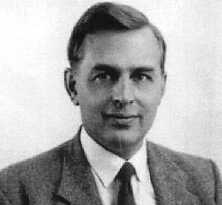
15.03.1929 - 09.04.2008
V. J. (“John”) Dunleavy had a life-long passion for chess, but it was not until he retired to Devon in 1990 that he had the time to devote to chess administration and in that relatively short time made a great contribution to the organisation of the game in, firstly, his newly-adopted county of Devon, then the West of England Chess Union, and then to the BCF, which, under the guidance of John and a few colleagues, evolved into the English Chess Federation.
His line of the Dunleavy family had left Ireland at the time of the great Potato Famine of 1845 and had for several generations settled in Blackburn, Lancashire.
John’s paternal grandfather, John “Bob” Dunleavy (b. 03.01.1882 in Blackburn) was a Musician Sergeant in the Royal Garrison Artillery. He was stationed in Portsmouth when he met and married Emily Annie Ayling on 23rd August 1905. Emily Annie had been born in Chichester on 29th April 1885 and her mother, Emily Shippam, was a member of the family who made Shippam’s meat and fish pastes. Emily Shippam’s parents came from Boxgrove, Sussex, so there was some logic, though coincidental, in John Dunleavy ending his days in that area.
Bob and Emily Dunleavy soon had two children, Margaret May and Victor John, but Bob died shortly after on 13th June 1909, and in 1910 his widow Emily married one of her late husband’s colleagues, Frank Arnell, and they settled in Southampton.
When Bob’s son, Victor John Dunleavy snr, grew up he married Dorothy Pople, a local girl from Southampton. Our Victor John jr was their first born, and was called John from the start to distinguish him from his father Victor. Two brothers followed, Robert Malcolm (b. 07.09.1932) and Roger Graham (b. 30.12.1940).
John was academically gifted and at the age of 10, a year early, got a scholarship to Taunton’s Grammar School in Southampton. Before the war, it was a fee-paying school but awarded plenty of scholarships to local boys like John to ensure they got pupils of talent.
John was due to start there in September 1939, but world events upset the usual routine. On 24th August the BBC broadcast an announcement that all teachers in evacuation areas were to report to their schools at 9 a.m. on the 26th. Southampton had been designated an evacuation area in anticipation of the major port of Southampton becoming a prime target for enemy bombing. Radio announcements came in rapid succession and had almost immediate effect. First, the summer holiday was to end on 29th August and the evacuation of schools was to start on Friday 1st September. There were two days of near panic as parents sought to know what had to be done in so short a time. John, together with all pupils had to report to Taunton’s School at 6.30 a.m. on Saturday 2nd September, from where they were to be evacuated en masse to Bournemouth, where they would share the campus of Bournemouth School.
On arrival at Taunton’s, he already held his one permitted item of hand-luggage, and was issued with a gas-mask, a paper carrier bag and identity label. The boys were split into two groups of 50, each with its own identity banner and letter; one of the group being the future TV comedian, Benny Hill. At a given signal the first group with John in it moved off, to be followed in due course by the second. They walked in procession, led by a policeman and the school’s English master, Dr. Horace King carrying the banner, from the school to Southampton Central station. The designated train duly arrived at 10.30 a.m. and the boys got on, to the order “eight children and one adult per compartment“. Everything went smoothly to plan, not least because Dr. King was a good organiser. He was elected to Parliament as Labour MP for Southampton Test in 1950 and became the first Labour Speaker of the House of Commons (1965 - 71).
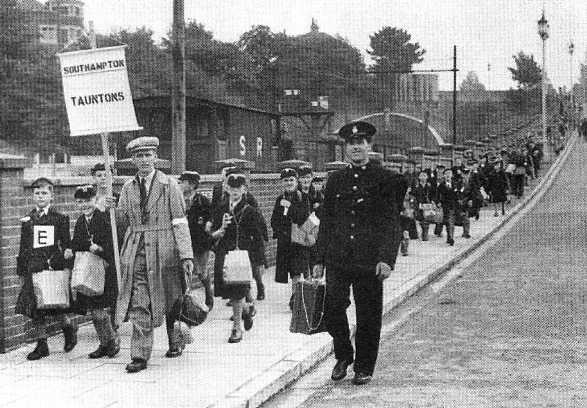
Future Speaker of the House of Commons, Dr. Horace King, carrying banner with young John Dunleavy, Benny Hill and others in tow.
On arrival in Bournemouth, John’s group was sent to a distribution centre at St. Paul’s School, where the group assembled, each boy waiting to be claimed by whoever happened to come in. It was a pure lottery as to which adult claimed which pupil, and some boys were luckier than others. John was claimed by an elderly, kindly couple, Mr. & Mrs. Shaw of Boscombe Down, who had never had children of their own and to whom John became like a son, and the war hadn’t even started yet. He stayed with the Shaws for the duration of the war.
Taunton’s had a strong tradition in the physical sports and had had a chess club since November 1896. It had been introduced by the Chairman of the Governors, Robert W. Chipperfield, a life-long supporter of the game, who wrote “A knowledge of chess I hold to be, if not the panacea for all the ills that flesh is heir to, at least a solace to a few of them; besides which it is an instructor - it teaches its votaries patience, perseverance and politeness, hope and resignation, to submit with equanimity to defeat, and not to be cocky when victorious or successful“. The chess club was part of an unbroken ethos of the school, not dependent on the keenness, or lack of it, of any one master. Its fortunes over the years had inevitably varied with the intake, but although the immediate pre-war years were not particularly illustrious by their own standards, the school B team twice won the Hampshire League Div II, while the A team came 2nd in Division 1 in 1935 - 36. Players of that era included N. V. Boniface, and L. G. O’Neill who won the British Boys’ U-18 Championship in 1937, a title won in other years by the likes of Milner-Barry, C. H. O’D Alexander and Penrose. At this time, Taunton’s hosted a spectacular Living Chess match, the players being Portsmouth-born Sir George Thomas and C. H. O’D Alexander, with the boys dressed up as the pieces. Held on a blazing June day, it was a perfect scenario, except that some of the pieces not taken early in the game fainted from the heat in their heavy costumes.
It is easy to see how John, in this kind of atmosphere, developed his love of the game. After the war, the school returned to its old premises and normal services were resumed. The chess club’s A team won the Robertson Cup in 1945-46 for the first time in the history of the school, the members of this history-making team being J. F. Barrett, A. E. Neill, J. L. Levy, D. G. Newton, K. Robinson and V. J. Dunleavy. The lasting nature of the love of chess inculcated by the school was demonstrated by the existence of a club for former pupils - Old Tauntonians. In the 1946 - 47 season, while John was in his final year at the school, they won the Hampshire League.
|
|
P | W | L | D | F | A | |
| 1st | Old Tauntonians | 6 | 4 | 1 | 1 | 17 | 13 |
| 2nd | Southampton | 6 | 3 | 1 | 2 | 18 | 12 |
| 3rd | Portsmouth | 4 | 1 | 2 | 1 | 11 | 9 |
| 4th | Andover | 4 | 0 | 0 | 0 | 4 |
16 |
His school was clearly at the very epicentre of all chess in Hampshire at this time. It also developed his love for sport, albeit from the comfort of his armchair, particularly football (he supported Southampton, “The Saints”, all his life), cricket, rugby, golf and snooker.
Even in the difficult wartime circumstances John passed his School Certificate with flying colours, and was faced with deciding which subjects to take at A level. His first love was Mathematics, but got talked into taking Languages by teachers who may have had their own agenda, and he took French, German and Spanish, which in retrospect he considered a mistake.
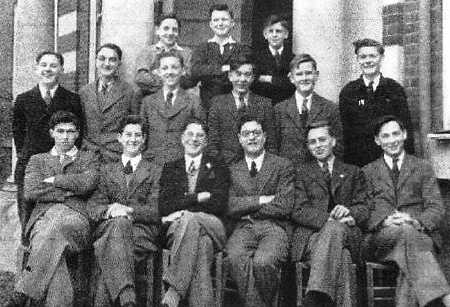
The Librarians of the Senior Library - John Dunleavy seated 2nd right.
He had set his heart on going to Oxford University and sat their entrance exam. He was fully expected to pass, but for the first and only time in his life failed an examination. The irony was that if he had stuck to his first instinct and taken Maths A level he would probably have succeeded. It hit him hard and he refused to try for any other university, leaving Taunton’s at 19 and going straight into the compulsory national service, joining the RAF. He spent most of this two years in Scotland working on radar.
On demobilisation, he found a job in Southampton with a wholesale greengrocer. As a recreation, he went with two friends to a local drama group, where he met Joan Wilson, a former pupil of the Convent High School who had also been recently demobbed, in her case from the WRNS.
They married in 1952, and spent the rest of the 1950s in Birmingham, where John had got a job with the British Tabulating Machine Company. This somewhat arcane sounding company had started in the US as the little-known Tabulating Machine Company. In 1908 they had granted an exclusive licence to the British company to licence its punched-card machines.
This was now 1952, the dawn of the age of the electronic computer. The American parent company became IBM and its British counterpart, after a series of takeovers and mergers, became International Computers Limited (ICL) in 1959. John stayed with ICL for the rest of his working life.
He first moved to the Hall Green area of Birmingham, south of the city centre and from there to the Handsworth district where he joined the Lozells Chess Club, playing regularly in the Birmingham League. It was here that he first met and played against Roy Heppinstall, 40 years later to serve together on the BCF Management Board.
He stayed in Birmingham until the autumn of 1958, when they moved to Carshalton in the south London Borough of Sutton, where they brought up two sons, Alastair Mark (b. 03.01.1961) and Malcolm David (10.12.1962).
In August 1959 he entered the BCF Congress in York, where he played in the usually very strong Major Open. However, Peter Clarke reporting the event for the BCM, observed significantly “It is disappointing to see this Major Open getting steadily weaker year by year, as it undoubtedly is. Just after the war it was always full of first-rate players“. To rub it in, of the 36 players John came last but one, with 3/11 points. Only the 93 year old E. Douglas Fawcett, another Devon Pioneer, came below him. Both would have reaped better rewards in a lower section.
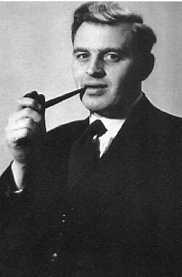
An early attempt at giving up cigarettes
Shortly after arriving in London, he joined the Wallington & Carshalton Club, and soon became involved in the Surrey County Chess Association. He was a full member of the SCCA from his first season there, and became a Vice President from 1973, actively working on the Council. However, as the world-wide computer business developed, he became increasingly involved in his career, which left less and less time for chess.
The burgeoning computer business led to a constant series of mergers and take-overs. In Prime Minister Harold Wilson’s 1960s vision of a white hot technological revolution, it was clear that Britain would never be in a position to stake a claim in the world-wide computer market while most large companies tried to develop their own models in a multitude of subsidiaries. In this political atmosphere John’s original British Tabulating Machine Company, having become International Computers Ltd (ICL) in 1959, swallowed up the computer arms of firms like GEC (1961), EMI (1962), Ferranti (1963), English Electric (1963) & Marconi (1964), leaving them to concentrate on their core businesses and letting ICL produce the computers.
Throughout this process, there were inevitably thousands of retirements and redundancies among the companies concerned, but John rose within ICL, holding a series of different posts and finishing as a Senior Executive in the Compensation Department, in which capacity he travelled the world constantly. He never quite made the Board, but was close. On retirement, ICL’s Chairman and Chief Executive, Peter Bonfield, presented him with a book inscribed
“To John Dunleavy, Many thanks on behalf of the Board of ICL for 39 years’ service“, adding significantly, “Thanks for your personal support, Peter Bonfield - April 4th 1990“.
He had taught both his sons to play chess. At one point Alastair became SCCU Under-11 Champion and went on to captain Dulwich College chess team, in the footsteps of Ray Keene, but after winning a place at Warwick University, gave the game up “lest he become like Bobby Fischer“. Malcolm was not so keen, but his two sons, having been taught from an early age by their grandfather, enjoy a game from time to time.
John retired in 1990 and moved to a house on the outskirts of Kingsbridge in South Devon. He started to study for a degree with the Open University, but at the same time had more time to get involved with his new county association, the DCCA. Gradually and inevitably the chess overtook the academic studies as he became more and more involved in organisation, and he was forced to drop this OU ambition.
He became Devon Competitions Secretary for a time while studying for his arbiter’s exam. After qualification, he officiated at the Paignton Congress from 1996 and other local events.
When Harry Golombek died in 1995, he left a sum of money in his Will for the promotion of chess, details to be determined by The Friends of Chess. John lobbied them, arguing that as Golombek had won the1st Paignton Congress in 1951, ahead of Euwe and Donner, it would be very appropriate to celebrate the venerable event’s Golden Anniversary with an international tournament in his memory. This was agreed and in 2000, with the cooperation of Gerry Walsh, an executor to the Golombek estate, a 10 man All-Play-All was organised. Under John’s leadership, the event was meticulously planned, with committee members often being faced with agendas containing over 60 items.
The invitees were Dr. John Nunn, Keith Arkell who had been a supporter of the congress for many years, Danny Gormally, Mark Hebden and Matthew Turner from England, Klaus Bischoff and Alexander Naumann from Germany, Robert Fontaine the promising French junior, Karel van der Weide (Netherlands ) and Tiger Hillarp-Persson (Sweden). So well organised was it by John, there was little scope for snags, and the event ran smoothly. In fact, he remained so much in the background throughout that it was easy to forget the magnitude of his contribution.
In fact, this event seemed to encapsulate his approach to life in general. He had always been a shy person, shunning any hint of limelight while happy to keep on the road any event for which he was responsible. In the photographs, he can be seen standing, almost reluctantly, at the edge of the group.
Golombek Memorial Tournament Paignton.
3rd - 11th September 2000
Category 11
|
|
1 | 2 | 3 | 4 | 5 | 6 | 7 | 8 | 9 | 10 | tot | ||||
| 1 | Nunn | g | Eng | 2578 | X | ½ | ½ | ½ | ½ | 1 | ½ | 1 | ½ | ½ | 5½ |
| 2 | Bischoff | g | Ger | 2556 | ½ | X | ½ | 0 | 1 | ½ | 1 | ½ | ½ | 1 | 5½ |
| 3 | Hebden | g | Eng | 2505 | ½ | ½ | X | 1 | ½ | 0 | 1 | 0 | 1 | ½ | 5 |
| 4 | Fontaine | m | Fra | 2449 | ½ | 1 | 0 | X | 0 | 1 | ½ | ½ | ½ | 1 | 5 |
| 5 | Turner | m | Eng | 2491 | ½ | 0 | ½ | 1 | X | ½ | ½ | ½ | 1 | ½ | 5 |
| 6 | Gormally | m | Eng | 2499 | 0 | ½ | 1 | 0 | ½ | X | ½ | ½ | ½ | 1 | 4½ |
| 7 | Arkell | g | Eng | 2481 | ½ | 0 | 0 | ½ | ½ | ½ | X | 1 | ½ | ½ | 4 |
| 8 | Persson | g | Swe | 2549 | 0 | ½ | 1 | ½ | ½ | ½ | 0 | X | 0 | ½ | 3½ |
| 9 | Van der Weide | m | Ned | 2467 | ½ | ½ | 0 | ½ | 0 | ½ | ½ | 1 | X | 0 | 3½ |
| 10 | Naumann | m | Ger | 2489 | ½ | 0 | ½ | 0 | ½ | 0 | ½ | ½ | 1 | X |
3½ |
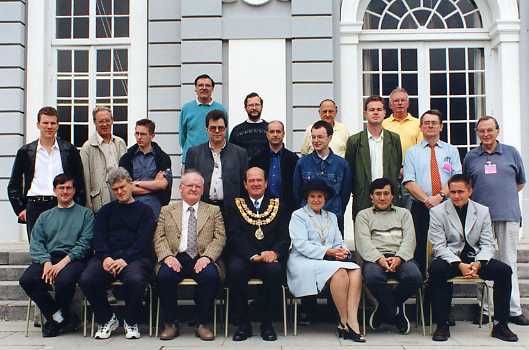
The group of players at the Golombek Memorial.
Seated l - r: Matthew Turner; Dr. John Nunn; Gerry Walsh (arbiter for the event); Cllr. Colin Charlwood, Mayor of Torbay and consort; Mark Hebden; Alexander Naumann.
Standing: Tiger Hillarp-Persson; John Wheeler (Chairman of the Friends of the Paignton Congress); Robert Fontaine; Klaus Bischoff; Keith Arkell; Danny Gormally; Karel van der Weide; Steve Boniface (Arbiter); John Dunleavy (Congress Secretary):
3rd row: Alan Crickmore (successor to John as Congress Secretary); ? ; Frank Parr; Alan Maynard.
John’s postscript in the event programme also tells us something of the man.
A POSTSCRIPT BY THE CONGRESS DIRECTOR.
Putting this tournament together proved to be a more interesting challenge than at first appeared. The late arrangement of other events in a busy chess summer took away both actual and potential players. However, in the end, we have a Category X1 tournament with which to honour the memory of Hon. GM Harry Golombek OBE and that is what I set out to achieve in the first place.
Five established Grandmasters will do battle with five young International Masters of high promise. Harry was ever one to encourage the younger generation and it is my belief that he would have thought this gathering of chess talent provided a fitting memorial. He would have been particularly pleased that his relatives have generously donated a substantial Best Game prize to encourage the sort of creative chess that he would have been delighted in writing about.
Sadly, three Grandmasters, each of whom held Harry in high esteem, were unable to accept invitations to play: Jonathan Mestel, Jonathan Speelman and Vassily Smyslov.
One acceptance that I was particularly pleased to receive was that of Gerry Walsh, Chairman of both The Friends of Chess and the British Chess Federation, who agreed to act as Chief Arbiter. Gerry was a long- time friend and helpmate of Harry’s and was his chess executor. It is appropriate that, thanks to David Anderton, the portrait of Harry by John Bratby will hang above Gerry’s desk in the playing room.
I have been helped by many in the selection of players for this tournament and in other matters. I wish, in particular, to acknowledge with gratitude the assistance of David Anderton, the BCF International Director, Egon Ditt, President of the German Federation Uwe Boensch, the German National Coach, Jean- Claude Loubatière, President of the French Federation and Kees Stap of the Royal Dutch Federation.
Finally, I express my thanks to my colleagues of the Paignton Congress Committee for their unfailing support in bringing this Memorial Tournament to fruition: Victor Cross (Chairman), Steve Boniface, Bill Frost, Bob Jones, Alan Maynard, Philip Trussler and John Wheeler.
John Dunleavy
John was elected as Devon’s Council Delegate to the West of England Chess Union in June 1996. His love of the law and the precise language of constitutions soon led him to offering to revise WECU’s constitution. His first draft was accepted by the June Council Meeting 1997.
At the same meeting he stepped in as one the Union’s two delegates to the BCF Management Board. Two years later, the Federation slimmed down the Board by reducing the number of Union delegates to one, and at the June 2000 Council Meeting a choice had to made. John came through this selection process and continued to represent the Union’s interests.
Further, more radical changes were mooted by the Federation and it was agreed that it should represent the interests purely of England, as the other home countries already had their own national organisations. The evolution from British to English Federation demanded much careful planning and John was in the forefront of this, spending many hours, often late into the night, consulting by phone, e-mail, letter and in person, with colleagues of the sub-committee charged with expediting the change, especially the highly-experienced David Anderton, who recalls…
“John was the most active BCF Management Board Member in dealing with the complex work to draft and finalise the Memorandum and Articles of Association and Bye Laws and Regulations of English Chess Federation. He did a lot of creative work as well as checking the drafting with great care. We spent many hours in the evenings and weekends both talking on the telephone and emailing each other. He took his responsibilities as Chairman of Governance Committee very seriously and was widely respected for his impartiality.”
This last observation will be repeated by many who knew him. In whatever activity, John knew his own mind, while at the same time being loyal to his chairman. He would never enter into internecine plots or cliques - with him everything was out in the open.
During the course of 2007 he was awarded a hat trick of life vice presidencies, of Devon, WECU and the ECF.
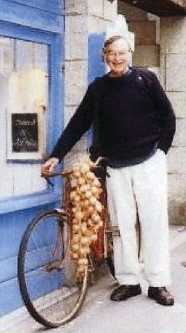 On holiday in Brittany in 2003
He was a great bibliophile, with a large collection covering history, politics, science, languages, mathematics, but particularly chess. He had several hundred chess books and a large number of ornamental sets and boards, and these were beautifully laid out in his new house in Boxgrove.
At the time of his retirement, he had discovered he was diabetic and was developing arterial disease in his legs, the latter induced by years of heavy smoking before he gave up the habit in the 1970s. He was always mindful of this, but after the new millennium his health became of increasing concern, and they decided to move back to their home area to be nearer family members and grandchildren. In October 2007 a pleasant house was found in Boxgrove, near Chichester, large enough for John to display his extensive library. He joined the Chichester club and had started playing again that winter, when his two conditions worsened, the one fatally interacting with the other, and he was hospitalised.
While in hospital, the doctors debated what to do about his worsening leg condition. After five weeks in hospital, on 8th April he phoned ECF President Gerry Walsh on his bed-side pay phone. When Gerry asked what he wanted, John said - “Nothing in particular - let’s just talk till the phone card runs out”, which they did. After half an hour the line suddenly went dead, as the credit on his card had indeed run out. The next day, John died suddenly and unexpectedly of a heart attack - as if his own card had run out.
On the morning of the funeral, as family members foregathered at the house, John’s two grandsons took out one of his more spectacular chess sets and calmly played a quick game. Joan observed that they were thus in a peaceful mindset when the party set off for the crematorium.
John would have been very happy with that.
© R. H. Jones. 2010
Bibliography:
Testimony of Mrs. Joan Dunleavy.
Spooner, H. A History of Taunton’s School, Southampton 1760 - 1967 Southampton 1968
Campbell-Kelly, M: ICL - A Business & Technical History. Clarendon Press 1989
DCCA & WECU minutes.
Posted in Pioneers of Devon Chess |
Tags: Benny Hill, chess, Devon, Dunleavy, Horace King, ICL, Southampton, Taunton's School |
No Comments »
Bruce, Ron (1903 - 1991)
Ronald MacKay Bruce.
(26.08.1903 – 26.04.1991)
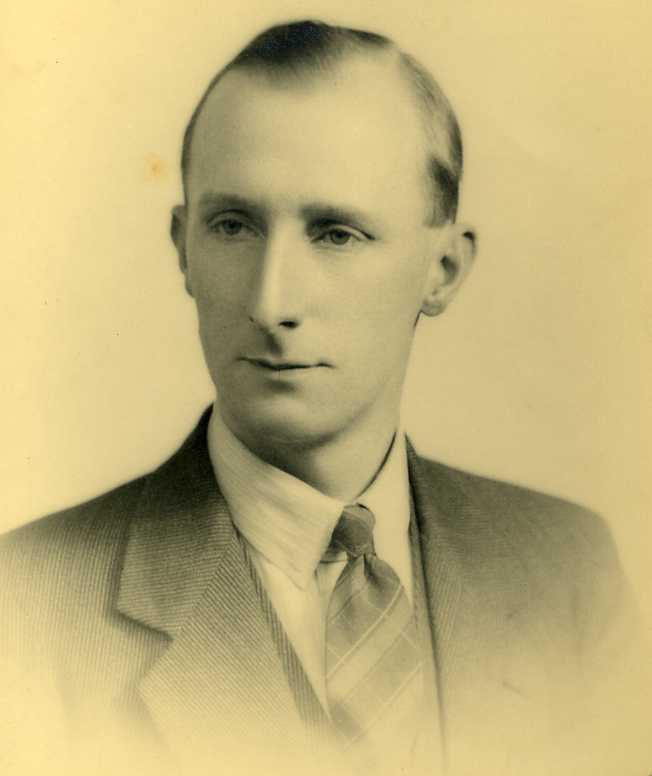
Ron Bruce was a true entrepreneur, which brought him success in business and a legacy in chess which survives to this day and fully entitles him to the title of being a Pioneer of Devon Chess.
He was born in Plymouth, the only son of John and Lydia Bruce (née MacKay), when they were living at 47, Durham Avenue. John Bruce had been brought up in a large family in Ayr but had severed links with them when he moved south to become a ladies hairdresser and wigmaker at one of the smartest salons in the city. In spite of her Scottish name, Lydia had been born in London.
Ron started work at an auctioneers, but his prospects were somewhat limited by the stammer that stayed with him all his life. His next venture was renting out cigarette machines, re-filling them with packets of 5 whenever necessary.
He became a member of the Plymouth Chess Club in 1921 and was soon their young star, becoming the Devon Individual Champion in 1924 and winning the Club Championship for the 1st time in the 1924/25 season. For the 4 decades from 1928 – 68 he failed to win it only 5 times.
His capture of the Plymouth Club Championship in 1925 entitled him to enter the Winter-Wood tournament, a knock-out competition held each summer between the Champions of all clubs affiliated to DCCA. He went on to win this at his first attempt and was a regular winner thereafter. A full list of his victories may be found in the appendices.
In 1930, when he was 27, he was approached by a fellow club member, Mary Dew, whose 10 year old daughter, Rowena, was showing an aptitude for the game that she felt needed a greater talent than her own to develop to its full potential. So it was that Mrs. Dew took Rowena round to Ron’s house at 126, Old Park Road, for two 1 hour lessons each week; she stayed in the room, partly to chaperone her daughter and partly to pick up some tips for herself. With his speech impediment, it was something of a laboured process, but it worked well enough. Within 5 years his pupil had become FIDE World Girls Champion; he was 32.
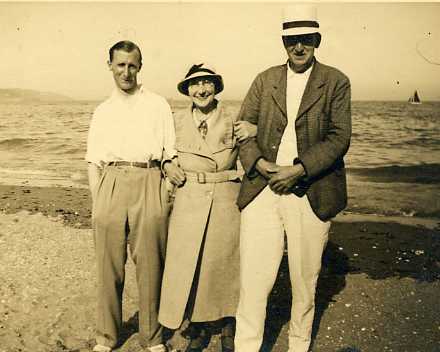
Ron with his mother, Lydia, and father-in-law Harvey Dew.
In 1937 he took his pupil and her mother to Blackpool for the British Championships. Mrs. Dew competed in the 3rd Class Division 2 where she finished with 5½/10 and just out of the prizelist. Her 18 year old daughter on the other hand won the British Ladies Championship with the considerable score of 10/11. The BCM observed “Miss Dew gives all the credit for her success to R. M. Bruce, the Plymouth C.C. captain, who has assiduously coached her for the congress”. Ron went up to Blackpool for the second week to take part in one of the new week-long tournaments, winning his section and pocketing the 1st prize of £1.50.
The following year the Championships were held at Brighton, where Rowena came 3rd on 7½. Her mother scored 4½ in the 3rd Class Div. 1, but the week-long sections had been deemed a failure and were dropped, so Ron did not play as he wouldn’t have been able to spare the time considering his next undertaking, due to start a few days after the Brighton event.
In 1938 the Plymouth Club was due to celebrate its 50th anniversary, and with Ron that meant doing it in style. A large congress was organised for the 1st full week of September, with the top section of 8 including both current World Champions, Alekhine and Vera Menchik. The top section was completed by Sir George Thomas, Dr. List, the 30-somethings Stuart Milner-Barry and George Wheatcroft, while Devon’s interests were represented by Harold Mallison of Exeter and Ron himself.
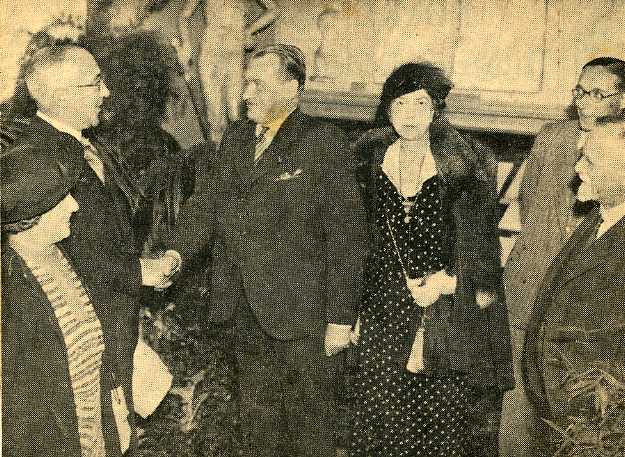
The Alekhines meet Plymouth's Lord Mayor.
The Mayor of Plymouth, Mr. E. S. Leatherby and his wife greet Dr. and Mrs. Alekhine at the civic reception for the Plymouth Jubilee Congress. On the right are L. Barford (Arbiter) behind Ald. J. Derbyshire (BCF President). The real star is clearly Grace Alekhine, a wealthy and stylish patron of the arts with a back-story every bit as exotic as her husband’s. She herself had been a chess champion in France, and after the war had a house in St. Ives.
Ron would have been happy to stay in the background on such occasions, attending to the detailed arrangements.
The final table was:-
| 1 | 2 | 3 | 4 | 5 | 6 | 7 | 8 | Tot. | ||
| 1 | Thomas, Sir G. A. | X | ½ | 1 | 1 | ½ | 1 | 1 | 1 | 6 |
| 2 | Alekhine A. A. | ½ | X | ½ | 1 | 1 | 1 | 1 | 1 | 6 |
| 3 | List, Dr. P. | 0 | ½ | X | 0 | 1 | ½ | ½ | 1 | 3½ |
| 4 | Milner-Barry, P. S. | 0 | 0 | 1 | X | 0 | 1 | 1 | ½ | 3½ |
| 5 | Menchik, V. | ½ | 0 | 0 | 1 | X | 0 | ½ | 1 | 3 |
| 6 | Mallison, H. V. | 0 | 0 | ½ | 0 | X | ½ | ½ | 2½ | |
| 7 | Wheatcroft, G. S. | 0 | 0 | ½ | 0 | ½ | ½ | X | 1 | 2½ |
| 8 | Bruce, R. M. | 0 | 0 | 0 | ½ | 0 | ½ | 0 | X | 1 |
This was a fine victory by the veteran Thomas. In BCM, Golombek summed up Ron’s performance thus:
Bruce lives in Plymouth and finds it very difficult to get first class practice. He was obviously unaccustomed to playing with such opponents but showed that with more good practice he would do much better.
The 7 rounds were played in 6 days. The Tuesday was particularly tough, with a game in the morning, the afternoon reserved for adjournments and the Round 3 game in the evening. The draw had determined that Ron would face Alekhine in the morning with Black. He tried the Caro-Kann but was cut down in a game that lasted 11 moves and 30 minutes and entered the chess literature. His opponent for the evening game was Vera Menchik, which he also lost. His one consolation was his subsequent claim to have been the only person to have played two current world champions on the same day in serious play; he dined out on that story for the next half century.
There were 9 other American sections of 8, and among the prizewinners were B. H. Wood and the 12 year old Elaine Saunders, shortly to become the next British Ladies Champion.
On Saturday April 1st 1939 Ron and Rowena were playing for Plymouth in an away match against Paignton in the Bremridge Cup, Devon’s premier team tournament. Ron won his game on Board 1 against their captain, Frank Pitt-Fox, though Plymouth didn’t go on to win the cup that year. It may have been the date or the exhilaration of a win under his belt, but there must have been something in the air that day, for on the way back to Plymouth, Ron suddenly pulled the car into a lay-by at South Brent. He didn’t know what made him do it at that particular moment, it was just on a whim, but he proposed marriage to his sole passenger. Rowena accepted, though they would have to wait till she was 21 the following year, which they duly did, eventually marrying on 13th July 1940. This little episode explained the name they gave to their family home, Brent Whim – they had got engaged at Brent on a whim. From then on, every time they passed that spot on the old A38 they would just touch hands and smile to each other. Which went to show how, beneath that stern and sometimes forbidding exterior, Ron was just an old romantic at heart.
The 1939 British Championships moved to Bournemouth but with the political uncertainty of the time, and the absence of the top players competing in the Rio de Janeiro Olympiad, the men’s championship was scrapped in favour of a more general Premier Tournament which included Euwe and Landau of the Netherlands. The usual trio of Ron, Rowena and her mother spent the fortnight there. Ron scored 4/11 in the Major Open A behind the likes of Znosko-Borovsky, Sämisch and the Drs. Fazekas and List, but ahead of his club mate, Jack Goodman.
The Ladies Championship proceeded as usual but Rowena was well and truly upstaged by 13 year old Elaine Saunders who scored 10/11 without a loss, while she recorded a very modest 5. Her head may have been full of wedding plans.
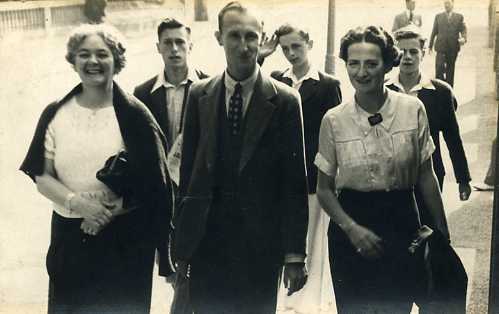
Enjoying the sea air on Bournemouth promenade - August 1939
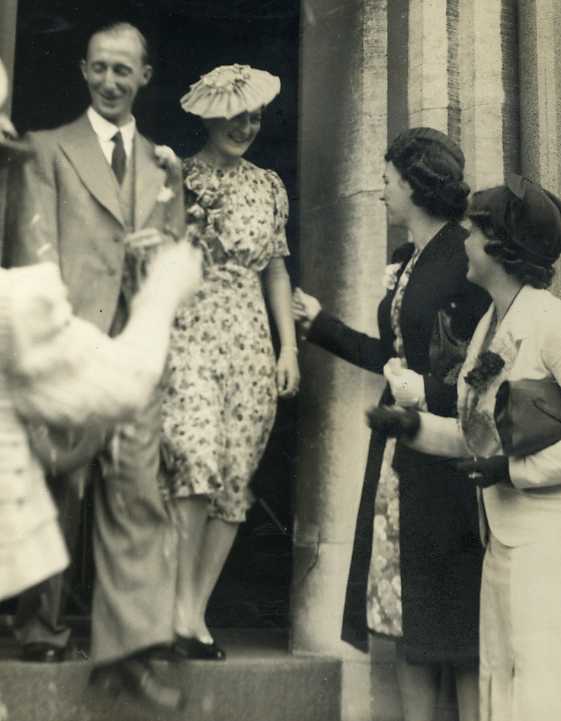
13th July 1940 - The happy couple leaving the church.
At this time, Ron had a shop in the city centre selling shoes on a credit basis, but this was destroyed along with much else in the Plymouth blitz of April 1941. After the War, as the city centre was slowly rebuilt, Ron joined forces with a colleague called Syme Hewitt and they set up H & B Credit Traders. They had large premises in the city where a wide range of household goods could be acquired for cash or on credit. A large team of reps covered most of West Devon and Cornwall, calling on customers’ houses, collecting weekly payments and offering further goods from a catalogue. It was a very successful venture in its post-war heyday, and many UK cities had similar, relatively small operations but it was thing of its time and eventually, with the rising prosperity of the ‘60s, nationwide firms gradually took over. As the economic basis of their business was gradually undermined Ron and Syme sold out their shop to the Greenshield Stamp Company, a company then on the rise, and now, in its turn, gone forever. They retained a small shop at Plympton for a time until they both retired when Syme’s son took it over.
As soon as peace was restored in 1945, Ron’s chess career resumed its normal pattern, though this time in partnership with his wife whose chess profile, with its international dimension, was far higher than his own. This was never allowed to come between them, however, as he was happier out of the limelight and she always gave Ron full credit for her own chess achievements. Every year followed a similar pattern; the New Year would find them at Hastings, Easter would be the West of England Congress and August involved the British Championships, where Rowena won the Ladies Championship eleven times. Weekends would be taken up with either county or Devon league matches, and midweek they would be contesting the various tournaments in the Plymouth Club, or playing Bridge on a strictly non-competitive basis.
In 1947, he took on the Captaincy of the Devon team after Harold Mallison was forced to retire due to failing eyesight, probably exacerbated by his experiences in the trenches in the Great War. Ron was to do this job for exactly 40 years.
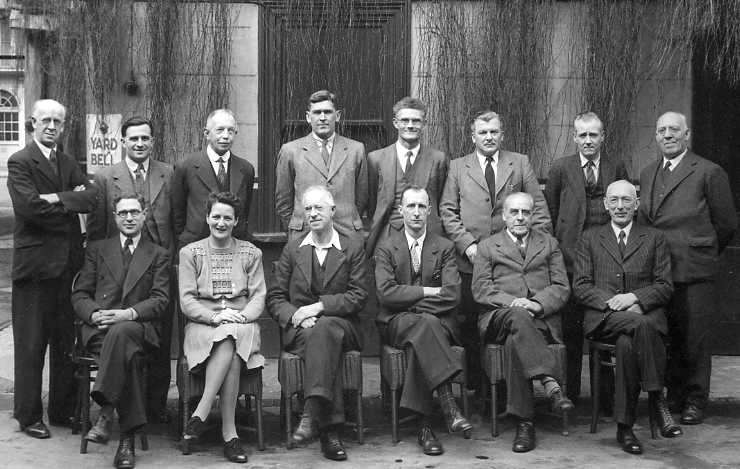
Devon v Middlesex 1947
Ron Bruce’s 1st season as Devon Match Captain found then contesting the final of the S.C.C.U. Championship in a match against Middlesex at the Red Lion Inn, Salisbury, March 29th 1947. They lost to a much stronger side.
They are, in board order:-
1. H. V. Mallison (tieless- drew with Gabriel Wood); 2. F. E. A. Kitto (not shown as he was probably late, as was usual – drew with W. Winter); 3. Ron Bruce (seated 4th from left – drew with König); 4. R. A. “Ron” Slade standing 2nd left – lost to Dr. List); J. B. “Jack” Goodman (seated extreme left played J. Stone); 6. J. Gibson (drew with M. Blaine); 7. R. W. Hornbrook (drew with Stephen Crockett); 8. Rowena Bruce (drew with J. Gilchrist); 9. G. J. Cradock (lost to J. D. Soloman); 10. G. T. Womack (drew with W. S. Wallis); 11. W. H. Regan (lost to A. Hussain); 12. C. Soper (drew with M. Adler); 13. T. J. Hart (lost to J. E. Redon); 14. R. B. Copleston (seated 2nd from right – lost to C. Jahn); 15; F. H. Light (lost to G. Rutland); 16. G. D. Crowther (lost to J. Anstey).
In 1948 the Plymouth Club was due to celebrate its Diamond Jubilee and, almost in defiance of Plymouth’s wartime destruction, it was decided to hold another celebratory event on much the same lines as that a decade earlier. The star attraction this time was Max Euwe, at that time the only person alive who had been World Champion, with the Lithuanian-born Dr. List returning. Ron again represented the home club and he was joined by the new kid on the Devon block, Frank Kitto, and Andrew Thomas of Blundell’s School, Tiverton. The other home country players were Dennis Horne (27), Gabriel Wood (45) and William Winter (50). There were about 100 players involved all together.
The event was a triumph for Kitto who tied for 1st place with Euwe. Ron paid the usual price for his back-room work. In fact, he was drawn against Euwe and Kitto in rounds 1 and 2 respectively and his losses to them so early on doubtless put them on the winning track and Ron on the downward path.
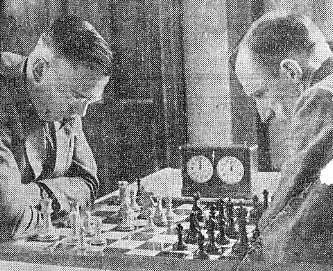
Euwe v Bruce 1948
Above: Ron on his way to a 1st round loss against Euwe.
The final chart
| 1 | 2 | 3 | 4 | 5 | 6 | 7 | 8 | Total | |||
| 1 | M. Euwe | X | 1 | 0 | ½ | ½ | 1 | 1 | 1 | 5 | 1st= |
| 2 | F. E. A. Kitto | 0 | X | ½ | 1 | 1 | 1 | ½ | 1 | 5 | 1st= |
| 3 | G. Wood | 1 | ½ | X | 0 | 1 | 0 | 1 | 1 | 4½ | 3rd |
| 4 | D. M. Horne | ½ | 0 | 1 | X | 1 | ½ | ½ | 0 | 3½ | 4th |
| 5 | A. R. B. Thomas | ½ | 0 | 0 | 0 | X | 1 | 1 | ½ | 3 | 5th= |
| 6 | W. Winter | 0 | 0 | 1 | ½ | 0 | X | ½ | 1 | 3 | 5th= |
| 7 | Dr. P. M. List | 0 | ½ | 0 | ½ | 0 | ½ | X | 1 | 2½ | 7th |
| 8 | R. M. Bruce | 0 | 0 | 0 | 1 | ½ | 0 | 0 | X | 1½ | 8th |
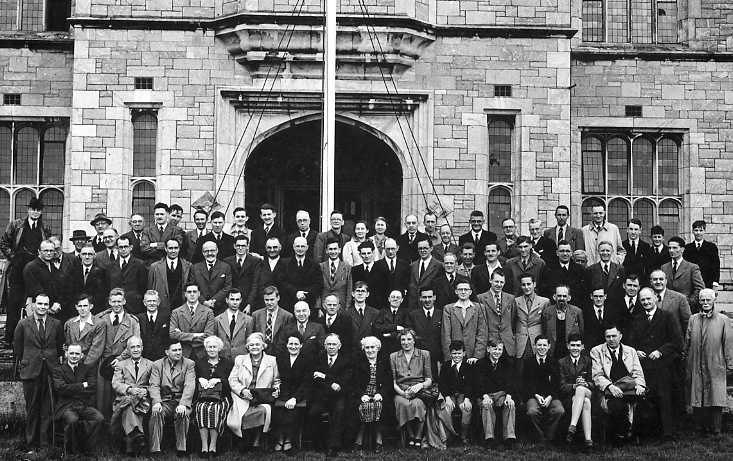
Plymouth Diamond Jubilee Congress
Above: The group photograph of the Plymouth Diamond Jubilee Congress.
Plymouth Institute 9th – 14th August 1948.
Euwe is seated extreme left. Next to him is Denis Pereira Gray, later knighted for his services to medicine. At Euwe’s right shoulder is A. R. B. Thomas with the Gandalf-like Winter at his right shoulder. Rowena and her mother are seated together left centre, while Ron Slade has his hands on knees. Frank Kitto is standing front row extreme left.
In the back row, Ron Bruce is standing in front of the right guy rope with Ken Bloodworth beside the left one, and he has Leonard Barden on the left.
At the closing ceremony Dr. List paid a graceful tribute to the organisers, the “unknown soldiers of the chess world”, without whom chess would be at a standstill. Ron was not least among that hard-working band.
By 1950 Ron had accrued much experience in organising commemorative chess events, and as the Devon County Chess Association was then approaching its own 50th anniversary it was natural that the idea of a similar event should arise. A committee was formed on which both Ron and Rowena were key members. The Treasurer was Frank Willett who lived in Paignton and he was aware that the Trustees of the Singer Estate had recently sold their family house and grounds, Oldway Mansion, to the local council for use by the public. Thus it was that DCCA’s Golden Jubilee Congress was held at Oldway. So successful was it that it continued there for the next 60 years.
In 1987 Ron had completed 40 years as County Captain and was due to stand down. Members of the Devon team chipped in for a gift to be presented at his last match, against Gloucestershire at Ilminster. Beforehand, a discreet enquiry was made to Rowena as to what kind of item might best be appreciated by him, and she was very clear – he would like a small 2-bar electric fire as he felt the cold at home. This begged the question as to why, if this was the case, given his very comfortable means, he hadn’t run to central heating at home. In fact, he and Rowena had always lived very frugally. One of his trademarks was the Russian-style fur hat which he wore wherever he went throughout the winter months. What was less well-known was the fact that he generally wore it around the house as well. He even wore it in the bath! The presentation went ahead as planned, the County President saying a few inadequate words of appreciation in front of the other 62 players. Ron could barely speak as a tear or two rolled down his cheek.
His health had started to give out in these his final years; two operations for skin cancer on his scalp were followed by the gradual onset of Parkinson’s Disease, but unknown to anyone he had also developed lung cancer which was what ultimately brought about his death at the age of 86.
When in 1983 the British Chess Federation introduced an annual award in recognition of outstanding and long-standing contributions to chess organisation, called the President’s Award, Ron and Rowena were high on the list of candidates and received it in its 2nd year. The magnitude of their combined input was clear and undeniable. Ron was never at ease socially but through his obvious dedication inspired a loyalty among his fellow team and committee members that led to Devon always punching above its weight.
His role in the creation of the Paignton Congress makes him a true Pioneer of Devon chess.
© R. H. Jones. 2010 – All rights reserved.
Appendix.
His record of trophy wins.
|
Plymouth Ch. |
Devon Individual Ch. |
Winter-Wood |
West of England Ch. |
|
|
1924 |
|
|
|
1925 |
|
1925 |
|
|
1928 |
|
1928 |
|
|
1929 |
1929 |
1929 |
|
|
1930 |
1930 |
1930 |
|
|
1931 |
|
1931 |
|
|
1932 |
|
1932 |
|
|
1933 |
|
|
|
|
1934 |
|
|
|
|
1937 |
|
|
|
|
1938 |
|
|
|
|
1939 |
|
|
|
|
1940 |
|
|
|
|
1945 |
|
|
|
|
1946 |
|
|
|
|
1947 |
|
|
|
|
1948 |
1948 |
1948 |
|
|
1949 |
|
1949 |
|
|
1950 |
1950 |
1950 |
|
|
|
|
|
1951 tied with Kitto |
|
1952 |
1952 |
1952 |
|
|
1953 |
|
1953 |
|
|
1954 |
|
1954 |
|
|
1955 |
|
1955 |
|
|
|
1956 |
|
|
|
1957 |
|
1957 |
|
|
1958 |
|
|
|
|
1959 |
|
1959 |
|
|
1960 |
|
|
|
|
1961 |
|
|
|
|
1962 |
|
|
|
|
1964 |
|
|
|
|
1965 |
|
1965 |
|
|
1966 |
|
|
|
|
1967 |
|
1967 |
|
Bibliography:
Testimony of Rona Ross-Bryant.
B.C.M. & Chess.
Picture credits: All photographs courtesy of Rona Ross-Bryant except the following:-
Both group photographs – author’s collection.
Both newspaper pictures – Western Morning News.
Bremridge, Rev. H. (17. 11. 1854 - 28.06.1913)
Revd. Henry Bremridge
17th Nov. 1854 - 28th June 1913
In the late 19th century, a number of pioneers had impregnated Devon with the idea and perceived need of a county-wide association to draw the various threads together, but it was left to the Rev. Henry Bremridge to be the midwife that delivered the DCCA into the world.
The Bremridges were an old-established Devon family whose origins were in the North Devon village of Bremridge, between Barnstaple and South Molton. Henry’s father, John Philip Bremridge, was in the ministry, and married Alicia Tidbold, youngest daughter of J. A. Tidbold of The Firs, Chulmleigh. While living at Morchard Bishop, where he was a curate, they had their first son, Philip, before Henry was born in November 1854. They also had a daughter.
As a small boy he watched his parents play chess, and learnt the moves himself early in life. His father became the Vicar of Winkleigh, a quiet village in mid-Devon.
Henry went up to St. John’s College, Oxford, where he was a member of the University Chess Club, but at that time he was more interested in physical sports, playing Rugby for the University for two years, losing to Cambridge in his first year but beating them the next time. For three years he rowed in his college boat, and got his cricket colours in his third year. In later life, he played golf regularly on the links at Westward Ho!
He graduated in 1880, and succeeded his father as Vicar of Winkleigh when James Philip died in September 1887. Ten years later he came back to the game and started taking it seriously, being quoted as saying “Chess is the finest game ever invented“.
In the meantime he had married Dora Milne, 6 years his junior. First born was a daughter, Mildred Constance, born on 10th April 1892, followed by a son, James Philip Alfred (born 30th September 1893). However, the young family were touched with tragedy when young Mildred died on 3rd February 1895 aged 2, as her mother was 8 months pregnant with their 3rd child. This was Godfrey (born 1st March 1895), but Mrs. Bremridge herself died just 4 weeks later on 6th April, possibly resulting from a combination of post-natal depression and deep mourning for her lost daughter.
Henry married for a second time, this time to Charlotte May Roby nee Godwin, known as May (2nd September 1877 - 16th August 1958). Together, they had 4 more children; Frances Mary Grace (27.08.1903 - 25.08.1994), Charles Henry Godwin (16.08.1905 - 22.09.1934), Bernard Lionel (22.12.1906 - 05.09.1995) and Philip Alexander Roby (05.06.1911 - 21.12.1999).
Charles’ short life was accounted for by a flying accident near Aylesbury. Frances married the Revd Jack Chudleigh Way, who became Vicar of Winkleigh between 1943 - 1957
A man of broad views and wide sympathies, Henry was highly respected, both by his parish flock and his chess colleagues. His parish duties in the small village of Winkleigh may not have been onerous for a man of such wit and energy as Bremridge possessed, but he spread himself wide.
He was president of the local Church of England Temperance Society; President of the Cricket and Bowling Clubs; Reading Room; Choral Society; Nursing Association; also Chairman of the School Managers; was a member of the Committees of the Diocesan Branch of the Church Defence, the Council of Preventative and Rescue work, the Religious Education fund, and a keen worker for various missions.
In the late 1890s, he entered several congresses outside Devon, which brought him into contact with more organised chess. One of these was the SCCU Congress, held in September 1898 at Salisbury, where was erroneously listed in the charts as “Rev. Brimbridge”. Also playing in this event was fellow Devonian, Rhoda Annie Bowles, one on the country’s leading chess organisers of the time, and doubtless there were opportunities for them to talk about the possibilities of getting chess in Devon onto a more organised footing.
During the course of 1901, Bremridge, at the suggestion of officers of the Southern Counties Chess Union, took the initiative in convening a meeting to test the waters and, if the will was there, to form a Devon association. The City elders allowed the meeting to be held at the Guildhall in Exeter’s High Street, which was presided over by the Mayor Mr. A. Edward Dunn, shortly to become MP for Camborne.
The meeting was well-attended, and many letters of support were read out from supporters unable to attend. A steering committee was formed and Bremridge was elected both Secretary and Treasurer of the infant association.
If Bremridge was not of the very highest rank of Devon chess players, he was perhaps unlucky not to have won the 2nd county championship in 1903, when he was a close runner-up to the highlyexperienced and capable Charles Lambert. Their individual match was the decider.
|
1 |
2 |
3 |
4 |
5 |
6 |
7 |
8 |
Total |
|||
| 1 | C. J. Lambert | Exeter |
x |
1 |
1 |
½ |
1 |
1 |
1 |
1 |
6½ |
| 2 | Rev. H. Bremridge | Winkleigh |
0 |
x |
1 |
1 |
1 |
1 |
1 |
1 |
6 |
| 3 | T. Taylor | Plymouth |
0 |
0 |
x |
1 |
1 |
1 |
1 |
1 |
5 |
| 4 | E. D. Fawcett | Totnes |
½ |
0 |
0 |
x |
0 |
½ |
1 |
1 |
3 |
| 5 | E. Palmer | Exeter |
0 |
0 |
0 |
1 |
x |
1 |
0 |
1 |
3 |
| 6 | C. T. Blanshard | Totnes |
0 |
0 |
0 |
½ |
0 |
x |
1 |
1 |
2½ |
| 7 | J. E. D. Moysey | Totnes |
0 |
0 |
0 |
0 |
1 |
0 |
X |
1 |
2 |
| 8 | E. V. Hawkins | Exeter |
0 |
0 |
0 |
0 |
0 |
0 |
0 |
x |
0 |
For four years Mr. Bremridge was both Secretary and Treasurer of the Association, and the work done by him during that period was enormous. He felt that he could not continue, and wished to retire. At the A.G.M. in September 1905 a compromise was reached whereby he retained the secretaryship, and George W. Cutler took over as Treasurer. Henry was also President of the Exeter Chess Club for some years.
 At this time Cutler wrote, “Mr. Bremridge is persona grata wherever he goes. His very presence among chess players is cheering and inspiring, and he is beloved in all Devon chess circles. He has the happy knack of stimulating others by his enthusiasm for the game, and he attracts to himself a willing band of workers. He is ever ready to help chess by all means in his power, so it is no wonder that he is a ‘tower of strength’ to the DCCA”.
This new arrangement did not last long, however. In September 1909, the DCCA held its A.G.M. in the Barnfield Small Hall, and although Bremridge himself was unable to attend as he was travelling in Ireland, his wife, May, read out his annual report followed by a letter of resignation which included the lines… “I am not tired of chess. I am not going to give it up. It is the most fascinating and intellectual of games, and I think it has helped me make some good moves in life: but the duties of secretary are many, and undoubtedly take up valuable time, and after eight years’ active service I am, I think, entitled to be placed on the reserve list”. With six young children back at the Vicarage, the four youngest all still under 10, it was hardly surprising that he, and not least his wife, wished to ease his administrative burden.
W. H. Gundry of Exeter was elected to take over from him.
That marked the end of his relatively short but great contribution to Devon chess. He may have already suspected that he was not due for a long life, for he passed away in a London nursing home on June 28th 1913 after a long illness, at the comparatively early age of 58.
But he is far from forgotten. One of the first things he did in 1901 was to donate a cup for the county’s champion club, still known today as the Bremridge Cup, and Devon’s premier team trophy. Its early winners were as follows, giving an indication of where the playing strength lay at that time.
| 1902 Exeter | 1907 Plymouth | 1912 Devonport | ||
| 1903 Exeter | 1908 Devonport | 1913 Exeter | ||
| 1904 ? | 1909 Paignton | 1914 Paignton | ||
| 1905 Plymouth | 1910 Paignton | 1915 Plymouth | ||
| 1906 Exeter | 1911 Paignton | 1916 Torquay |
However, at some point in the early 1980s, the original cup disappeared in mysterious circumstances, and a replacement had to be bought.
Henry’s family is the only one of the early Pioneers that can be readily traced down to the present day.
His eldest son, James Philip became a Lieut-Commander in the Royal Navy and died on HMS Delhi in 1926, and was buried in Kalkara Naval Cemetery. His son, James Philip Henry, also joined the Navy and was killed in 1941 aged 18 when HMS Repulse was sunk off Singapore.
Godfrey Bremridge was only 18 when his father died in 1913. During WW1, he joined the Royal Flying Corps, and downed 5 enemy aircraft in the last 12 months of the war. He then emigrated to the Transvaal, where he started an orange farm, and became father to 2 daughters and a son, John Henry (born 1926). In 1933, the family returned to England while the children went through school. In 1939 he re-joined the RAF as a Pilot Instructor, but was killed in a flying accident in 1941.
 After the war, Godfrey’s son, John Henry Bremridge, went to Hong Kong, where he eventually became Finance Secretary / Minister, (1981 - 86) getting an OBE and Knighthood for his work. He was a keen chess player and died in 1994. Sir John had four children, Anne, Elizabeth, Charles (also a chessplayer) and Henry Bremridge, who currently lives in the South Hams area of Devon.
Clearly, the chess gene continues to run through the generations of the Bremridge family, and Devon chess owes the reverend gentleman a great debt.
Bibliography:
Gaskell, E: Devonshire Leaders 1907
Williams, B. H: Ancient Westcountry Families Bridger 1916
Testimony of Henry Bremridge.
BCM
Copyright: R. H. Jones 2010.
Posted in Pioneers of Devon Chess |
Tags: chess, Devon, HMS Delhi, HMS Repulse, Winkleigh |
No Comments »
Bloodworth, Ken ( 25.06.1914 - )
Kenneth John Bloodworth.
b. 25th June 1914
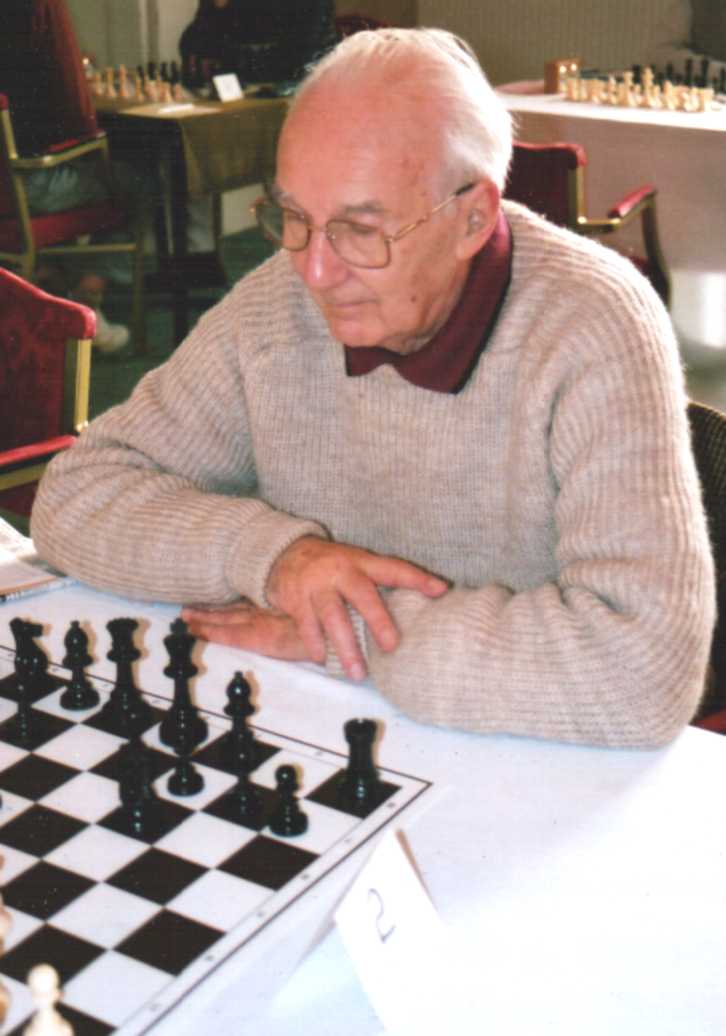
Ken’s line of the Bloodworth family originated in the small village of Leonard Stanley, Gloucestershire, on the western edge of the Cotswolds, between Stroud and the M5. The Bloodworths had lived and worked in Leonard Stanley for most of the 19th century, which was noted for its woollen industry, and there are Bloodworths on the village War Memorial. Ken’s Grandfather Bloodworth moved to nearby Cheltenham where he came to own a bakery shop at 306, High Street. His main claim to fame was that he invented and patented a nutritious drink that he called “Cheltine Foods”. It was successful and he eventually sold the patent, the purchasers changing the name to “Ovaltine”.
He had three children from a first marriage, and three sons from a second, Archibald Frank, Stanley and Vernon.
Archibald Frank Bloodworth was born on 8th July 1890 and married Elsie Vera Channon on 18th August 1913. Ken was their first-born and a brother, Richard, followed. It was Ken’s maternal grandfather, Henry Channon, who introduced the young Ken to the game, although nothing much came of it at that stage.
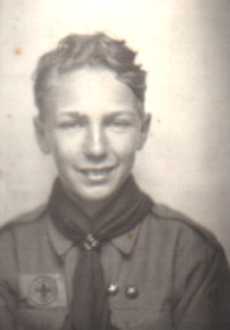
Ken at the Boy Scouts’ World Jamboree, Arrowe Park, Birkenhead, 1929
In 1924, the family moved to London and Ken later attended Hampton Grammar School, and he returned to the game in his final year there. In 1934, aged 20 he joined the Royal Navy, and with time on his hands on board ship, started to take the game more seriously, winning his ship’s championship in 1938, on H.M.S. Nelson.
It was here that he got his first taste of teaching. One day his captain summoned him to his cabin and explained that they had on board a very capable stoker who was not academically inclined and unable to pass even the lowest grade of exam that he needed to get promotion. The captain thought Ken would be the ideal person to take him on. Ken demurred at first, but soon changed his mind when the captain explained that it came with the rank of Acting Schoolmaster and an extra 1/6d (7½ p) per day. The stoker passed the exam, was promoted and another seed was sown in Ken’s mind.
His main job was to ensure ships were properly provisioned and this became increasingly important, especially as, with the outbreak of war, new ships were being built and launched at a great rate. One ship he was involved with preparing for sea, was suddenly handed over to the Polish Navy by the Government. As the boat prepared to go to sea for the first time, the small team Ken was with were expected to move on to the next ship, but by this time, Ken had got friendly with the Polish crew, mainly through the language of chess - there were a number of good players among the Poles and they really sharpened up Ken’s game - so he elected to stay on the O R P Krakowiak, where he remained for the duration of the war. The ship to which Ken was expected to move was duly completed and launched, but was bombed on its maiden voyage and Ken’s former colleagues were all killed. Chess can thus be said to have saved Ken’s life.
(below): Ken in Naval Uniform.
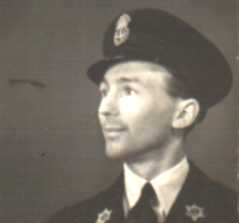 I
I
He picked up all the usual wartime medals for his actions in the North Atlantic, Mediterranean and North African theatres of war, but was also awarded the Krzyz Walecznych by the Polish government, instituted in 1920 for acts of great valour and courage in battle, the equivalent of France’s Croix de Guerre, and only very rarely awarded to allies.
On one occasion, the Krakowiak tied up in Plymouth for 24 hours on 1st June 1944, and on reporting to the naval stores office, Ken encountered the teenage Joyce Turner in the supplies office, where they each had to counter-sign the appropriate forms. “Hmm”, she mused, “Bloodworth - that’s a funny name”. They finished up going to a dance that night, and were married the following year (see below).
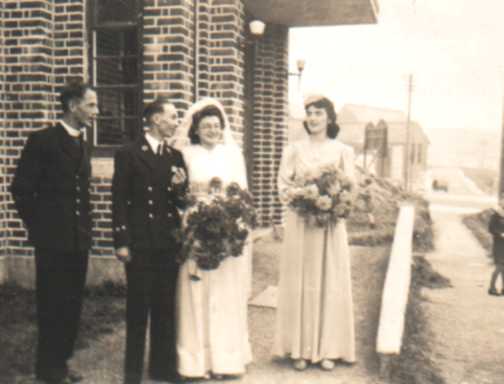
After the war he was demobbed and settled in his wife’s home town. He first became an uncertificated teacher at Montpellier School, Plymouth, before going to Leavesdon Green Training College near Watford, to train as a teacher. On qualification, he worked in a number of Plymouth primary schools, Public P. S. (1949 - 60); Honicknowle (1960 - 64); Montpellier again (1964 - 68) before returning to Honicknowle as Deputy Headteacher (1968 - 74) from where he retired.
In 1946 he joined Plymouth Chess Club, which at that time was run under the benevolent tutelage of Ron and Rowena Bruce. Later that year he entered the Hastings Congress for the first time. In 1948/9 he won the Major A Section with 7½ points, with J. Lindsay-Moodie and N. Clissold 2nd= both on 7. The following year won the Best Game prize in the Premier Reserves.
There was a schools’ chess league in post-war Plymouth, which was being run by Brian Adams, and Ken took this over in 1950. Ken was also elected secretary of the Plymouth Club in 1952, a post he held for 5 years.
In 1952 a new Headteacher was appointed at Plymouth College. This was F. W. Lockwood, who had been classics master at Golombek’s old school, Wilson’s Grammar School, and Head of the William Ellis School since 1944. He was a great promoter of junior chess, being Chairman and Treasurer of the Chess Education Society and making his school the annual venue for the London Boys’ Championship, in the days when the likes of Jonathan Penrose and Peter Clarke were first making their mark. Very soon after his arrival in Plymouth, he invited the town club to make its home there and even won one of the sections in the club’s tournaments. He thought about creating a junior tournament in Plymouth on similar lines to the one he ran in London, and talked the idea through with the club secretary, Ken. With Lockwood’s previous experience and practical support, not to mention a grant of £10 from the DCCA, Ken organised the first Devon Junior Congress at Plymouth College after Christmas 1953. That year, there were 24 entrants, local schoolboys George and John Wheeler being among the top winners. It was deemed a success and plans were made to make it an annual event. Unfortunately for Devon chess, Lockwood was suddenly taken ill and died in hospital on 19th February 1955 at the early age of 47. He could reasonably have been expected to put another 25 years’ effort into chess in Devon. It was a great loss, but fortunately, the torch he had carried had been passed on to Ken, just in time, as it turned out.
After Lockwood’s death, the Plymouth Club had to move out of the College, but the Junior Congress stayed, and under Ken’s stewardship the Devon Junior Championship went from strength to strength. Ken ran it for 27 years, until the DCCA imposed conditions on it which made it impossible to run. At its height it attracted over 200 young players. An international section was introduced which, at the time, was the only tournament of its kind in the UK. Although started on a shoestring, it later attracted Lloyd’s Bank sponsorship and young players entered from all over western Europe. At least six competitors went on to become senior champions of their countries - Germany, Netherlands, France, Ireland, England and Scotland.
By the mid-1950s he had become Devon’s Junior Chess Secretary and shortly after held the same post for the West of England. From there he was appointed as WECU Delegate to the British Chess Federation, and first came into contact with junior chess at a national level. In 1958 an England junior team was being run by W. Ritson-Morry, and by the following year Ken had also become involved. In 1960 the BCF formed a committee to run junior activities and Ken was invited to join the committee in its second year.
At that time, one of the projects that the new committee had to consider was an offer by The Times newspaper to sponsor an inter-schools chess event. Ken suggested that an age handicap should be included to account for the inevitable differences in the average ages of the teams involved, to ensure a level playing field, as it were. As is often the case, it was conceded that it might be a good idea, but that Ken should devise a draft scheme. He did so, it was adopted, and is still in use today.
In 1961, Ken succeeded as secretary of the Glorney Cup competition and remained in that office for 30 years. This tournament had been inaugurated in 1948 when the Irish Secondary Schools Council had suggested a match to be played in Dublin between six boys from Ireland and six from England, a match that England won 11½ - ½. The following year, Wales joined in and an Irish businessman, Cecil Parker Glorney, presented a challenge cup for annual competition - (see picture below). It became a regular testing ground for the teenage boy players of the four home countries. 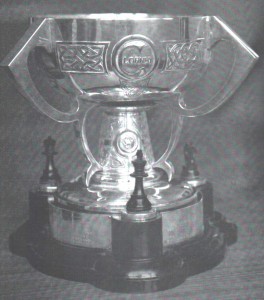
After finding his feet in this post, Ken sought to expand its scope by inviting teams from the continent. The entry is rarely the same two years running, but to date, the Netherlands have won the cup 12 times and France twice. Also, in 1968, girls were included with the inauguration of a cup donated by Faber, the book publishers. Selection for the Glorney and Faber Cups continues to be regarded as a high point in the career of any junior, and gives them valuable experience and stand them in good stead when graduating to the senior ranks.
In August 1989 Plymouth was due to host the British Championship for the second time, and it also hosted the Glorney and Faber Cups the previous week. This would enable the juniors to stay on and participate in the bigger event. It also provided an opportunity for competing teams to recognise Ken’s unstinting work for almost three decades. To this end, he was presented with an illuminated letter from the Dutch which read….
Dear Mr. Bloodworth,
The Board of the Royal Dutch Chess Federation has decided to award you with the
Mark of Honour
For your never-ending efforts to make the Glorney and Faber a yearly success.
Yours faithfully,
B. Hoeksema-Meijer.
He was also presented with an inscribed glass goblet, bearing the legend…
Presented by the competing nations to
K. J. Bloodworth
For his promotion of the Glorney Cup
Youth Team Chess Tournament
July 1989
This was, in fact, a Caithness Glass replica of the Glorney Cup itself, done on the initiative of John Glendinning, the Scottish representative, on behalf of all the competing nations.
In 1991 Ken completed three decades as secretary when the competition was held in Ghent, Belgium, his last year.
Plymouth has hosted the British Championships on three occasions - 1957, 1989 and 1992. For the first of these, Ken acted as congress secretary, as the BCF had no such official position at the time. He did everything, down to finding local accommodation for juniors, where necessary.
In September 1963, J. E. Jones, for some unknown reason, suddenly ended writing his weekly chess column in the Plymouth-based Western Morning News, and Ken was asked to take over. When he agreed, he was specially asked by the Editor to be an impartial and objective reporter of the Devon and Cornwall chess scene, something his predecessor had not always been. Ken then filed his weekly copy for the next 37 years, before handing on to another Jones in 1999. This job constituted the post of Devon’s Publicity Officer, and was the last administrative office he relinquished.
He was elected President of the Devon County Chess Association for a three year spell, from 1970 - 73, and as WECU President from 1986 - 88.
In 1980, in his capacity as former Chairman of the BCF Junior Committee, Ken flagged up the existence of a promising young primary school pupil in his home patch. The response in committee was to the effect that the boy might be a big fish in the small pond of the Far West, but it would be a very different matter if and when he met the big boys. The 8 yr old’s name was Adams - Michael Adams - and the rest is history. Ken’s early intervention enabled Adams to be provided with a top coach, Shaun Taulbut, a move organised by Leonard Barden.
In 1983 the BCF inaugurated an annual award, the President’s Award for Services to Chess to give its full title, to recognise the various contributions to the organisation of the game in Britain. Such was the esteem in which Ken was held that he was nominated in only its third year, 1985.
In his eighties, he slowed down on the administrative front, but continued to play a mean game in local congresses and competitions. He was an invaluable member of Devon’s 2nd team, and was instrumental in getting Devon to the National U-150 final, when he grabbed a spectacular last-minute win against Cambridgeshire in the semi-final at Swindon, snatching an improbable 8½ - 7½ victory from what at one point in the match seemed the jaws of death. In recognition of this, the team captain, Ian Mason, awarded him the Match Captain’s award for that season, the presentation being at the final (see below). In the subsequent final, Devon lost to Essex 9½ - 6½, but Ken managed a safe draw.
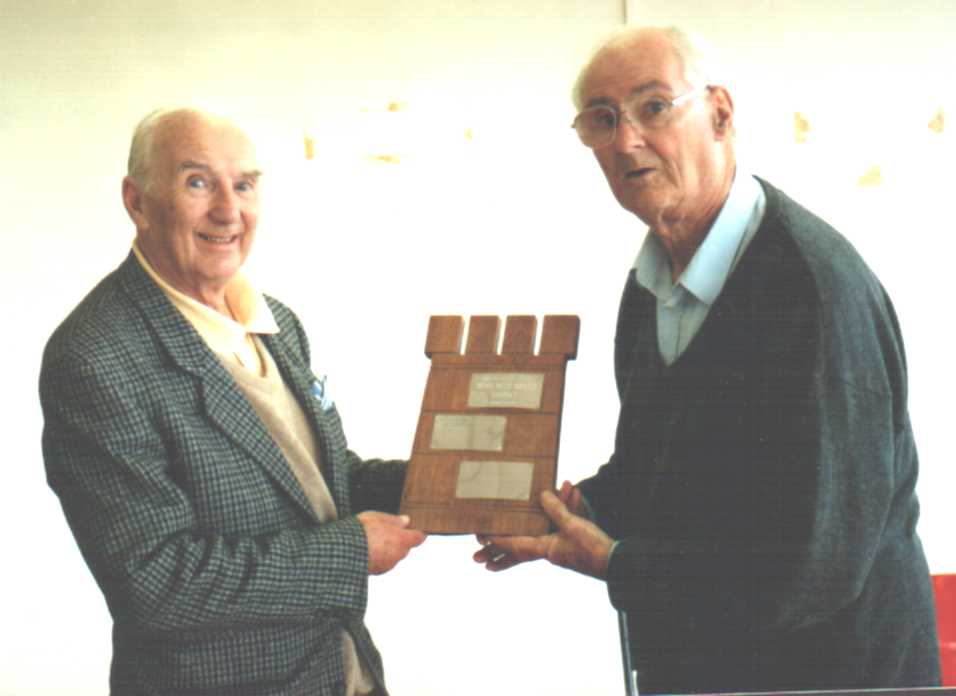
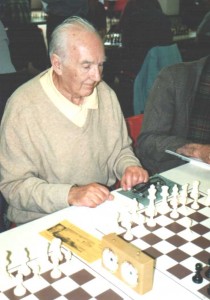
October 2007: Ken in play at the Weymouth Congress
October 2007: Ken in play at the Weymouth Congress.
In 2004 he celebrated his 90th birthday with a special match, organised for him by the Plymouth Club. This comprised a team from his home club against a team consisting of senior players with whom Ken had been involved during his long career.
In October 2007, in his 94th year, he was still sprightly enough to drive himself in his new car from Plymouth to Weymouth to take part in the annual Dorset Congress (see above).
Ken and Joyce had two sons, Peter and Richard, who both took up the game in their youth. Richard played in one of the junior sections in the British Championships, but has since moved to Australia, where he, in turn, has two sons. Peter lives on the south coast and has a son and two daughters, one of whom has recently provided Ken with his first great grandchild.
Ken’s energy and commitment to the game seemed boundless. He didn’t just dabble for a short time with a range of jobs - he stuck at them for decades at a time and developed them in the process. Taking a snapshot in, for example, 1972, the year of the Fischer - Spassky match, Ken was, in no particular order, (a) President of the Devon County Chess Association (3 years). (b) weekly chess columnist of the Western Morning News (37 years); (c) Organiser of the Devon Junior Congress and Lloyd’s Bank Junior International Congress (27 years), and (d) Secretary and organiser of the Glorney Cup (30 years). There were, of course, a host of other posts either side of this. All this in addition to his playing commitments for various Plymouth and Devon teams and congresses, and not forgetting that at that time, he was still the Deputy Head of a busy Plymouth school.
It’s a wonder he had time to fit in his other interests of playing Bridge and relieving bookmakers of some of their profits.
© R. H. Jones 2010
Bibliography:
Testimony of K. J. Bloodworth.
BCF Various BCF Yearbooks.
Sunnucks, A: The Encyclopaedia of Chess Hale 1970
Whyld, K: Chess Columns - A List Olomouc 2002
Posted in Pioneers of Devon Chess |
Tags: Bloodworth, chess, Glorney Cup, Plymouth, Polish navy |
No Comments »